
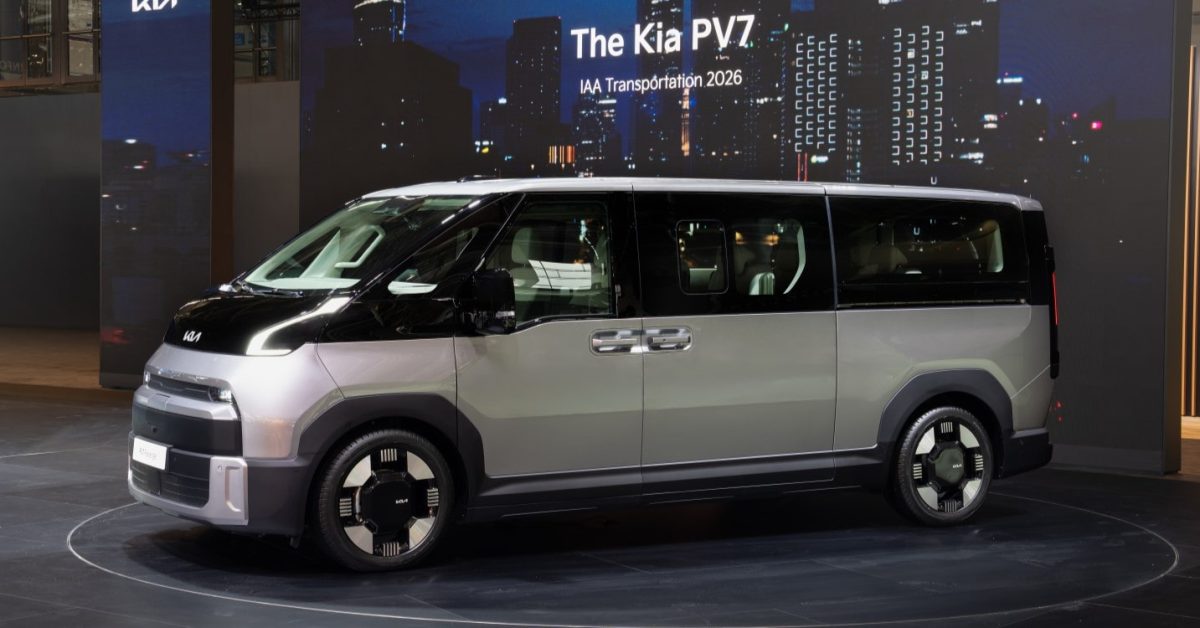
Kia is expanding its electric van lineup with the PV7, a larger PV5 sibling that can carry nine people or a whole lot of cargo. The Kia PV7 van is launching in 2027 The PV5, Kia’s first fully electric van from its Platform Beyond Vehicle (PBV) business, is proving to be a bigger hit than expected. A year after it went on sale, the PV5 quickly became Europe’s most popular small electric van. In the first half of 2026, it was the top seller in its segment, accounting for 37% of electric C-segment van sales across Europe. Next year, Kia will launch the PV7, the second electric van from its PBV business. Kia revealed the PV7 at IAA Transportation in Hanover, Germany, in September. It’s based on the same E-GMP.S platform as the PV5, but the PV7 features a considerably longer wheelbase and stretched body, opening up more space inside. The PV7 is over 17.5 ft long, measuring 5,350 mm long, 1,995 mm wide, and 1,990 mm high, with a 3,500 mm wheelbase. In comparison, the PV5 is just 4,695 mm long, 1,895 mm wide, and 1,915 mm tall, with a 2,995 mm wheelbase. That’s even bigger than the Volkswagen ID. Buzz Long-Wheelbase (LWB), which measures 4,962 mm in length with a 3,239 mm wheelbase. Kia PV7 Passenger (Source: Kia) 23 different top hats coming Like the PV5, the PV7 will initially be available in Passenger and Cargo body styles, but Kia plans to launch 23 different variants, or “top hats,” over the next few years. It will be offered with two nickel-cobalt-manganese (NCM) battery packs: 71.5 kWh and 96.2 kWh. The Long Range Cargo model offers an all-electric WLTP range of over 460 km (285 miles). Even at full capacity, Kia said the new PV7 achieves nearly 400 km (248 miles) of range and still has 350 liters of trunk space. Front-wheel drive (FWD) will be standard at launch, but Kia plans to add an all-wheel drive (AWD) option later. Depending on the configuration, the FWD electric powertrain delivers up to 268 horsepower (200 kW) and 309 lb-ft (420 Nm) of torque. Thanks to its 800V architecture, the Kia PV7’s battery can charge from 10% to 80% in about 25 minutes with a 350 kW DC fast charger. It will be Kia’s first vehicle with two charging ports, including a front AC/DC port and an optional rear side AC port. Kia PV7 Cargo (left) and Passenger (right) Source: Kia) With vehicle-to-load (V2L) capabilities, it can serve as a mobile power source for tools, equipment, a campsite, or other external electronic devices. Personal and business use The PV7 Cargo, designed for businesses, fleets, and logistics, is available in 2- and 3-seat configurations and offers up to 6.1 cubic meters of cargo space. The High Roof variant offers even more, with up to 8 cubic meters. Maximum payload is up to 1,165 kg (2,568 lbs) for the Cargo Long and up to 1,200 kg (2,645 lbs) for the compact model. The PV7 Cargo Long features a 550 mm loading height and, according to Kia, enough capacity for up to three Euro pallets (800 x 1,200 mm). An added heavy-duty mode adjusts the vehicle’s response to varying payloads to help maintain stability and control while driving. Depending on the use, buyers can choose between full-open twin-swing tailgate doors or a lift-up tailgate. The PV7 Passenger, on the other hand, is designed for personal use and families, or can also be used as a shuttle with room for up to nine passengers in the global version. In Korea, it will seat up to 11 passengers. The 7-seater features Long-Rail Easy Remove Seats, enabling various interior seating configurations. The 9-seater variant, on the other hand, is available with or without a fourth row. High-tech and spacious interior Inside, both versions feature Hyundai’s new Pleos Connect infotainment system, with 12.9″ and 14.6″ display screens and physical controls for commonly used functions. The system runs Android Automotive OS, making it more like a smartphone with apps and customizable screens. It also includes Hyundai’s Gleo AI, an AI-powered in-car companion that can answer questions, control navigation or vehicle functions, and more. Kia said the PV7 is based on a “Mobile Workspace” concept, with a layered dashboard and center console to optimize space. The Kia PV7 Passenger and Cargo will go on sale in Korea and Europe in the second half of 2027. It will then roll out to new markets with new derivatives and conversions. Kia will announce PV7 prices closer to its launch. In Korea, the PV5 Passenger and Cargo Compact starts at 45.9 million won ($34,000) and 41 million won ($30,000), respectively. In Germany, the PV5 Passenger 5-seater starts at €38,690 ($43,000). FTC: We use income earning auto affiliate links. More.
Kia’s PV7 electric van stretches over 17 feet and seats 9
Full Article
Original Source
Read the full article at Electrek →KhanList aggregates and links to publicly available news content. We do not host full articles from third-party sources. Always verify important information with original sources.