
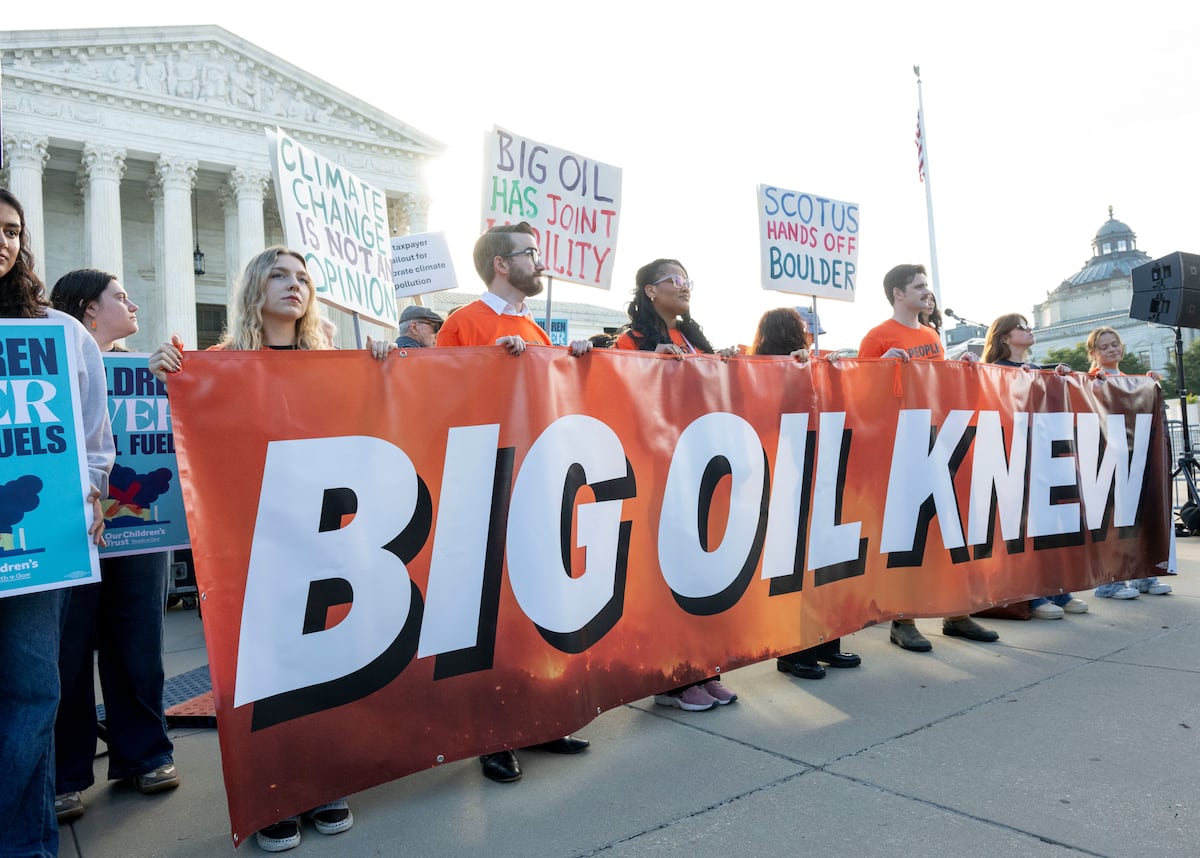
The first hearing of the Supreme Court’s new term on Monday addressed one of the most consequential cases for the U.S. energy sector: The City of Boulder v. Suncor Energy, a lawsuit regarded as one of the major battles over liability for climate change. Framed by many as a David-and-Goliath dispute, the City of Boulder, Colorado, sued two oil companies seeking accountability for climate change. Justices heard the parties’ arguments for roughly two hours and questioned lawyers on technical and jurisdictional matters. These are the key points in one of the most important court battles expected in the coming months.How did the case start?Several officials from Boulder, a city of just over 100,000 residents located less than 50 miles from Denver, decided in 2018 to file a lawsuit in state court against Suncor Energy, which operates two refineries in Colorado, and again Exxon Mobil, over the environmental damage their activities have caused and the consequences for climate change.What are Boulder officials seeking?Boulder, known for its progressive policies and for being an environmental pioneer, sought compensation from the companies for the expenses it incurred to protect its facilities and residents’ properties from the effects of climate change, including increasingly frequent and severe storms and wildfires.In the complaint, Boulder and Boulder County accuse the oil companies of long deceiving the public about the consequences of their activities and fossil fuels for the climate. They say the companies concealed reports showing harm to the environment and highlighted the impact of fossil fuels, such as gasoline, on climate change because of emissions during production, refining, distribution and use.Three years after filing the suit, in 2021 Boulder endured the worst wildfire in its history: a devastating blaze swept through thousands of acres in Marshall, a community in Boulder County. Almost 50,000 people were evacuated, the fire destroyed about 1,000 homes and two people were killed. Local officials estimated losses at roughly $2 billion. The event intensified local authorities’ efforts to hold oil companies accountable.What do the oil companies argue?Last summer the defendant companies appealed to the U.S. Supreme Court. The oil firms have spent years trying to derail the case. Before turning to the highest court, they unsuccessfully sought to move the litigation to federal court, arguing that the federal Clean Air Act regulates emissions and therefore federal jurisdiction applies. They also asked a Colorado state court to dismiss the case, but that effort failed as well.After those strategies failed, they appealed to the Colorado Supreme Court, which left the case open and allowed it to continue in the lower state courts. After that setback, the companies petitioned the U.S. Supreme Court, arguing that the Constitution was being violated because a lower court cannot adjudicate a matter governed by a federal law. They noted that pollution and climate change are not confined to one state. “There are no borders in the air,” they said.The oil companies’ lawyers contend that only federal law or federal courts can handle tort claims like Boulder’s, and therefore the case should not proceed in Colorado state court. The energy companies maintain that Boulder is effectively trying to impose a de facto carbon tax that could bankrupt the energy industry.“If Boulder’s claims are allowed to proceed, some 90,000 municipalities across the country would have the ability to influence national and international energy policy by asking juries to impose catastrophic damages on particular fossil fuel producers,” Kannon Shanmugam, counsel for the oil company, said in the opening arguments on Monday.What does the White House say?The Trump Administration has sided with the oil companies, reversing the position of the previous Biden administration. The White House now argues the suit is an unconstitutional attempt to regulate greenhouse gas emissions where a federal law already exists. It contends the case seeks to extend Colorado state law beyond the state’s borders.U.S. Principal Deputy Solicitor General Sarah M. Harris, representing the administration, said during the hearing that interstate air pollution is an inherently federal matter. Harris defended the position that the Clean Air Act and the Constitution vest Congress with the authority to regulate greenhouse gas emissions. So, she said, if the suit proceeds, Colorado state courts would be permitted to usurp that authority, which would be unconstitutional.What are the jurisdictional issues?The main debate centered on whether Boulder can invoke a state-law violation to seek compensation from oil companies when a federal law already regulates emissions and pollution. Several justices also asked whether they should review a case that has not yet been finally resolved by Colorado’s courts, since the Supreme Court normally can only review final decisions from state courts. “Does the Supreme Court of the United States have jurisdiction to hear the case, given that the Colorado Supreme Court’s ruling was not a final disposition of the matter?” asked Justice Clarence Thomas, one of the court’s longest-serving justices, appointed by President George Bush in 1991.What is at stake?The case will be decisive in determining whether the dozens of lawsuits filed by cities and counties, many led by Democrats, have a future. Dozens of progressive local governments have joined a wave of efforts to hold energy companies accountable for climate change. If the Supreme Court sides with Boulder, it could trigger a flood of suits against energy and other companies seeking multimillion-dollar damages. In that scenario, the case would go down in history as a turning point for how courts handle environmental claims.What did the justices say?The conservative justices displayed skepticism about Boulder’s suit or else were cautious. The balance of power on the Supreme Court—conservative by a 6-to-3 margin—is complicated by the fact that one justice has requested recusal. Justice Samuel A. Alito, appointed by George W. Bush in 2005, recused himself after acknowledging he owns shares in ConocoPhillips and Phillips 66, companies not named in this case, but whose stock could be affected by a ruling against the industry. He also took a luxury fishing trip two decades ago with an investor in one of the companies involved.Alito’s decision creates a slightly tighter lineup at the Court. If the justices were to split four to four, which remains possible though unlikely, the case would return to Colorado’s state courts and continue there before officials who tend to be more progressive.At Monday’s public hearing, the three liberal justices expressed sympathy for Boulder’s lawyers’ arguments. By contrast, conservatives led by Justice Brett M. Kavanaugh voiced doubts about the suit. He argued that Boulder’s case could prompt a wave of similar lawsuits that would bankrupt energy companies. “We do not need to reinvent the wheel, because we have said repeatedly—and Congress, presumably in enacting the Clean Air Act and its amendments, relied on this court’s precedents—that this type of pollution is a matter of federal law unless Congress indicates otherwise,” he said.Although the other conservative justices were more cautious and posed probing questions to lawyers on both sides, Chief Justice John Roberts told Boulder County’s attorney: “Presumably, if you prevail, the next day, a municipality in every single state will file a lawsuit. How do you think that will work out on the ground?” he asked.Where does the discussion stand?After the oral argument held in July, a period of intense deliberation is expected. The Supreme Court is scheduled to issue its decision beginning next summer, between June and July 2027, before the current term ends.Sign up for our weekly newsletter to get more English-language news coverage from EL PAÍS USA Edition
Key points from the Supreme Court in the case against the oil companies. What is being judged? What are the repercussions?
Full Article
Original Source
Read the full article at English →KhanList aggregates and links to publicly available news content. We do not host full articles from third-party sources. Always verify important information with original sources.