
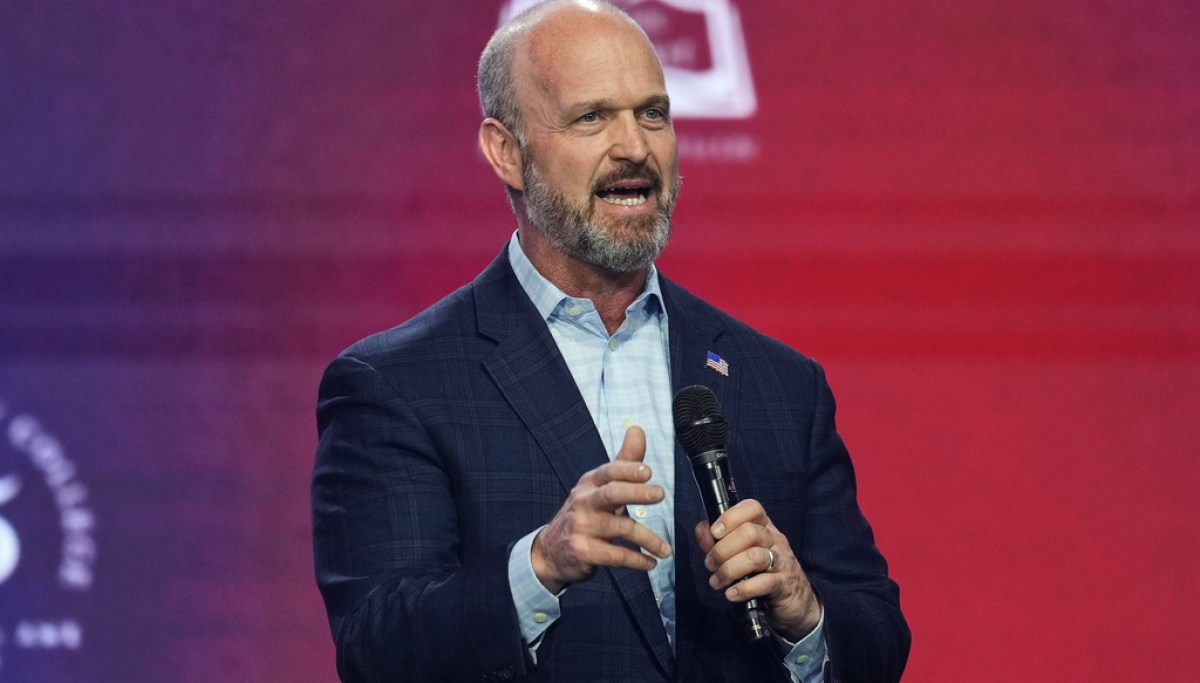
In a recent Washington Examiner column, Heritage Foundation President Kevin Roberts argues that infighting among conservative factions threatens to derail the GOP’s future. To save the party, he contends, the camps must fuse together just like conservatives did 50 years ago.Which is odd, considering Roberts recently chased dozens of respected conservative scholars out of the Heritage Foundation after backing his “close friend,” the antisemitic conspiracy theorist Tucker Carlson. It’s also odd considering Heritage’s central economic idea, populist protectionism, was just overwhelmingly rejected by voters.Yet, in the guise of “fusing,” Roberts asks movement conservatives — both in his column and in a more detailed letter on the Heritage website — to reevaluate their long-held beliefs while reexamining none of his own. And every bad-faith begging of a question Roberts poses conveniently lands exactly where the paleocon happens to already be standing. Roberts does an excellent job laying out the wide-ranging consequences of increasingly radicalized Democratic Party rule, and why discord on the Right threatens to undermine the ability to stave off the worst excesses of the radicalized Left.But the man who referred to Carlson’s conservative critics as “a venomous coalition” pins the blame for the GOP infighting on the “libertarian and establishment Republican pundits” who have allegedly launched baseless attacks on the well-meaning shrinking violets of “MAGA NatCon,” whose only offense “was daring to question a Republican platform that produced one presidential popular vote victory between 1992 and 2012.”It’s unfortunate that an alleged constitutional conservative is feeding the myth of a “popular vote.” Republicans controlled Congress for 14 years from 1992 to 2012, in which time they passed a number of substantive economic and welfare reforms. Even more importantly, perhaps, they stood in the way of generational policy changes that would have been instituted under Bill Clinton and Barack Obama — the very kind of threat Roberts claims necessitates a modern fusing.Republican “elites,” says the president of the Heritage Foundation, “still lash out any time a conservative refuses to parrot the party’s 1980 or 2000 platform.”Kevin Roberts, president of the Heritage Foundation, speaks during Turning Point USA’s AmericaFest 2025 on Friday, Dec. 19, 2025, in Phoenix. (AP Photo/Ross D. Franklin) Well, it beats parroting the GOP’s 1880 platform. It is certainly better than parroting the three failed presidential runs of Roberts’s hero and the paleo patron saint of paleoconservatism, Pat Buchanan.Moreover, is Roberts aware that he heads a think tank with a $135 million budget and tentacles throughout the GOP? If so, why is he still pretending to fight the “establishment”? The “dissident right,” as paleocons also like to call themselves, is a misnomer. The Heritage Foundation is the establishment. MAGA has now been running the party for 10 years. In many ways, it has been running it into the ground.But the question is, why would conservatives want to fuse with people who mock their beliefs and create revisionist histories blaming them for all the problems of the world? Why would they do it now when it’s blaringly obvious the entire “fusion” project exists to preemptively secure Vice President JD Vance the 2028 presidential nomination?Roberts, Vance, and their supporters seem significantly more comfortable fusing with Tucker Carlson’s fans than fiscal and small-government conservatives. The NatCon movement exists to unwind fusionism and expel classical liberals from the movement. Vance and Roberts endlessly make the case for reversing the alleged failures of Reaganism and bringing the country back to a more glorious and moral time.The 1970s, I guess.Sure, political factions with diametrically opposing policy ideas can come together temporarily to fight a larger common threat. But there’s a fundamental misunderstanding about conservative fusionism. The “economic libertarians, Cold Warriors, and moral traditionalists,” as Roberts points out, did create “a new national majority” in the 1960s. Conservatives often liken this movement to a “three-legged stool.” But that isn’t exactly right.Fusionists believed civic and moral flourishing were bound to ordered liberty and individual and economic freedom. Movement conservatism wasn’t a transactional, strategic alliance of three ideological camps. It was one that could only work together.Frank Meyer, the champion of fusionism, was a big critic of the Heritage-style ideas of Russell Kirk and “new conservatives” (even back in the 1960s, paleocons were pretending they had new ideas). The movement, “stripped of its pretensions is,” Meyer wrote, “sad to say, but another guise for the collective spirit of the age.”Then, and now.The 1980s fusionist coalition stressed upward meritocratic mobility, free markets, federalism, patriotism, social conservatism, and autonomy from the soul-crushing federal bureaucracy. The paleocon has replaced most of this idealism with victimhood and a dour, angry, doomer, often chauvinistic outlook. In the world of Vance and Roberts, the working American is a victim without agency.Meyer titled his most famous book In Defense of Freedom: A Conservative Credo. You’ll notice that NatCons rarely bother using antiquated ideas such as freedom or liberty. They are far more inclined to mock the “principles” of those who do.Roberts not only feeds the myth that the fusionists were hopeless failures who never rose to the occasion until Trump’s second term, but he also seems to function under the notion that Trump’s second term is popular among average American voters. Listening to the NatCon, you might be under the impression that suburban voters in Georgia, Florida, and Arizona are clamoring for 19th-century mercantilism and isolationism.Like many others, Roberts misconstrued Trump’s slim personal political victories as an enduring national realignment. It is true that Trump captured the imagination of many non-ideological low-propensity working-class voters in Michigan and Pennsylvania (at the expense of losing suburban voters throughout the Sun Belt). Trump also made inroads with Hispanic, black, and Jewish voters. All of that was blown up by his second term, which Roberts portrays as the most successful presidency in modern political history.Trump was uniquely positioned as a celebrity candidate, helped by the unlikability of Hillary Clinton and the failures of Joe Biden. Yes, the GOP needed an attitude adjustment, a stiffening of the spine.VANCE-LINKED GROUP LAUNCHES 2028 EFFORT TO WIN BACK GROUND FOR CONSERVATIVESBut modern paleoconservatism is a white Christian nationalist identity movement hyperfocused on the working class in a country with fewer white people, fewer Christians, and a shrinking working class. There is, of course, nothing wrong with being white or Christian or a member of the working class. But a conservative movement without universal values isn’t really conservative, at all.And the chances of it finding any long-term success, fusing or no fusing, are highly unlikely.
Kevin Roberts’s one-sided ‘fusion’ is a NatCon power play
Full Article
Original Source
Read the full article at Washingtonexaminer →KhanList aggregates and links to publicly available news content. We do not host full articles from third-party sources. Always verify important information with original sources.