
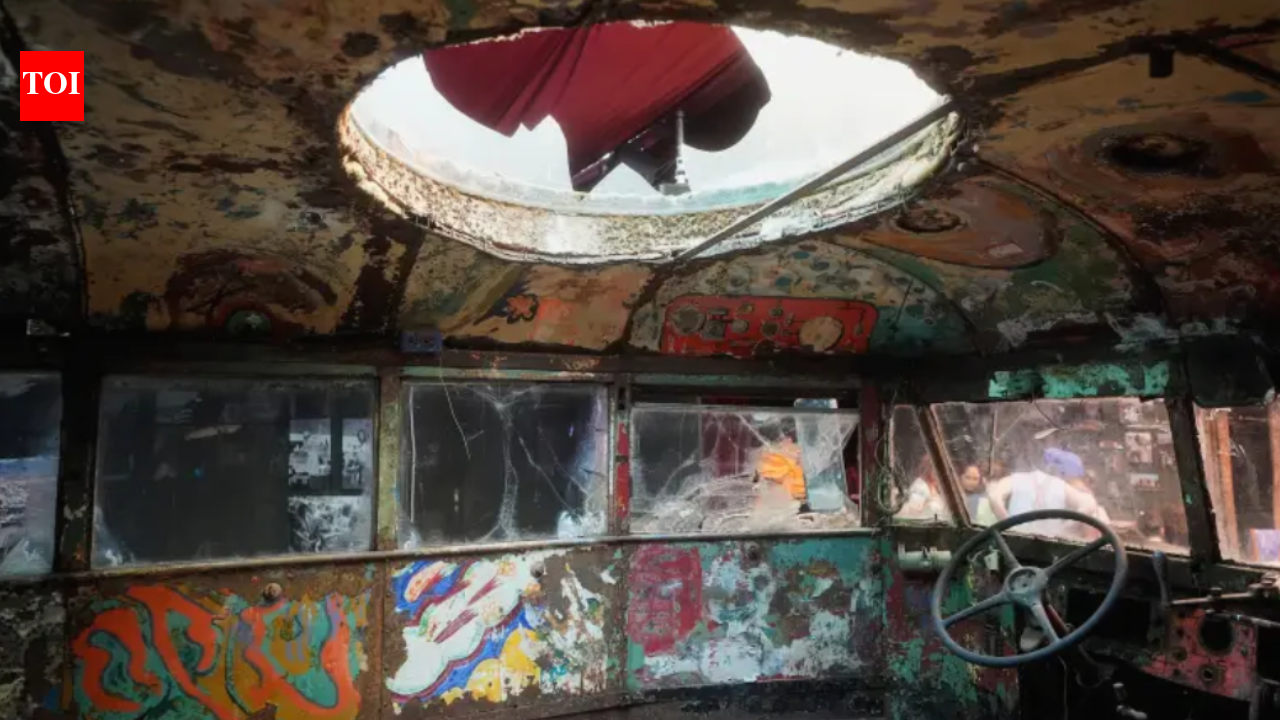
Kesey bought the school bus using money he earned from his novel “One Flew Over the Cuckoo’s Nest”.Ken Kesey’s psychedelic bus “Furthur”, once used for a cross-country journey that became part of America’s 1960s counterculture, has returned to San Francisco after decades away. The bus is now the centrepiece of a new exhibition celebrating the legacy of the Grateful Dead and the city’s connection with the hippie movement.The exhibition, “Forever Grateful/Golden Gate Park”, opened Saturday at the County Fair Building in Golden Gate Park. According to news agency Associated Press, along with Kesey’s bus, it features the BMW owned by Grateful Dead frontman Jerry Garcia. The car remains in mint condition and has never been displayed publicly.The exhibition brings together historic memorabilia, interactive installations, performances, photographs and artwork connected to the Grateful Dead and the counterculture that developed in San Francisco during the 1960s. It also gives visitors a chance to experience some of the art and activities associated with that period.For the Haight Street Art Center, which organised the exhibition, the return of the bus is about more than displaying an old vehicle. Kelly Harris, the centre’s executive director, said the exhibition is meant to encourage people to connect through art, music and activism.“This invites people to communicate and connect around art, music, and activism,” Harris said. “In this day and age, when we need something to bridge community, we know that this space allows for that to happen and Furthur is the portal.”How Furthur became part of countercultureKesey bought the school bus using money he earned from his novel “One Flew Over the Cuckoo’s Nest”. In 1964, he and his friends, known as the Merry Band of Pranksters, drove the bus across the United States.The journey was fuelled by marijuana and LSD and was intended to explore human consciousness through art, music and mind-altering drugs. The bus was painted in bright, swirling colours and became a defining part of the group’s activities.The trip later became widely known through Tom Wolfe’s 1968 book “The Electric Kool-Aid Acid Test”, which documented Kesey and the Pranksters’ experiences.Kesey had earlier been a student involved in government tests of mind-altering drugs. After returning to California, he began sharing his experiences at parties held at his home in the hills above Stanford University.Those gatherings became known as the “acid tests”. They combined music, art and psychedelic experiences and soon became closely linked to the emerging San Francisco counterculture.A local bar band called The Warlocks performed at the parties. The group later became the Grateful Dead, which was formed in 1965 and went on to become closely associated with San Francisco’s hippie movement.The band’s members lived in a cheap Victorian house in the city’s Haight neighbourhood. They later became an important part of the 1967 Summer of Love.Recreating the 1960s experienceThe new exhibition is designed to give visitors more than a traditional display of historical objects. It will use performances and interactive installations to recreate parts of the counterculture experience.Visitors will be invited to share their first encounter with the counterculture. They can talk about becoming a Deadhead, the name given to Grateful Dead fans, during Garcia’s lifetime, discovering the band after his death or experiencing the group for the first time through the exhibition.Actors from Third Rail Projects, a New York-based experiential performance company, will guide visitors through part of the exhibition. One section includes a dark tunnel filled with mirrors that leads to booths where visitors can begin conversations.Visitors will also experience a liquid light show, an art form associated with the 1960s. It uses liquids of different densities in watch glasses and projects changing, colourful patterns around a room.Edward Rice, associate managing director at Third Rail Projects, said visitors may experience the exhibition with people they already know or with strangers.“You might go with the people that you came with, or you might get packaged with a couple other folks that you didn’t know, and you’ll then unpack the experience with each other and have a conversation with a stranger that you wouldn’t have had otherwise,” Rice said.Furthur to be restoredThe exhibition also marks the beginning of an effort to restore the now-dilapidated Furthur bus. The bus was kept at the Kesey family farm in Pleasant Hill, Oregon, after its years on the road. It was last seen in public at Woodstock in 1969.The bus got its name after a typo appeared on its destination sign. Now, more than six decades after its famous journey, it is being brought back into the public eye as part of the exhibition.The “Forever Grateful” exhibition will run through October 25. It will also feature photographs from the Grateful Dead’s concerts in Golden Gate Park and a screen-printing station where visitors can create their own artwork.Renee de Cossio, director of exhibitions at the Haight Street Art Center, said the exhibition looks at the Grateful Dead’s influence and the communities built around its music.“This entire exhibit, it’s a very layered story of the Grateful Dead and their influence, their phenomenon, and their impact on communities, on society, on people, and how their legacy still lives on,” she said.For Harris, the Furthur bus remains central to that story. “The focal point is the Furthur bus. And Furthur is a call to action. Never stop creating, never stop exploring, keep going further,” Harris said.
Ken Kesey's psychedelic Furthur bus returns to San Francisco for restoration
Full Article
Original Source
Read the full article at Timesofindia →KhanList aggregates and links to publicly available news content. We do not host full articles from third-party sources. Always verify important information with original sources.