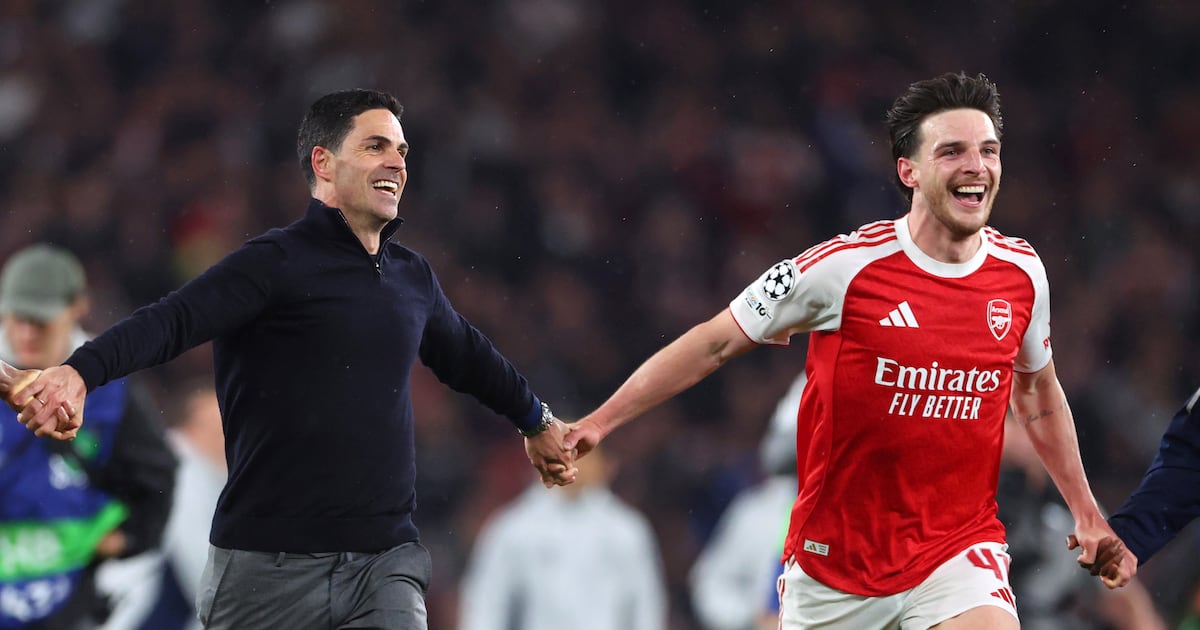
Is football coaching more and more a young man’s game? The average age of the current crop of Premier League coaches is 46 – four years younger than their equivalents in the summer of 2016. But it turns out 2016 was the anomaly. If you go back to the summer of 2006, the average age of a Premier League manager was 47. If you go back another 10 years to the summer of 1996, the average age was ... 47. So – football managers are only getting younger in the same sense that policemen are getting younger. We get older, they stay the same age (and increasingly they get hair transplants). The typical manager is still an ex-footballer in his mid to late 40s.It is true, though, that the typical manager used to be a more familiar kind of ex-footballer. Of the 20 Premier League managers in the summer of 1996, 17 had played in England’s First Division, the exceptions being Alex Ferguson, Ron Atkinson and Ray Harford. Eight had won the league as players, five had won the FA Cup. The current 20 includes two Premier League title winners and four FA Cup winners, with all of those medals having been won by Frank Lampard, Michael Carrick, Xabi Alonso and Mikel Arteta. Only seven of the current 20 played in England’s top division and 11 never played in England at all. READ MOREFew Premier League fans have any idea what to expect from guys like Pierre Sage, Matthias Jaissle or Sergei Jakirović, but coaches come and go so fast these days there might never be time to get to know them. Eleven of the current Premier League managers were appointed within the last year, and nine within the last three months. So it is that Arteta, closing in on seven years at Arsenal, has found himself the longest-serving and most powerful manager in the division. Can he mastermind Arsenal’s first successful title defence in 91 years? Arsenal still look the strongest squad, as they did last season, but much will depend on the condition of Declan Rice, who played 69 matches last season for Arsenal and England and finished the campaign struggling to manage chronic nerve pain in his hamstring. Clearly Rice is a tower of strength, but even his body can’t take many more seasons like that. Declan Rice turns 28 in January and is arguably the second-biggest current star in the Premier League. Photograph: Glyn Kirk/AFP via Getty Images Yet only this week, in the London Times, a columnist was urging him to become even more of an all-action figure than he already is. Matthew Syed believes Rice needs to be “liberated” to become “the kind of player who can break up attacks and then dart forward, shoot and score from outside the box ... with your most talented player, do you not want him to shine himself rather than letting others do so? To have a crack at goal rather than always giving others the chance? ... is there not a case for this most selfless of players to show a tad more selfishness[?]”You feel almost sorry for Rice that whatever he does on the field will be interpreted and judged by this prevailing culture. At this point in his career – he turns 28 in January, has 80 caps for England and is arguably the second-biggest current star in the Premier League – he should be looking for ways to make his game more efficient. Efficiency doesn’t have to come at the price of personal glory. There’s an obvious outstanding model for him to follow: the player in question just captained his country to the World Cup, winning the Golden Ball for best player in the process. Manchester City's Rodri. In English football hardly anybody values what the Spanish player does. Photograph: Martin Rickett/PA Wire Emulating Rodri’s achievements would probably make Rice very happy – winning the World Cup might be even better than scoring a few more goals from outside the box. But in English football hardly anybody values what Rodri does, because hardly anyone understands it. You might as well ask a chimp to explain an iPhone. That’s why Rodri never won a player of the year award in England, despite winning the Ballon d’Or, the Champions League MVP and player of the tournament at both the Euros and the World Cup. As a strategic-minded, Rodri-type player in deep midfield or even central defence, Rice could have another 10 years at the top. As a player whose specialty is charging around the pitch like a maniac, his shelf-life will be much shorter. The three sides who look most likely to challenge Arsenal this season all happen to be coached by guys who used to be Rodri-type deep-lying midfielders. Enzo Maresca spent his career playing the same position as Pep Guardiola, with less distinction, and has since been managing teams in a Guardiola-style, with less distinction. Now he replaces Guardiola at Manchester City, so the comparisons are about to get pointed. Arne Slot’s initial success at Liverpool illustrated how a change of coach can have an invigorating effect in the short term, as new ideas combine productively with existing good habits. But nobody believes Guardiola’s departure will make City stronger in the long run.[ Brilliant, embittered and pure box office: This is José Mourinho at his bestOpens in new window ]The most interesting player at City – and the biggest name left in the Premier League – is Erling Haaland, who returns from his break having been one of the stars of the 2026 World Cup. You wonder how that experience will have affected Haaland, who has scored so many goals for City without ever having that kind of cut-through. Post-Guardiola, will he still see City as the best-possible platform for his talents?City already have reinforced with Elliot Anderson, whose all-action style makes Rice look stately, but Maresca’s job will be a lot easier if Rodri is still there at the end of the transfer window. Bernardo Silva has already left for Real Madrid, with the departures of John Stones and Nathan Ake adding to the end-of-an-era feel. Chelsea head coach Xabi Alonso has the materials to build a powerful team this season. Photograph: Yu Chun Christopher Wong/Eurasia Sport Images/Getty Images At Chelsea they are hoping that the big brain of Xabi Alonso can create order from the churn and confusion of the Clearlake era. Their already-bulging squad has been swollen by another €400 million of incoming players, taking the spending under the Eghbali-Boehly regime beyond the €2 billion mark. They still have not signed a top striker, with Emmanuel Emegha, a €25 million signing from feeder club Strasbourg, the latest young hopeful to audition for the role. Partly because they have so many options Chelsea are almost an unknown quantity, but the materials are there for Alonso to build a powerful team.In Morgan Rogers they have signed an established Premier League powerhouse and star, while Cole Palmer’s seven-week summer break might have finally allowed him to get over his persistent injury worries. Alonso would rather not have lost Marco Cucurella, Chelsea’s most consistent performer over the last two years, but the absence of European football is an advantage for the coach in his first season, allowing him time to train (and rest) the players. Just look at Manchester United, who missed out on Europe last season and promptly improved by 29 points in the table. Michael Carrick now has to show that he can sustain United’s improved form from the second half of last season while managing the additional demands of the Champions League. Central midfield has been an area of chronic weakness for years and United’s signings have been concentrated in that area, with Youri Tielemans and Andrey Santos arriving to offset the departure of Casemiro, whose regular headed goals did not make up for his lack of mobility. United have spent €90 million so far, well short of the €250 million they have spent in both of the summers since Jim Ratcliffe took over the football side of the club, so Carrick will be expecting more to arrive before the end of August. The big team that looks most vulnerable is Liverpool, where Andoni Iraola might have walked into a good job at a bad time. That might surprise supporters who think that because Jeff Bezos is part of a consortium that has bought a 30 per cent stake in Liverpool, they must be set for a new era of massively increased spending and therefore success. But even Bezos is not richer than the Saudis, who have failed to turn Newcastle into a real power, and Liverpool’s new investors, who will likely soon be the new owners, did not appoint Iraola. The coach arrives with a reputation for fast-paced high-intensity football, but while the fans might welcome the change of emphasis after a season of failing Slotball, the squad looks totally unsuited to the style. Even Tottenham - spending big on midfielders in their first post-Daniel Levy summer - currently look like they have better depth. [ ‘Don’t become the protagonist’: Andoni Iraola on the secret of Spain’s success and his role at LiverpoolOpens in new window ]Only Dominik Szoboszlai and Milos Kerkez have the running power and stamina to be natural fits for an Iraola team. At 25, Virgil van Dijk would have been the perfect defender for this system, but can he still be at 35? Is Iraola really going to get Alexander Isak pressing from the front? Can he finally get the best out of Florian Wirtz, who spent his first season in England looking too weak to play in the middle and too slow to play wide? And does Wirtz have the stomach to prove himself in this league, or might he already have a sinking feeling as he looks around Europe noticing how few of the most technical players in the world (including the English ones) are playing Premier League murderball? If the answer to most of these questions turns out to be no, Bezos-Liverpool could be looking forward to a rejuvenative Europe-free season in 27-28.
Ken Early: Can Mikel Arteta mastermind Arsenal’s first successful title defence in 91 years?
Full Article
Original Source
Read the full article at Irishtimes →KhanList aggregates and links to publicly available news content. We do not host full articles from third-party sources. Always verify important information with original sources.