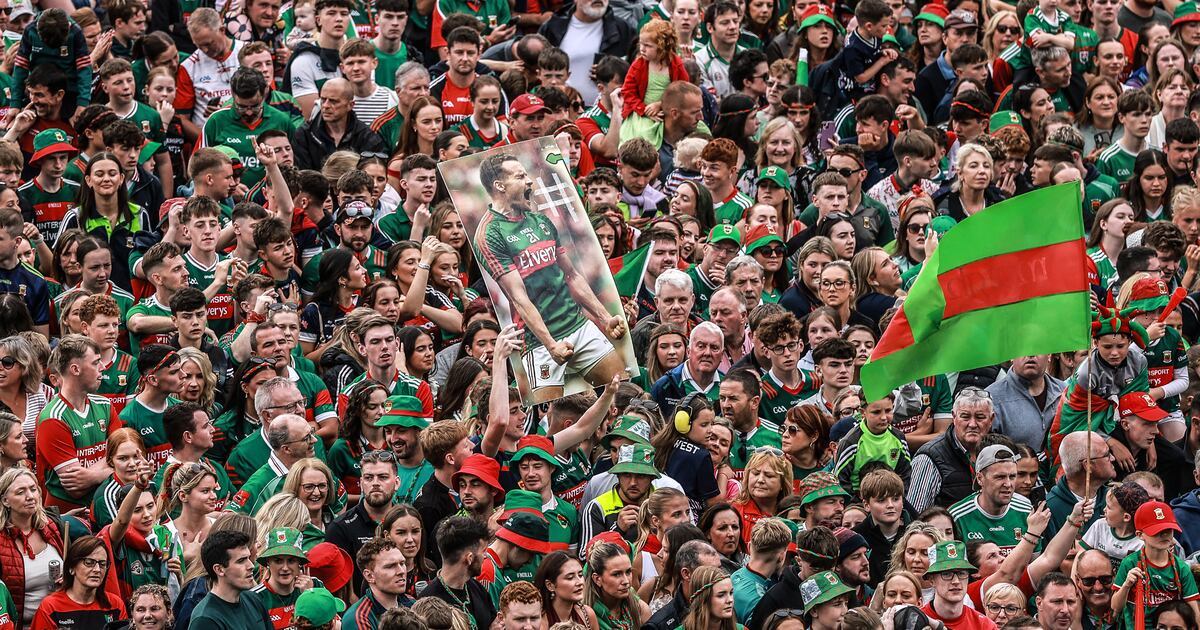
MacHale Park in Castlebar has always been best suited to those Saturday night matches in winter, when the season is young and the promise uncontained. An ideal evening would be polar cold and dry, with maybe a low fog hovering across the low fields. Some big-shot county – Kerry, Dublin, one of the Ulster blades or Galway – would be in town. The downtown pubs – McHale’s or Sloyan’s or Buckos – would benefit from the pre-match crowd. The main stand would be full for at least half an hour before throw-in. The younger crowd would arrive in their going-out clothes. In the press box, the usual faces. Austin Garvin, who trained Mayo minor teams to two All-Ireland titles in the barren 1970s, would be there. Seán Rice, another seer of the Mayo tradition, would be there. Former players might be gigging with Midwest Radio. You were bound to see, in the stand, any of the well-known faces of Mayo football – Liam Mac or Willie Joe or James Nallen, David Brady or the Mortimers. Maughan. The team would take the field. And that’s when you’d feel it: the static electricity of pure Mayo togetherness and separateness which would travel from the crowded stadium across the vast county to signal another go at this thing. Since Mayo became All-Ireland senior football champions again late last Sunday afternoon, ending a 75-year wait, the sounds and images of the day have traversed the digital globe, landing everywhere from Australian television to CNN.“And finally, the win reverberating around the world this week – ending one of the longest droughts in sports history, and breaking an Irish curse,” said Christiane Amanpour, the political anchor, ending her show with footage of the closing seconds.Mayo captain Jack Coyne lifts the Sam Maguire Cup after his team's victory against Kerry in the All-Ireland SFC final at Croke Park last Sunday. Photograph: Stephen McCarthy/Sportsfile via Getty Images The audio footage of Midwest Radio’s broadcast from Croke Park also swept the globe as commentator Stephen Grealis and analyst Martin Carney delivered a closing stanza that was half poem, half primal scream. Tens of millions of viewers were discovering Gaelic football for the first time. Understandably, they had questions. What was this sport? Why hadn’t they seen it before now? If the teams draw those crowds, why aren’t the players paid? And so on. The Mayo diaspora, from former US president Joe Biden to the Gallagher brothers of Oasis, heard the call and responded with messages. “Congratulations MAYO lick it up to ras very proud LG x,” wrote the younger Gallagher, a regular visitor to his mother’s homeplace of Charlestown.READ MOREWithin Ireland, the national response was equally remarkable. The 139-year history of the senior football championship is based on county allegiance that is fierce and sometimes poisonous. But last Sunday, Mayo’s finest hour was transformed into a unique day of national celebration within seconds of the final whistle. Old rivalries and enmities were temporarily suspended. All 30 neutral counties were moved, in a way that seldom occurs, by the success of the winning team and its followers after a litany of sporting heartbreaks. The players and supporters of Kerry – the standard bearers for the sport – remained in the stadium. As serial winners, the scenario was alien to their psyche, but they saluted its importance.All was flipped: all of that bottled disappointment of 11 lost All-Ireland finals since 1989, of the memory of family members or friends no longer alive to witness this, all the primordial pride in their county now let loose into the atmosphere. It was overwhelming.“I have nothing to say,” Lee Keegan, one of Mayo’s greatest ever footballers, admitted in a choked voice as he stood with the other RTÉ panellists. Then, Keegan delivered a searing, unforgettable tribute.“I’m f***in’ delighted. I’m so proud. I just have no words. That’s just unbelievable. I thought I’d never get to see the day this comes. And to see what they did today, the way they finished it . . . the sneering for years, the laughter at Mayo – those guys are legends for the rest of their lives.”Lee Keegan in action for Mayo during the 2021 All-Ireland SFC final defeat to Tyrone. Photograph: Ryan Byrne/Inpho National landmark events tend to be grim, tragic or politically momentous. But even as captain Jack Coyne delivered a momentous speech in a prolonged guttural howl, it felt as though the significance of the day was being claimed by history: that this was one of the more unique – and joyful – national episodes since the foundation of the Republic.Any visitor knows this: Mayo is a chatty county, filled with natural, often excitable storytellers. And everyone now knows about Mayo’s staggeringly bleak fortune in All-Ireland finals between 1951 and Sunday. It would have been understandable had the county and its footballing representatives turned surly or uncommunicative as the doleful record was extended. The years of All-Ireland final defeat could be recited like the sorrowful mysteries: 1989, 1996 (after a replay), 1997, 2004, 2006, 2012, 2013, 2016 (after a replay), 2017, 2020 (the Covid final, played at night in a ghostly Croke Park) and 2021. The numbers ticked up like an unpaid debt. The pursuit was epic. Still, with the unfulfillment, it was threatening to become macabre. In the age of the meme, the jokes came thick and fast. Through all that, Mayo footballers and supporters never shied away from speaking about it, nor returning to All-Ireland finals.“Maybe we make too much of the football,” Fr Leo Morahan, the former county board executive, said back in 2007.“Mayo has the whole Celtic thing of either being ecstatic or absolutely down in the depths of despair. Maybe it is common to all coastal counties, I don’t know. Take the old saying, ‘Mayo, God help us’. My belief is that it originates from the Famine when a lot of people fled the land and crowded the port towns like Sligo, Dublin and Galway to get away. And when people were asked where they came from, the reply was ‘Mayo, God help us’, and it stuck. But in a way, I am kind of proud of that. You carry your wounds with honour.”That’s what they did. Walk into any Mayo pub and it won’t be long before you will come upon photographs of the 1936 team and the mid-century team that won back-to-back All-Ireland titles in 1950 and 1951. Three All-Ireland titles is hardly a lavish haul. But the composition of that back-to-back winning team was filled with bright, brilliant people. Seán Flanagan, the captain, was then a young barrister and TD who would go on to hold several Cabinet ministerial posts. Eamonn Mongey was a barrister and, later, registrar of the High Court. Pádraig Carney, a doctor who, in an implausibly glamorous turn, flew home from his new life in America to play with the team for the 1954 season. Peter Solan was an engineer, Paddy Prendergast a garda, Joe Dixon a farmer. They all carried themselves with authority and easy self-assurance and they left a deep imprint on the county. Those two years, when the team in its dashing all-white strip dominated, set the template for what Mayo football represented.Fr Morahan’s observation about ecstasy and despair remains the key to its mythologies. The most remarkable statistic about Mayo football has nothing to do with All-Ireland finals. After the gradual dissolution of the team that won successive All-Irelands, Mayo managed just five Connacht title wins – 1955, 1967, 1969, 1981, 1985 – in 30 years. In other words, the county senior team was essentially locked out of the business of winning the All-Ireland. They failed to win a single senior Connacht title throughout the 1970s. When John O’Mahony took charge of the senior team in 1988, he combined his unique personality traits of meticulousness, shrewdness, a kind of spiritual goodness and a romantic sensibility about Mayo to fan the embers and set the whole thing in motion again.Former Mayo manager, the late John O'Mahony. Photograph: Lorraine O'Sullivan/Inpho Famously, the 1989 team was offered a flight from Knock Airport, then the pride of the county, to Dublin. O’Mahony later regretted accepting it as it created extra fuss. But Mayo might well have beaten Cork that day and the return flight that Monday evening yielded a fabulous-if-lonely sight for the team as the plane began its descent. The narrow roads were a procession of car lights and, as they hit the tarmac, the players could see thousands of people, of faces, against the wire.“The crowd got us all,” Kevin McStay, the former player and manager, would later say. “There was something very sad and very rural about it. It almost had the look of a massive country funeral.”[ Mayo’s victory was the greatest sporting occasion I’ll ever attendOpens in new window ]If so, it was a party with a raucous wake. The losing team toured the country for a week, convinced that Mayo was on the threshold of reclaiming lost glories. Instead, that year marked the beginning of the concerted quest which would go on for a further 37 years. The “curse” legend was probably revived after the freakish outcome of the 1996 drawn final against Meath, when a hopeful downfield punt from Colm Coyle literally bounced over the Mayo crossbar. It was a bizarre moment of bad luck, but there was no single reason why Mayo hadn’t won.“I wish there was,” John Maughan, the manager in 96, told The Irish Times.“Really, I would love if someone could present one identifiable reason. But don’t come to me with all the voodoo talk or curses. That is pie in the sky. I heard the same thing down in Clare with the hex of Biddy Early. And I don’t mind it. It is a fun thing. Equally, it’s not about theories on guys getting injured or over-training for a certain week in August or all those things that are analysed afterwards. And, of course, I have heard that we have lost games because Maughan didn’t change X, Y and Z at a given time. But hey, you dance with the girls that are in the dance hall.”Maughan said that in February 2004, when he was beginning his second term as Mayo manager. By September, he had the county back in an All-Ireland final, when Kerry defeated his young team.Like most GAA counties, the network of names and connections within Mayo football are impossibly dense: you could fill the entire print edition of this newspaper mapping them. For instance: Martin Carney, who played with Donegal and Mayo, is a nephew of Jackie Carney, a player on the 1936 team and trainer, along with Gerald Courell, of the 1950/51 champions. Conor Loftus, who played on Sunday, is a grandnephew of Dr Mick Loftus, another of the 1950/51 class, who went on to serve as president of the GAA. John O’Mahony was a teacher and coach of Andy Moran at St Nathy’s. Moran’s first year with Mayo was 2004. Maughan would often collect him at Ballaghaderreen ahead of training and was a natural raconteur behind the wheel, usually involving Mayo football stories. Sixteen years later, freshly retired, Moran would recall, on these pages, a lost trip to Kildare for “some pitch opening – Charlie McCreevy was coming in on a helicopter and cutting a ribbon”.Maughan, the newcomer sensed, was giddy on that drive. He kept saying he had “a treat” and managed to contain his excitement no further than Tulsk.“Ciarán Mac,” he announced, “is back.”There has always been a flamboyant streak running through Mayo football. The 1970s was in some ways defined by Ted Webb, the imperious young star from Ballyhaunis who was tragically killed in a car accident in February 1976. The previous summer Henry Wills took a stunning image of Webb in full flight: it remains one of the imperishable Mayo football images. In the late 1980s, luring Ger Geraghty – one of the many young Mayo people who moved to Chicago – became a primary mission of O’Mahony’s. He would later refer to Geraghty as “the missing link” in that period. The late 1980s and 90s had Liam McHale, the sallow, languid 6ft 6in basketball prodigy. “Liam Mac was the best on that team I played on,” McStay said when asked about Geraghty. “Ger was a good bit better than Liam.”And Ciarán McDonald, sinewy and tattooed and blond-haired at a time when conformity was demanded on GAA fields, seemed to embody everything that made Mayo different. At his best, he was liquid gold on the field. McDonald made his debut for Mayo in 1994 – the year O’Mahony guided Leitrim to a historic Connacht championship. McDonald had made his club senior debut, with Crossmolina, in his mid-teens and kicked 0-4. He continued to play with his club team well into his 40s, besotted with the game. Through all that time, he seldom gave interviews. A rare exception was a fascinating sit-down television interview with Second Captains a decade ago.Mayo's Ciarán McDonald (left) holds off Padraig McMahon of Laois during an All-Ireland SFC quarter-final replay at Croke Park in 2006. Photograph: Lorraine O'Sullivan/Inpho “Number one I’d be a shy person,” he said with a laugh when asked by Eoin McDevitt why he remained silent.“I’d be introverted – I wouldn’t be extrovert, no matter what people said about me.”But that night, he opened up about his feelings for Mayo football in a way that was thoughtful, painfully modest and scrupulously honest.“Oh, it’s pretty raw,” he said of his three All-Ireland final defeats.“You’d have the mad illusion in your head you’re still good enough to play inter-county football, with the hope of getting an All-Ireland title. They are defeats . . . but it was great to be there. Would it be great to have an All-Ireland title at senior? Course it would.”When Paddy Prendergast, the last of the starting team from 1951 and a man of extraordinary warmth and charisma, died in 2023, Ballintubber club chairman Tony O’Connor – whose sons Cillian and Diarmuid won All-Irelands on Sunday – drew a line under the so-called curse.[ Darragh Ó Sé: Why were we all so wrong with our Mayo predictions? I think there are a few reasonsOpens in new window ]“They were a very religious group of players, who got Mass every morning when in collective training,” he told Seán Moran on these pages.“So, the idea of this curse is a load of rubbish. A group of players more likely to respect a funeral you couldn’t imagine. Poor Paddy. It was basically hurting him that this was going on. As he said himself, if there were any truth in it, ‘I’d roll over and die’, but he said there wasn’t an iota of substance to it. It was grossly insulting and very unpleasant.”Through all that time, it wasn’t so much the fictive curse that Mayo teams had to fight through as much as the burden of those accumulative defeats, and the weight of Time itself.“Mayo people – we are different. I can say that now,” Andy Moran said on these pages shortly after he retired.Mayo's Kobe McDonald and manager Andy Moran celebrate after last Sunday's All-Ireland SFC final victory against Kerry at Croke Park. Photograph: James Crombie/Inpho “There is a cultish element to us. But we love football and if the team is getting attention, I think that is a good thing for us as a county.”Everyone now knows how the story ends.Mayo lost the coin toss for jersey preference. Rather than the more neutral blue, they chose to wear the all-white strip designed as a commemorative honour of the 1950/1951 team. It was a risk: had the match gone badly – as many forecast it could do, those shirts would have become symbolic of another bleak day. John O’Mahony’s death, in 2024, cast a deep shadow over the west of Ireland. “I just thought he was brilliant, how he treated people,” James Horan, the former player who led Mayo’s second rush after becoming manager in 2011, once said of his manager. As it happened, the silver jubilee of the Galway All-Ireland winning team, which O’Mahony had managed in 2001, took place on Sunday. His wife Geraldine represented him on the pitch for the presentation before the crowd.Geraldine O'Mahony representing her late husband John O'Mahony for the celebration of Galway's All-Ireland winning team of 2001, which he managed. Photograph: Tom O’Hanlon/Inpho Andy Moran, in his first season, went for broke with his high-pressing tactics. Significantly, they liberated themselves through pure Mayo football traditions – high-octane adventurism and the imposition of organised chaos. A very young team was transformed into Mayo’s history boys over the course of the afternoon, joining the ranks of those three fabled years. Ciarán McDonald’s son Kobe, an extravagant talent bound for Australian rules football, was one of three first-season players to win an All-Ireland. Moran admitted that in those agonising last two minutes he said a silent prayer to his former teacher. “I’d be lying if I said at 69 minutes there I didn’t say a little prayer to Johnno,” he told RTÉ.“Johnno’s team was here, it was 25 years, my mentor, my friend – he tried twice with us. I have to say, I said a little one, I said, ‘Johnno, if I need you, it’s now’.”In those dazzling white shirts, the young Mayo team, on the threshold of becoming All-Ireland champions again, looked like an apparition.But as Mayo people around the world will remind themselves all winter: it was real. You carry your wounds with honour.Keith Duggan’s book, House of Pain: Through the Rooms of Mayo Football, was originally published in 2007 by Mainstream
Keith Duggan: Mayo carried their wounds with honour for decades. Now it’s time to heal
Full Article
Original Source
Read the full article at Irishtimes →KhanList aggregates and links to publicly available news content. We do not host full articles from third-party sources. Always verify important information with original sources.