
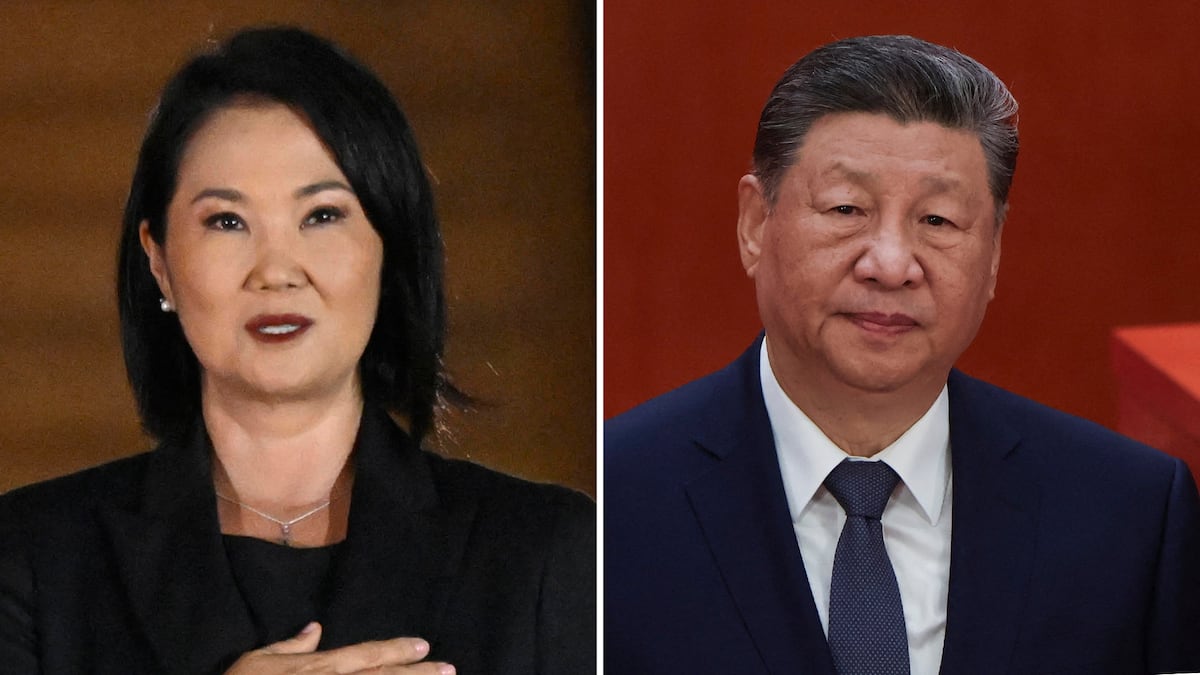
It all began with an exchange of messages. Two weeks before boarding a plane to China, Peru’s president, Keiko Fujimori, received a letter from her Chinese counterpart, Xi Jinping, on the occasion of the 55th anniversary of diplomatic relations between the two countries. In the letter, the Chinese leader expressed his willingness to continue strengthening ties with Peru and previewed the meeting they are scheduled to hold this Tuesday in Shenzhen, China’s tech capital, on the eve of the Asia-Pacific Economic Cooperation (APEC) summit. Tuesday’s meeting takes place amid U.S. pressure to curb Beijing’s influence in Latin America, especially in Peru, which counts the Chinese giant as its main trading partner.“I look forward to meeting with you in Shenzhen,” Xi Jinping wrote to the right-wing leader Fujimori in the letter dated November 2. The message, the core of which was published the same day by China’s foreign ministry —although the reference to the Shenzhen meeting did not appear in that version— arrives as Beijing seeks to increase its strategic investments in mining, energy and infrastructure in the South American country.The president’s reply, released by Beijing the same day, adopted a similarly cordial tone. Far from distancing herself from China’s courting, as the ultra-conservative Trump administration would have wanted, Fujimori stressed that the two countries have forged strong bonds of friendship and mutual respect and expressed her willingness to continue strengthening political dialogue and cooperation with the Asian superpower.Peru has become one of the main battlegrounds in the rivalry between China and the United States for control of strategic sectors in Latin America. Washington’s offensive responds to a geopolitical priority set out in the National Security Strategy that Trump presented at the end of 2025, which calls for “restoring U.S. preeminence in the Western Hemisphere” and dubs that approach the “Trump corollary to the Monroe Doctrine,” the framework the United States used since the 19th century to assert its influence over the continent.At the center of this quiet rivalry between the two superpowers is the Chancay megaport, north of Lima, a symbol of China’s growing influence in the region. Opened by videoconference by Xi Jinping in 2024, the deep-water terminal, which shortens maritime travel to Asia, is controlled by the state-owned Chinese firm Cosco Shipping. What represents a promise for the Peruvian economy to consolidate as the major maritime hub of the South Pacific is a growing source of concern for Trump hawks, who fear Chinese control of critical infrastructure in a region the United States has long treated as its backyard.Fujimori’s trip to China comes after having strengthened ties with the White House, especially on security issues, through the Shield of the Americas, the U.S.-led initiative to reinforce regional cooperation against transnational organized crime. But she has not abandoned commercial ties with Beijing. Since taking office, the president has said Peru will not take sides in the dispute between the two powers. “I am not going to get involved in the fight between the two countries,” she said in September after receiving U.S. Secretary of State Marco Rubio in Lima. Now she will be the one sitting across from Xi Jinping, in a meeting that will test that balance.Political analyst José Carlos Requena says Fujimori appears to have chosen to maintain good relations with both powers at once, following a traditional line of Peruvian diplomacy. It marks a shift from the signals she sent at the start of her government, when she moved closer to Washington, brought Peru into the Shield of the Americas and cut diplomatic ties with Iran, in line with Trump’s hardline stance. “Fujimori has preferred to keep good relations with both sides,” Requena says, noting that that posture contrasts with the more belligerent attitude toward China from the U.S. ambassador to Peru, Bernie Navarro.The numbers explain much of what’s at stake. For more than a decade, China has been the top destination for Peruvian exports: in 2025 it bought $33.5 billion worth of goods, about 37% of the total sold abroad, mainly copper and other minerals, according to official figures. Between January and September of this year alone, exports to China reached $31.3 billion. But Beijing’s presence in the country goes far beyond trade. Chinese companies have expanded investments in mining, transportation and infrastructure, in several cases by buying assets that previously belonged to Western groups. Today, companies linked to the Chinese state control Lima’s electricity distribution, on which millions of residents depend.According to the Peruvian government, that economic exchange will receive a new boost with the entry into force on November 1 of the optimization protocol to the bilateral Free Trade Agreement. Xi Jinping expressly highlighted this in his letter to Fujimori, convinced it will expand economic and commercial cooperation.Government officials at the presidential palace believe Tuesday’s Shenzhen meeting could result in new investment deals and financial aid to address the emergency caused by the El Niño phenomenon, which is already hitting Peru’s northern coast with heavy rains and flooding. In 2019, China financed nearly 90% of the construction and equipping of the National Emergency Operations Center (COEN), the headquarters from which authorities coordinate disaster responses.Fujimori is coming to the meeting with Xi Jinping at a difficult moment for her government. Just over 100 days into her presidency, her approval rating has fallen to 37%, twenty points lower than in August, while 53% of Peruvians disapprove of her administration, according to an Ipsos survey for Perú21 published on November 11. The president faces criticism over the limited results of her campaign against organized crime, one of the pillars of her platform, and for the lack of preventive work against El Niño. Potential agreements with China thus acquire an internal political dimension for a president who needs to start showing results to the electorate.Requena notes that Fujimori is not the first Peruvian president to reach out to Beijing. Pedro Pablo Kuczynski chose China as the destination for his first foreign trip after taking office in 2016, and Dina Boluarte also visited the country in 2024. The analyst believes the dispute between Washington and Beijing is more intense in rhetoric than in diplomatic relations. In fact, Donald Trump himself will travel to China this week, where he is scheduled to meet Xi Jinping and Vladimir Putin on Thursday in what would be the first trilateral meeting of the three presidents, on the sidelines of the APEC summit and despite trade tensions between the two powers.The importance Fujimori attaches to the trip was reflected in her early departure for Asia, foregoing the official farewell to Pope Leo XIV in Lima. The Peruvian president left for China on Sunday, November 15, on the penultimate day of the pontiff’s visit to Peru, the country he considers his homeland and where he was received with large displays of fervor. The Senate had authorized the trip amid criticism from opposition sectors, which questioned her absence while the “Peruvian Pope” concluded his South American tour, which had first taken him to Uruguay and Argentina, and while several regions faced emergencies due to the rains.The pope’s farewell was entrusted to Foreign Minister Carlos Espá, a lawyer who was communications director at the U.S. Embassy in Lima between 2008 and 2023 and who, before joining the cabinet, led a campaign of harsh criticism of China. As a presidential candidate he denounced the presence of Chinese fishing fleets off Peru’s coast and warned that the country risked becoming a colony of the Asian giant. While Espá stayed in Lima to see the pontiff off, Fujimori landed in Shenzhen to meet Xi Jinping, who two weeks earlier had written to her: “Sino-Peruvian relations have withstood the test of international vicissitudes (…) I am ready to work together with you.”Sign up for our weekly newsletter to get more English-language news coverage from EL PAÍS USA Edition
Keiko Fujimori to meet with Xi Jinping amid Trump’s pressure on Peru
Full Article
Original Source
Read the full article at English →KhanList aggregates and links to publicly available news content. We do not host full articles from third-party sources. Always verify important information with original sources.