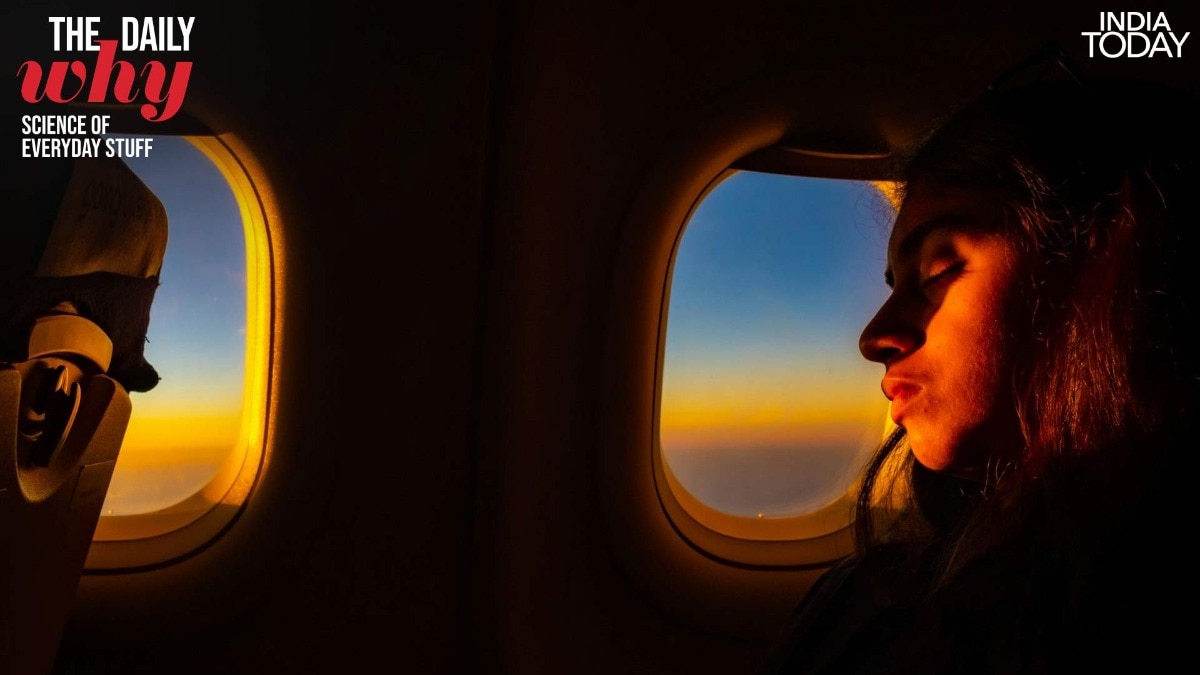
Cabin crew ask passengers to keep window shades open during takeoff and landing for reasons rooted in physics and biology, not sightseeing. Here is the science behind the rule, and how it differs from what actually protects passengers during turbulence.A passenger sits near an open window shade as the aircraft prepares for landing. (Photo: Unsplash)There is a small ritual that happens right before every flight lifts off the ground, and almost nobody thinks about it twice.A hand reaches for the window shade. A gentle tug, and the world outside slides back into view: the tarmac, the wing, and the sky waiting to be entered. The simple act of admiring the clouds feels dreamy and peaceful like the beginning of a nap. The window is, in truth, one of the oldest and most deliberate safety instruments ever built into an aircraft, and it has almost nothing to do with the view.Ask any passenger why the shade must stay up during takeoff and landing, and most will shrug. “Must be a boring old rule of the airline,” they will say. A rule without a reason. They are wrong, and the truth is far more interesting than the myth. The recent scare aboard Air India flight AI2379, flying from Phuket to Delhi on August 4, 2026, brought aviation safety back into every living room in the country.Severe turbulence threw passengers against the ceiling, injuring 17 people before the aircraft found its footing again and landed safely in Delhi, a stark reminder that the sky, for all its stillness, keeps its own quiet rules. The aircraft that survives mishaps best is the one whose passengers understand that every small instruction exists for a reason.WHY ARE TAKEOFF AND LANDING THE MOST DANGEROUS PARTS OF A FLIGHT?Of all the hours an aircraft spends in the air, only a sliver belongs to takeoff and landing. Yet that sliver carries a weight far heavier than its size.The aircraft sits closest to the earth here, moving fast, with almost no room to recover if something goes wrong. Boeing's own accident data tells the story starkly. Ever wondered why flight attendants insist on open window shades during takeoff and landing? It comes down to eye physiology, emergency visibility and decades of accident data, not sightseeing. (Photo: Unsplash) Landing alone, barely one per cent of total flight time, accounts for well over a third of all fatal accidents.It is the 11 most consequential minutes of any journey, the narrowest bridge between the ground and the sky.WHY DOES THE HUMAN EYE NEED TIME TO ADJUST TO LIGHT?The eye is not a machine. It is a slow, deliberate instrument, built from cells called rods and cones, each with its own rhythm.Rods, which govern vision in darkness, depend on a pigment called rhodopsin that regenerates only gradually once exposed to brightness. Human eyes take measurable time to adjust between bright and dark environments, a key reason cabin lights are dimmed before landing. (Photo: Unsplash) Cones, which handle colour and daylight, are hardly quicker. Step suddenly from a dim cabin into blinding sunlight, or from bright light into darkness, and the eye falters, caught between two worlds it cannot yet read.This is why shades stay open, so that daylight or darkness has already begun its slow work on the eye long before anyone might need to see clearly in a hurry.HOW DO OPEN WINDOW SHADES HELP SPOT DANGER OUTSIDE?A pilot cannot see the underside of the wing. The cabin crew cannot watch every engine at once.What the aircraft cannot see for itself, it borrows from the passengers seated beside its windows, an unspoken network of eyes scattered through the cabin, each one capable of noticing what instruments sometimes miss. Firefighters and ground responders rely on visibility into the cabin to plan safe entry during an emergency. (Photo: Unsplash) There could be mishaps like a thread of smoke or a stray spark. Something has, more than once, been caught by passengers this way before it became something worse.HOW DO OPEN SHADES HELP RESCUERS ON THE GROUND?The glass works both ways. Firefighters approaching a grounded aircraft read the cabin through its windows, watching for smoke, for fire, for anything that tells them where it is safe to enter.A closed shade, at that moment, becomes a wall between rescuers and the very information that could save the people behind it.DOES AN OPEN WINDOW SHADE HELP DURING TURBULENCE LIKE THE AIR INDIA INCIDENT?Honestly, no. Turbulence is a matter of the air itself, invisible and indifferent to what any window shows.What protects a passenger through it is not sight but restraint, a seatbelt fastened and forgotten, worn even when the sky looks perfectly calm. A fastened seatbelt, not an open shade, is what protects passengers when turbulence strikes without warning. (Photo: Unsplash) The shade and the belt guard against entirely different kinds of danger, one for what the eye might need to see, the other for what the body needs to survive.So the next time a hand reaches for that shade, remember what it is quietly promising the sky: that, whatever comes, someone was already looking.- EndsPublished By: Radifah KabirPublished On: Aug 7, 2026 14:30 IST
Keep window shades open at landing or takeoff. Why? They are watching something
Full Article
Original Source
Read the full article at Indiatoday →KhanList aggregates and links to publicly available news content. We do not host full articles from third-party sources. Always verify important information with original sources.