
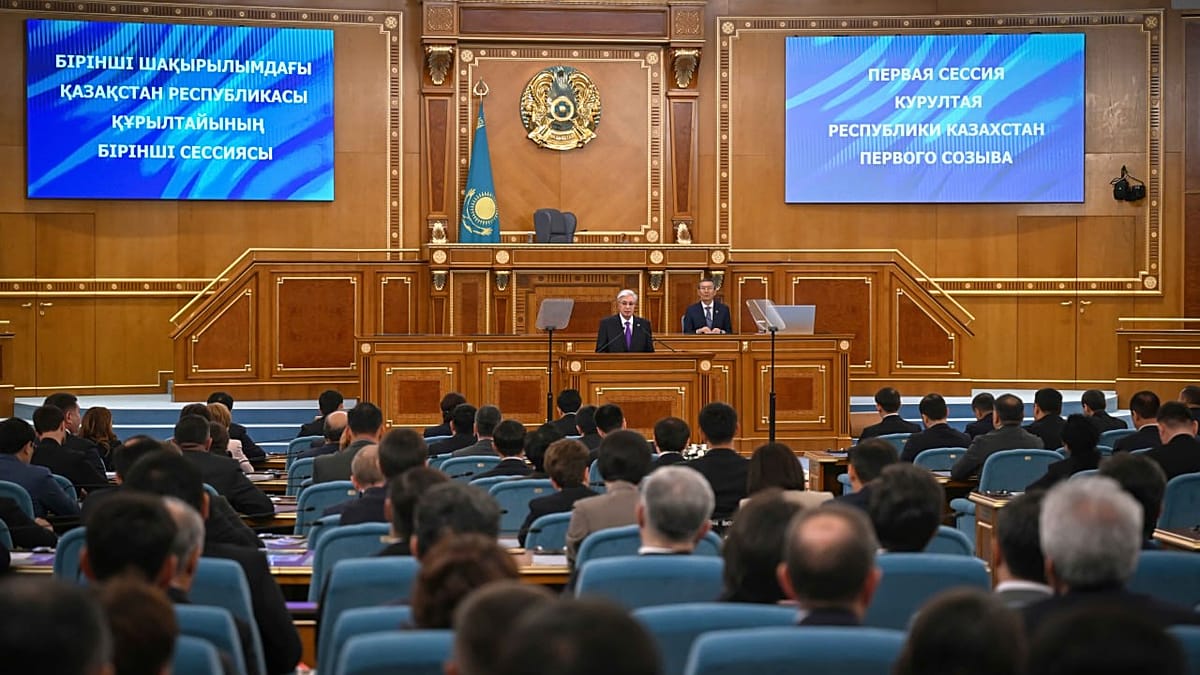
Kazakhstan has entered a new political season with a reshaped political system after the country’s newly established unicameral parliament, with its lawmakers gathered for its first session on Friday in Astana. ADVERTISEMENT ADVERTISEMENT It comes Kazakhstan’s pro-government Adilet party won more than 71 percent of the vote in last Sunday’s parliamentary election, that was triggered by a new constitution adopted earlier this year. The session attended by all 145 members opened with an address by President Kassym-Jomart Tokayev, who formally declared the first session of the first convocation of the Kurultai open and described it as the beginning of an important new stage in the country’s development. “From this day, the process of renewing the country’s political system begins. … The Kurultai will fundamentally modernise the system of government and give a powerful impetus to the work of the entire state apparatus. By improving the quality of national legislation, the Kurultai will provide a strong foundation for the country’s legal system,” Tokayev said. A new political system Under the Constitution, the government is required to step down before a newly elected Kurultai. Kazakhstan’s government therefore relinquished its powers as the new parliament convened. However, the country will not be left without a functioning government during the transition period. President Tokayev signed a decree instructing the cabinet to continue performing its duties until a new government is formed. Under Kazakhstan’s new Constitution, which came into force on 1 July 2026, the previous bicameral parliament, consisting of the Mazhilis and the Senate, was replaced by a unicameral parliament called the Kurultai. The term “kurultai” dates back centuries and historically referred to an assembly or council among the peoples of the Great Steppe. The new Constitution was adopted in a nationwide referendum held on 15 March 2026. “By coming together, our people accomplished a great deal in a very short period of time. Thanks to the nationwide referendum, the country successfully implemented a sweeping constitutional reform,” Tokayev said. The Kurultai consists of 145 lawmakers elected for five-year terms and representing five political parties. The Adilet party, which absorbed Amanat, the successor to the long-dominant Nur Otan party, holds a commanding majority with 110 seats. It is followed by the Auyl party with 10 seats, Respublica with nine, the Nationwide Social Democratic Party (OSDP) with eight and Ak Zhol with eight. New speaker of the Kurultai During the session, President Tokayev nominated Aibek Dadebai for the position of chairman of the Kurultai. Dadebai has headed the Adilet party since 7 May 2026 and has held several senior government and diplomatic posts, including serving as head of the Presidential Administration from February 2024 to May 2026. Tokayev said Dadebai had extensive experience in public administration and described him as an educated, patriotic and responsible citizen. “I consider him worthy of this position and ask the members of the Kurultai to support his candidacy,” Tokayev said. Later in the day, lawmakers backed the nomination and elected Dadebai chairman of the Kurultai in a secret ballot. Lawmakers also elected three deputy speakers: former senator Nurlan Beknazarov, former Mazhilis deputy speaker Dania Espaeva and Children’s Rights Commissioner Dinara Zakiyeva. The Kurultai will have eight standing committees, seven of which will be chaired by representatives of the ruling Adilet party, while the remaining committee will be headed by a member of the Auyl party. What happens next? Kazakhstan’s new political structure will continue to take shape in the coming weeks. Once the Kurultai is fully organised, President Tokayev will put forward candidates for vice-president and prime minister, before appointing the new government following consultations with lawmakers. A deputy chairman of the Security Council will also be appointed to a newly created post. Tokayev said he would deliver his annual address to the nation once the new parliament and government are fully formed. The institutional changes will continue into September, with the Kazakhstan People’s Council expected to be established in the second half of the month. The new constitutional body will represent the country’s ethnic, regional, social and political diversity and will have the right to initiate legislation. According to Tokayev, the process will renew “almost all key institutions of power” within a relatively short period.
Kazakhstan’s government steps down as newly elected Kurultai holds first session
Full Article
Original Source
Read the full article at Euronews →KhanList aggregates and links to publicly available news content. We do not host full articles from third-party sources. Always verify important information with original sources.