
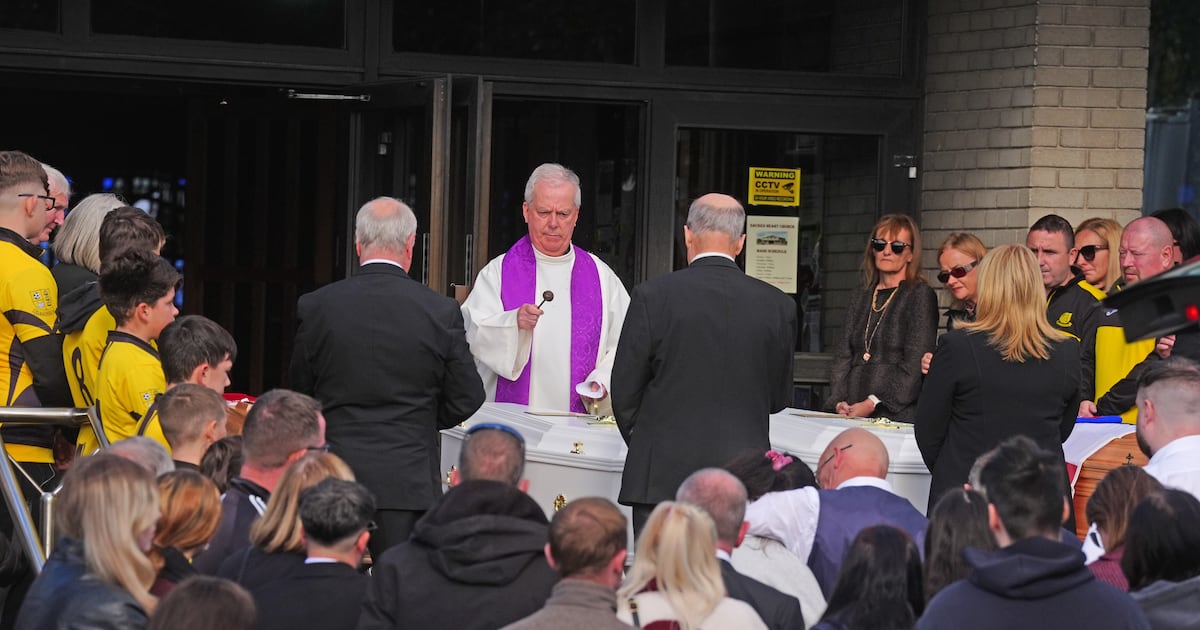
On Sunday, the human cost of our cool cocaine culture was laid before us as the remains of Kim and Philip English, and their boys Jayden and Callum, were carried to a Catholic church in Waterford city and placed in the care of a parish priest, Fr Gerry Chestnutt, for their funeral on Monday.The most remarkable aspect of that handover ritual is that there was nothing remarkable about it at all. It’s generally what we do in times of grief and tragedy. We entrust the final farewell of our loved ones to a man who is part of a tribe often vilified for his calling and who represents a near eviscerated institution. Yet, in some of the loneliest moments of our lives, we trust in that man’s wisdom and empathy, born of years spent attending scenes of human devastation, to bring a sense of the sacred that comes with the comforting old rituals of a Catholic funeral. That’s if we think about it at all. Maybe we just want a venue and a proven, formulaic way to handle the heartbreak of death. Either way, the Catholic funeral is such a natural part of us that we hardly question it. If pushed, we’ll repeat the accepted line – that Ireland is still Catholic but no longer religious – but we mostly prefer not to dwell on what that actually means. What exactly do we want of the Church now? Some Catholics argue if a church is reduced to a merely useful funeral venue that priests should stop facilitating them altogether. It’s understandable. It would also be another tiresome example of the church shooting itself in the foot. Leave aside the existential question of women in the church and have a look at the most strongly supported proposals at the first national synodal assembly last Saturday: healing as a priority; pathways of belonging for young people; communion with those struggling to see the relevance of the church. Severing one of the last through lines between the church and those wobbling on the margins will hardly help achieve any of those goals. READ MOREAfter decades of covering Catholic funerals, the memories that linger are of row after row of pale, subdued, awkward young men dressed in hastily-acquired black suits and ties and a photograph of a young face on the coffin. I never pass St John’s Lane Church in Dublin’s Liberties without remembering Anthony Campbell, the 20-year-old apprentice plumber who was working in a house where crime boss “Marlo” Hyland was the target of a double killing in which the boy was an innocent victim. A “mistake”.More than 2,000 mourners, who included rows and rows of black-suited young men, heard Fr Sean McArdle speak of Campbell’s “cruel and senseless death”, that “what happened to him was terrible and evil and has shocked all right-thinking and decent people”. He prayed “that in some way God will touch the hearts of the men and women of violence in our society”. That was 20 years ago. Last August, when rage towards the five dead boys in the M9 crash was at fever pitch, it fell to Carlow priest, Fr Tom Little, to tell a congregation of their grieving relatives and many young men that “what the boys did was wrong” while couching it in the promise of a merciful God.[ How drug debt fuelled Waterford arson attackOpens in new window ]We know the drill. When tragedy strikes, and the media descend on a community deep in shock, the priest will be available and will find the words when no one else can. He would possibly have given the last rites at the scene – or at least know the truth of it – and has been navigating a family’s distress and possibly a community’s divisions, as well as his own haunted flashbacks in the long days since. It’s when you attend a succession of those funerals and note the celebrants’ exhausted faces, the minefield of names, relationships and sensitivities to be negotiated, and hear the scrupulously worded, often brave homilies, that you wonder what their inner life must be like. Ten years ago, when eight suicides were recorded in Co Laois within three weeks, Fr Paddy Byrne described the clergy as “sacramental firemen” going from one crisis to another. In Belfast, Fr Aidan Troy, best known for defying death threats by walking daily with the girls of the Holy Cross primary school through a loyalist gauntlet of spit, stones, fireworks, blast bombs and sectarian abuse, has written of similar experiences.These men at the frontline know too much to ask if the victim was an observant Catholic or if the distraught relatives attended Sunday Mass. [ Waterford arson victims were ‘a beautiful family who did no wrong’, funeral toldOpens in new window ]In 2015, after a balcony collapse in San Francisco resulted in the deaths of six young people – a seventh, Aoife Beary, died in 2022 – an Irish priest serving nearby became the accidental voice and through line of old rituals for broken families and traumatised young people an ocean away. Fr Aidan McAleenan – just 10 years a priest – said, “The families decided what they wanted ... They wanted it to be like home.” “Like home”. There’s a phrase for the modern church to conjure with – and for all of us, because funerals are not just for old people. [ Funerals are the only aspect of Catholic life I engage with any moreOpens in new window ]
Kathy Sheridan: When words fail, we still turn to the priest to find them
Full Article
Original Source
Read the full article at Irishtimes →KhanList aggregates and links to publicly available news content. We do not host full articles from third-party sources. Always verify important information with original sources.