
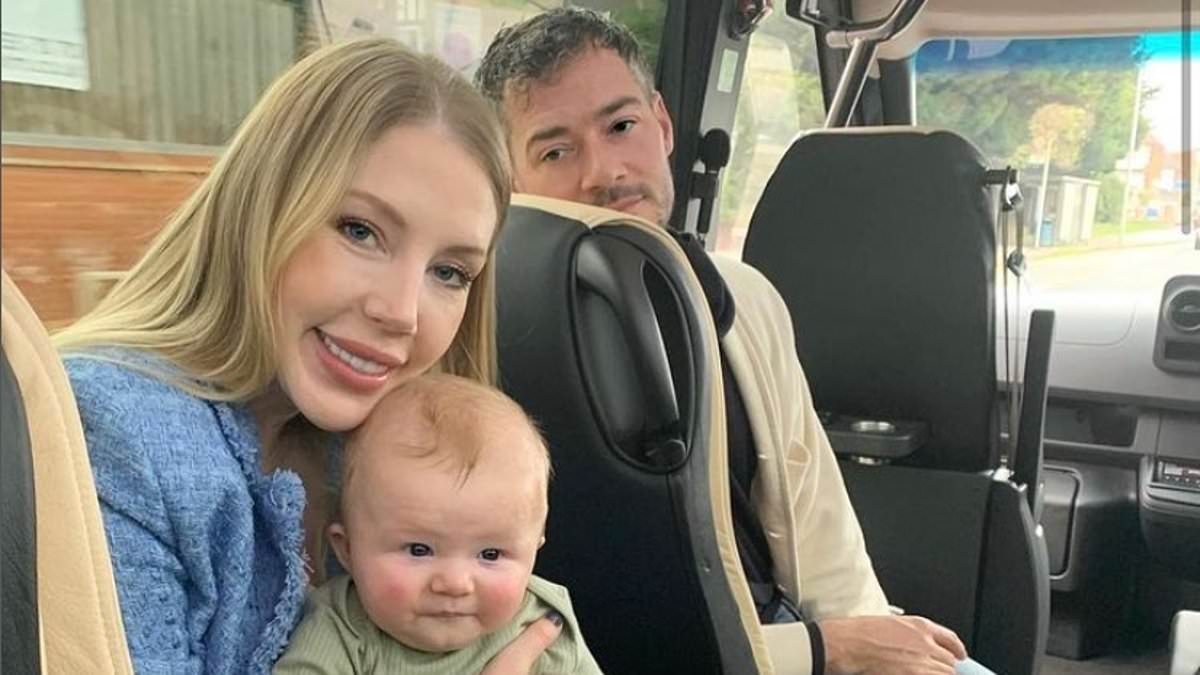
Katherine Ryan has spoken candidly about her husband Bobby Koostra's experience with male postpartum depression after she gave birth to their first son Fred.The comedian, 43, explained how the couple struggled to understand what he was going through and how Bobby was unable to articulate it at the time.Speaking on the Weirdo's Book Club podcast, Katherine explained how she believes Bobby's difficult childhood was part of the reason for the difficult period.She said that Booby's past and the death of his father at a young age may have contributed to the emotional challenges he faced as a new father. Katherine said Bobby has little memory of his childhood, something she compared to the emotional gaps described by Prince Harry following the death of his mother.'Especially with his history, he doesn't remember his childhood, he lost his dad young,' she said. 'You know how Prince Harry talks about this empty space, like a protective part of his brain blocked out his mother entirely, which is so sad? Bobby has the same thing.' atherine Ryan has spoken candidly about her husband Bobby Koostra's experience with male postpartum depression after she gave birth to their first son Fred. The comedian, 43, explained how the couple struggled to understand what he was going through and how Bobby was unable to articulate it at the time The couple's relationship progressed quickly, and after experiencing miscarriages, they welcomed their son Fred.Katherine revealed that the name was particularly significant, as it was also the name of Bobby's late father.'We got together very quickly and then we had some miscarriages and then we had Fred. Fred is his deceased dad's name, so will really set him up for failure emotionally,' she said.She also reflected on the couple's decision for Bobby to become a stay-at-home dad, explaining that she was keen to respect his wishes while avoiding taking on the role of making all the decisions herself.'He also had to look after Fred quite a bit, because I believed him about wanting to be a stay at home dad. I was trying not to be a first-born daughter in this scenario when he said he wanted to be a stay-at-home dad,' she explained.With lockdown having limited her work opportunities, Katherine decided to return to filming before heading out on tour. However, she acknowledged that caring for a newborn was a very different experience from looking after older children.'I think he's a great stay-at-home dad now that they're old enough to speak. But to give him a newborn, and I was still breastfeeding…'Katherine admitted she struggled to recognise what Bobby was experiencing at the time and explained that the couple did not understand that men could also experience postpartum depression.'Bobby was not really able to articulate what he was going through at the time. This was five years ago, but we didn't really know about male postpartum depression. He was just on edge.' The comedian, 43, explained how the couple struggled to understand what he was going through and how Bobby was unable to articulate it at the timeShe said Bobby rarely spoke about his feelings, meaning she did not fully understand the extent of his distress until he was able to reflect on the experience afterwards.'He doesn't speak much anyway. Didn't know what was going on. But when he came out of it, he was like, 'Oh, I was having a really terrible time,' she recalled.Looking back, Katherine described how Bobby had been consumed by worry, struggling to sleep and spending long periods watching their baby.'He was thinking about it all the time, he couldn't sleep, he would just watch Fred sleep,' she said.Although postpartum depression is often discussed in relation to mothers, fathers can also experience depression and anxiety during the perinatal period. Despite describing Bobby's experience with compassion, Katherine admitted that looking back has also brought feelings of guilt about her own decisions as a working mother due to internalised misogyny.She explained that, although she had returned to work while Fred was still being breastfed, she sometimes questioned whether she should have stayed home instead.'I describe it as if I wasn't around, Fred was exclusively breastfed for 10 months, so I was around. But if I had known…'Katherine acknowledged that these feelings were difficult to reconcile with her feminist beliefs, particularly because she recognised the influence of internalised expectations about motherhood and responsibility.'That's a difficult feminist admission because I do internalise misogyny and I think, 'Oh, I shouldn't have gone straight back to work.'She continued: 'I shouldn't have left a man alone with a newborn. I should have done it, I've done it once before. Reflecting on her tendency to take responsibility, she added: 'Again, the first-born daughter thing, I was like, 'I should have been in charge of this and it would have been fine.'
Katherine Ryan reveals her husband Bobby Koostra struggled with male postpartum depression after the birth of their son Fred
Full Article
Original Source
Read the full article at Dailymail →KhanList aggregates and links to publicly available news content. We do not host full articles from third-party sources. Always verify important information with original sources.