
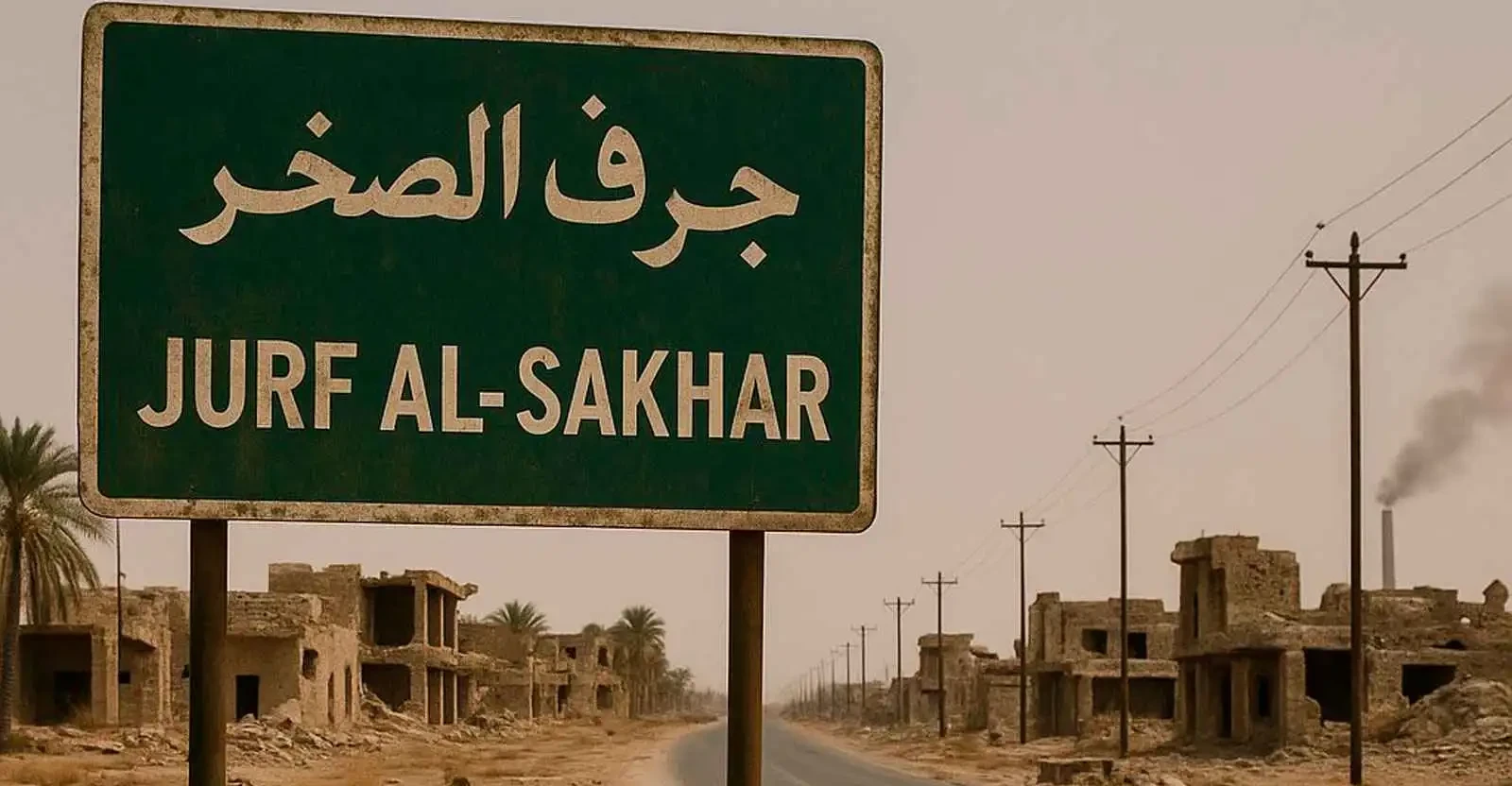
Bahjdad (IraqiNews.com) – Five days after federal security forces entered Jurf al-Sakhar (Jurf al-Nasr), informed sources revealed to Al-Mada newspaper—in a report on Wednesday, November 25, 2026—that the military operation has produced no substantive change to the balance of power on the ground. According to the report, Kata’ib Hezbollah retains full control over the town center and its vital surrounding perimeter, including the areas of Abd Ways, Al-Farsiya, Al-Hujayr, and Al-Fadhiliya. No federal security forces have entered this core perimeter—referred to by insiders as the “Kata’ib Hezbollah Square”—and the newly inaugurated joint control headquarters remains situated outside Jurf al-Sakhar’s administrative boundaries. Rather than retreating, the faction utilized the official deployment announcement to absorb more than 2,000 of its previously off-roster fighters into the official payroll of the Popular Mobilization Forces (PMF/Hashd al-Shaabi) under the 72nd and 79th Brigades, shifting their financial burden onto the state budget while securing institutional cover and legal immunity. Field accounts indicate that the federal deployment touted by Baghdad was largely confined to peripheral sectors and routine troop rotations: Iraqi Army: Deployment was restricted to the 38th Brigade of the 10th Division along the northwestern edge of Jurf al-Sakhar toward Anbar’s Amiriyat al-Fallujah axis and the canal linking Lake Habbaniyah to Lake Razzaza west of Karbala. Federal Police: The only state force maintaining direct contact with Kata’ib Hezbollah zones simply rotated existing positions, replacing the 16th Brigade with the 17th and 11th Brigades without advancing into faction-held territory. Counter-Terrorism Service (CTS): No CTS units deployed inside Jurf al-Sakhar, aside from a Karbala provincial regiment stationed at the garrison camp in Musayyib district outside the subdistrict’s borders. Meanwhile, informed sources noted that Kata’ib Hezbollah leveraged the publicized “withdrawal” to execute a wide-scale military redeployment, transferring substantial weaponry and equipment to establish new positions in western Anbar and western Karbala in anticipation of a potential renewed military confrontation between the United States and Iran, while Iranian and Houthi advisors remain active inside Jurf al-Sakhar. Political observers cited by Al-Mada suggest Tehran and allied factions orchestrated a nominal concession in northern Babylon—long targeted by Washington as a financial artery for Iran—in order to open a new security and political front against the Kurdistan Region. According to these assessments, Tehran is pressing Baghdad to obtain a list of Iranian Kurdish opposition members residing in Kurdistan and relocate them to Samawah in southern Iraq to neutralize their potential involvement in any U.S.-Iran conflict. This geopolitical maneuvering coincides with Prime Minister Ali Faleh Al-Zaidi’s announcement on Tuesday of heightened anti-smuggling measures around the Kurdistan Region’s perimeter, alongside Erbil’s denial of rumors regarding federal troop deployments inside the region or a return to the 1991 “Blue Line.” Simultaneously, allies of Al-Zaidi view the nationwide crackdown on oil pipeline tapping as leverage to prosecute and imprison leaders of defiant armed factions by choking off illicit revenue streams. The anti-smuggling drive took a sharp political turn after Najaf MP Abdul-Hadi Al-Hasnawi stated that a farm implicated in oil pipeline tampering in Najaf belongs to the Harakat al-Nujaba militia rather than a private family, following arrest warrants issued for two of his brothers. In Erbil, former Kurdistan Parliament member Abdul-Salam Barwari warned that actors implicated in Jurf al-Sakhar’s illicit economy are attempting to deflect scrutiny by manufacturing crises around the Kurdistan Region—effectively signaling that oil theft is not confined to northern Babylon. While characterizing Al-Zaidi’s official rhetoric on state monopoly over weapons as generally measured, Barwari cautioned that commentary from aligned media and activists revives a 2017 Kirkuk-style mentality hostile to Iraq’s constitutional federalism, seeking to exploit internal Kurdish political tensions following the recent reactivation of the Kurdistan Parliament.
Kata’ib Hezbollah retains core Jurf Al Sakhar stronghold and absorbs 2,000 fighters into state payroll
Full Article
Original Source
Read the full article at Iraqinews →KhanList aggregates and links to publicly available news content. We do not host full articles from third-party sources. Always verify important information with original sources.