
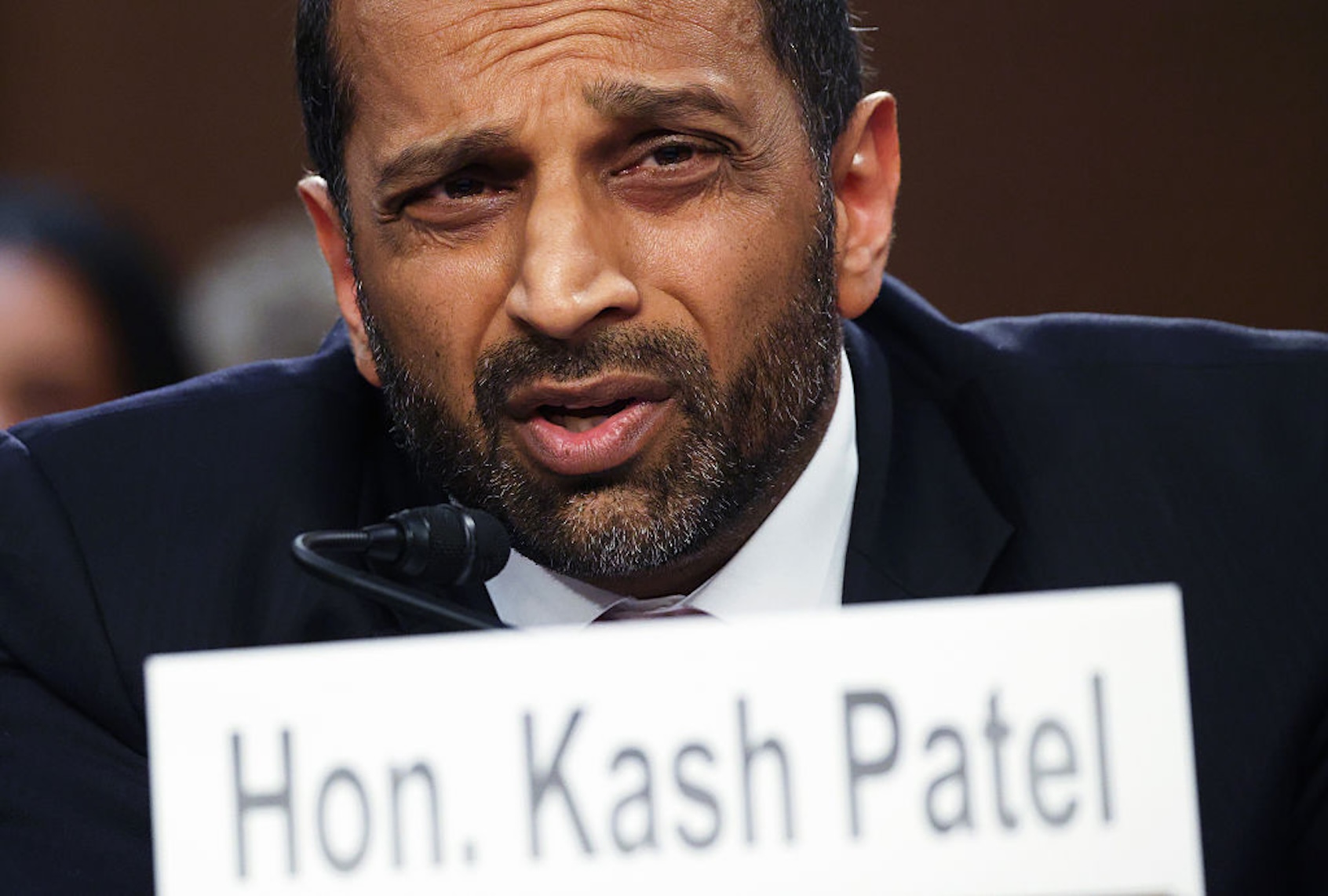
commentary The FBI director’s testimony is part of a larger MAGA strategy to sow cynicism Published September 18, 2026 6:45AM (EDT) FBI Director Kash Patel testifies during a Senate Judiciary Committee hearing on Sept. 15, 2026. (Win McNamee/Getty Images) Kash Patel wants to be the White House’s preeminent attack dog. But as usual, he can’t help but break through the fence and run into traffic. This time, his mistake was a very strange quasi-defense of people convicted of bestiality. Sen. Dick Durbin, D-Ill., led the FBI director straight into a trap during Tuesday’s Senate Judiciary Committee hearing when he asked Patel why his agency had dropped the hiring ban on people who admitted to engaging in sex with animals. “We did not want to punish victims of bestiality,” Patel replied. His words immediately ricocheted around the internet, as it’s generally understood that humans are the victimizers in such situations. Although he went on to argue that the change was to protect sex trafficking victims who may have been forced into such acts, his reasoning didn’t convince many on the committee, including Republican Sen. John Kennedy. “Why would you even get into bestiality?” the Louisiana senator asked. “We are not into bestiality,” Patel replied. Once you’re arguing that you’re not into having sex with animals, you’ve probably lost control of a situation. Things weren’t helped by the context of the shift in rules: The FBI is having such a hard time recruiting and keeping agents that Patel ended a myriad of hiring regulations rather than admitting that what the agency actually needs is for him to leave and be replaced by a competent manager. But the director’s bestiality debacle didn’t just highlight his nearly incomprehensible levels of incompetence. It also overshadowed the strategy he clearly intended to use to escape accountability during the hearing, which was to argue that the alleged imperfections of his interlocutors rendered all criticism of him null and void. As he entered the Senate chambers, Patel was photographed holding a card with a list of accusations to fling at Durbin during questioning, such as “Wife has lobbying conflicts” and “Wealth has increased by 364% since 1997.” It was almost certainly not accidental that the card was angled in Patel’s hand in such a way as to be visible to the camera, so that the claims would start spreading before Patel even got a word out. As practiced by Trump, whataboutism can quickly become silly and juvenile, as evidenced by his response to a female reporter who asked him about his alleged corruption. The president said that she “never smiles.” This strategy is classic “whataboutism,” which is defined as “the act or practice of responding to an accusation of wrongdoing by claiming that an offense committed by another is similar or worse.” It’s a popular tactic with Donald Trump and his lackeys. The most famous example may be former Attorney General Pam Bondi, who, like Patel, went into hearings holding clearly visible “burn book” lists of insults and accusations to throw at senators in an effort to avoid answering direct questions. As practiced by Trump, whataboutism can quickly become silly and juvenile, as evidenced by his response to a female reporter who asked him about his alleged corruption. The president said that she “never smiles.” When facing questions from the committee, the tired-looking Patel did a much poorer job than Bondi of flinging insults at senators. Instead, he resorted to generic attacks about “lies” and “fraud,” trying to maintain the appearance of going on offense without coming off as too rehearsed. Perhaps he realized how it would sound to respond to Durbin’s inquiries about bestiality with a “I heard your wife was a lobbyist” rebuttal. Or perhaps, as suggested by the circles beneath his eyes, he was lacking the energy to keep up with the committee members. Still, Patel did his level best to keep up the attack dog act, spending over four hours performing outrage at having to endure questions at the hands of the miscreants and reprobates that MAGA insists make up the Democratic caucus. The next day, MS NOW’s Joe Scarborough described Patel’s committee appearance with a popular pundit phrase: the director, he said, was “performing for an audience of one.” The idea is that Trump officials act like petulant children under questioning because it pleases their boss. It’s well known that Trump enjoys seeing his underlings jostle for his attention and favor. But whataboutism and attack dog strategies unfortunately do serve a greater political purpose for an authoritarian movement like MAGA. They breed cynicism about politics in the larger public. The goal of these tactics is not to exonerate the person using them from allegations of criminality, corruption or incompetence. It’s to create the illusion that everyone else is just as bad, if not worse. As The Bulwark’s Mona Charen wrote in 2025, Trump and his supporters “must believe—and teach—that everyone is just as corrupt as they are; that the standards themselves are flawed or at least universally flouted.” Such perverted justification explains how Trumpists can break the law or flout ethics, and then play the victim. “Everyone does it,” they tell themselves in the hopes of being supplied some measure of cover upon being singled out. As Charen notes, the tactic makes it hard to defend decency, because we “risk mockery by insisting that no, not everybody does it.” Want more sharp takes on politics? Sign up for our free newsletter, Standing Room Only, written by Amanda Marcotte, now also a weekly show on YouTube or wherever you get your podcasts. The corrosive effects of whataboutism led to the disaster that was the 2024 election. Republicans fixated on Joe Biden’s son, Hunter, who had severe addiction issues, along with the then-president’s unfortunate cooperation with Israeli Prime Minister Benjamin Netanyahu. This helped nullify the fact that, on both counts, Trump and his family are exponentially worse. Handed a “both sides are bad” excuse not to vote, enough left-leaning people sat out the election to let Trump take it, where he immediately made both the corruption in Washington, D.C., and the war in the Middle East far, far worse. The good news is that whataboutism seems to be losing a little juice in recent months, as evidenced by the fact that the coverage of Patel’s hearing was dominated by discourse about his incompetence, not his inelegant attempts to redirect the conversation to allegations that Democrats are “frauds.” Voters appear to be finally starting to listen to Democrats on an anti-corruption message, without letting their heads get turned by the “everyone is corrupt” message that Republicans favor. Whataboutism, it seems, has become a luxury good that is much harder to justify when times are hard. When the economy is booming and the country is not at war, it is easy to sit out an election — or worse, vote for Trump — while being self-congratulatory in saying and believing that “both sides do it.” But as gas prices steadily rise and there’s no end in sight to the Iran war, the costs of ignoring very real differences in the party become unavoidable. This is ultimately why Patel’s efforts to turn his hearing into Whataboutpalooza failed. The bestiality comments went viral not just because they were weird and titillating, though that never hurts. It’s because they illustrated the very real costs to everyday people that accrue when authoritarians rise to power on a wave of voter cynicism. For decades, most Americans felt like the FBI was a reliable law enforcement agency that could be counted on to solve crimes and protect us from some of the worst criminals. The new hiring standards show that is simply not the case anymore, and it makes ordinary people feel less safe. It’s all fun and games, it turns out, until the guy hired to find the local serial killer turns out to be the wrong breed of dog-lover. Related Topics ------------------------------------------ Related Articles
Kash Patel’s attack dog act does more than please Trump
Full Article
Original Source
Read the full article at Salon →KhanList aggregates and links to publicly available news content. We do not host full articles from third-party sources. Always verify important information with original sources.