
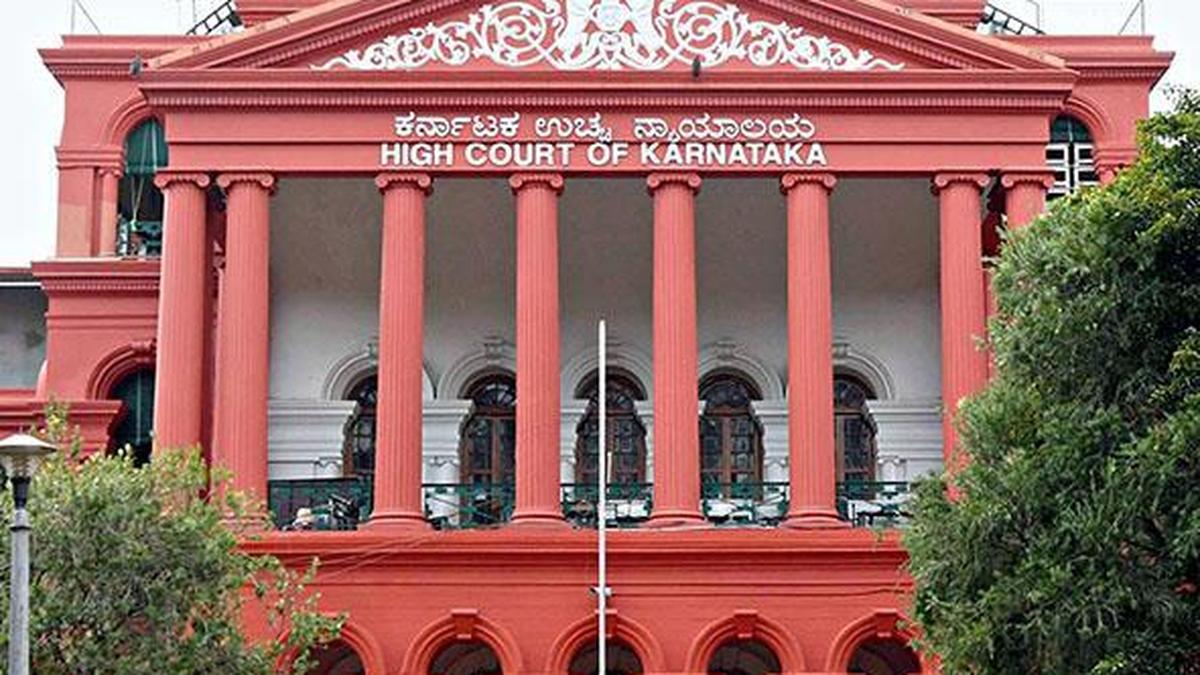
A view of the High Court of Karnataka. | Photo Credit: File photo The High Court of Karnataka on Tuesday deferred further hearing on a PIL challenging the State government’s recent decision to allow only the first two stanzas of the National Song, Vande Mataram, to be sung at official functions, in view of a pending Supreme Court case on norms requiring the singing of all six stanzas of the song and treating obstruction of its rendition as a punishable offence.A Division Bench comprising Justice Anu Sivaraman and Justice T.P. Vivekananda adjourned the hearing on the petition filed by city-based advocate Girish Bharadwaj by three weeks after a preliminary hearing on the issues raised in the petition and the initial responses of the State and the Centre.The petitioner has challenged the notification issued on September 8 by the Department of Personnel and Administrative Reforms restricting the singing of only the first two stanzas at State government programmes, except those attended by the President, Vice-President, Prime Minister or Governor.The primary argument of the petitioner is that the State lacks the legislative or executive power to prescribe the content of a national symbol or song, as the subject falls within the exclusive domain of the Union government.‘Informal Cabinet discussion’Interestingly, petitioner’s counsel Angad Kamath pointed out that no department had submitted a “note” for discussion on Vande Mataram, which was Item No. 37 on the agenda of the Cabinet meeting held on September 3.The Cabinet decision on the song was taken suo motu under the heading “informal discussion”, without any formal Cabinet note or legal consultation, Mr. Kamath argued, pointing out that all the other 36 items had been placed before the Cabinet through formal notes submitted by the respective departments. Hence, the decision taken through an “informal discussion” could not be construed as a Cabinet decision within the meaning of the Karnataka Government (Transaction of Business) Rules, 1977, it was argued on behalf of the petitioner. The petition also argued that the September 8 notification contained an internal contradiction, as it claimed to ensure “uniformity, dignity and due observance of appropriate protocol” while creating a State-specific variation by restricting the rendition to only two stanzas. State’s claimMeanwhile, Advocate General K. Shashi Kiran Shetty said that the Centre itself had informed the Supreme Court and the High Court earlier this year that singing the National Song is “not mandatory”. He also pointed out that the apex court is hearing a fresh plea challenging the penal provisions relating to insulting the National Song and other related issues, and has granted the Centre two weeks to respond.The petitioner’s counsel clarified that the plea does not seek to compel any individual to sing the song, in view of the Supreme Court’s ruling in Bijoe Emmanuel v. State of Kerala, but challenges the State’s practice of playing a truncated version of the song at official functions.Centre’s standAdditional Solicitor General of India K. Arvind Kamath supported the petitioner, stating that the Centre’s order on the National Song lays down clear norms on when it must be sung and when it is optional. However, whenever it is sung, it must be rendered in its official version containing all six stanzas, the ASG told the court. Published - September 22, 2026 07:53 pm IST
Karnataka High Court defers hearing on plea against State’s decision for singing only two stanzas of Vande Mataram
Full Article
Original Source
Read the full article at Thehindu →KhanList aggregates and links to publicly available news content. We do not host full articles from third-party sources. Always verify important information with original sources.