
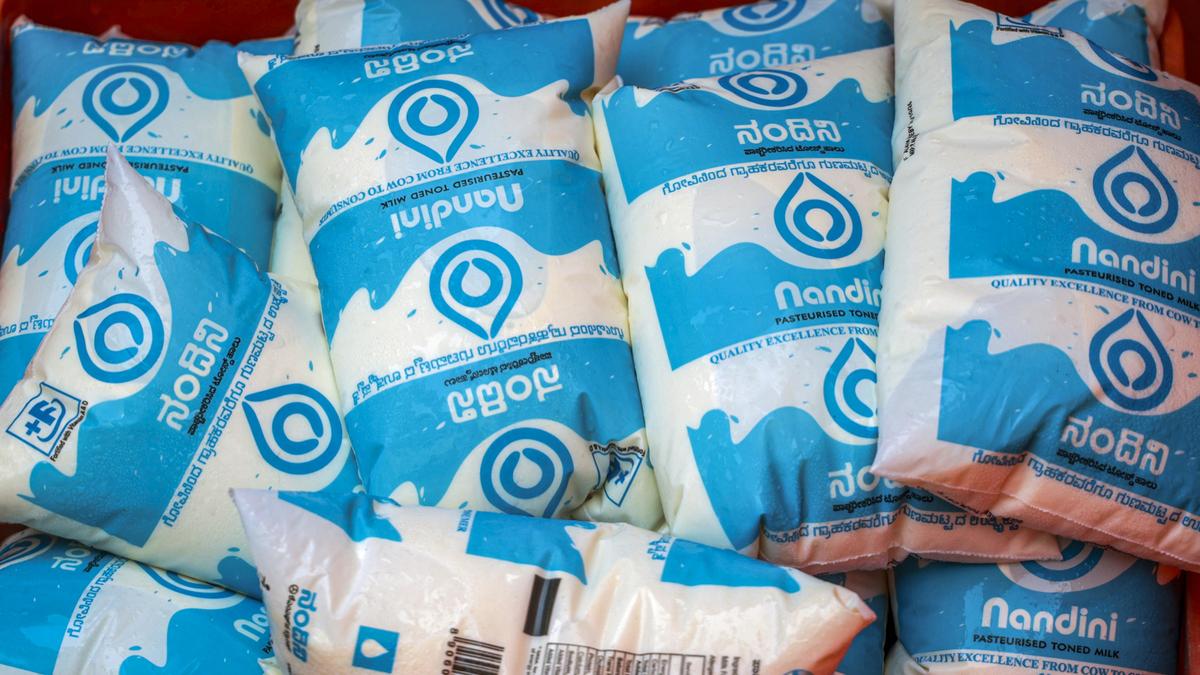
While approving the government’s milk price hike to support farmers, farmer groups have urged the government to determine the overall cost of producing milk and have requested that a fair purchase price be fixed according to the Swaminathan Commission’s C2+50% principle. | Photo Credit: File Photo Following the recent hike in the prices of milk, curd and their by-products, farmers put forward a series of demands to the State government and the Karnataka Milk Federation (KMF). These included action against hotels for disproportionately increasing the prices of tea, coffee and other food items.They also demanded that milk and curd be included in the food security basket for distribution to children at anganwadis, KMF’s financial position be strengthened, and the federation be run along the lines of the Amul model with minimal political interference.Badagalapur Nagendra, president, Bengaluru, Karnataka Rajya Raitha Sangha, said, “Investment should be increased in the collection of milk, refrigeration, processing and value addition. Our State farmers involved in animal husbandry and farming have the potential to provide more than one crore litres of milk, and the KMF must work towards utilising this potential. However, this can happen only when the system is strengthened financially and is free from political interference — as in the Amul model. Fair elections must be conducted in the KMF so that elected candidates don’t have vested interests.”He added, “The Amul model is stronger when it comes to marketing strategy, building infrastructure and marking its presence in other States so that it benefits their farmer community.”Besides this, the farmers also demanded that the State government improve animal health, vaccination, artificial insemination and breed improvement facilities at the village level, as a majority of the farmers involved in dairy farming were in rural areas. “Improving all these facilities at the village level will lead to an increase in the milk yield. Similar to insurance for crop failure, appropriate insurance should be provided for cows and buffaloes.”Highlighting the drought conditions in the State and the shortage of fodder, he said, “At present, cattle feed is provided by the KMF, but the quality should be enhanced, and it must be provided at an affordable price. Local fodder production should be encouraged by providing high-yielding seeds at the gram panchayat level to farmers, especially during droughts. A system should be developed to use maize, which is produced in large quantities in Karnataka, for animal feed at low prices.”Include milk in food basketMeanwhile, T.N. Prakash Kammarady, professor of Agricultural Economics, University of Agricultural Sciences, Bengaluru (UAS-B), emphasised that the government has to provide milk and curd to children in anganwadis. He said, “Along with cereals, milk and curd should be made part of the nutritious food basket under the National Food Security Act. These should be provided by local cooperative milk unions through midday meals, especially at anganwadis to support women and child nutrition programmes.”Mr. Kammarady urged the government to crack down on hotels for disproportionately increasing the prices of tea and coffee. “With one litre of milk, around 20 cups of coffee and tea can be made, whether at home or in hotels. They will add sufficient water to it also. However, increasing the prices from ₹20 to ₹30 per cup is not justified. It is a daylight loot of customers, just because they will come for a sip of tea or coffee. The government should crack down and regulate the prices of food items in hotels that are being increased in the name of the price hike,” he said. MSP for milkWhile approving the government’s milk price hike to support farmers, farmer groups have urged the government to determine the overall cost of producing milk and have requested that a fair purchase price be fixed according to the Swaminathan Commission’s C2+50% principle. This principle is a methodology to determine the Minimum Support Price (MSP) for agricultural crops, under which the MSP is set at a minimum of a 50% profit margin over the comprehensive cost of production.Import protectionMr. Nagendra also urged the State government to work with the Centre to restrict imports of foreign dairy products and protect domestic farmers, particularly in view of the recent trade agreements with the U.S., the European Union and New Zealand. Citing the subsidies and support extended to dairy farmers in these countries, he stressed the need for safeguards to protect Karnataka’s dairy farmers and cooperatives such as the KMF from possible import liberalisation. Published - November 07, 2026 07:19 pm IST
Karnataka dairy farmers seek KMF reforms based on Amul model, more investment in milk procurement
Full Article
Original Source
Read the full article at Thehindu →KhanList aggregates and links to publicly available news content. We do not host full articles from third-party sources. Always verify important information with original sources.