
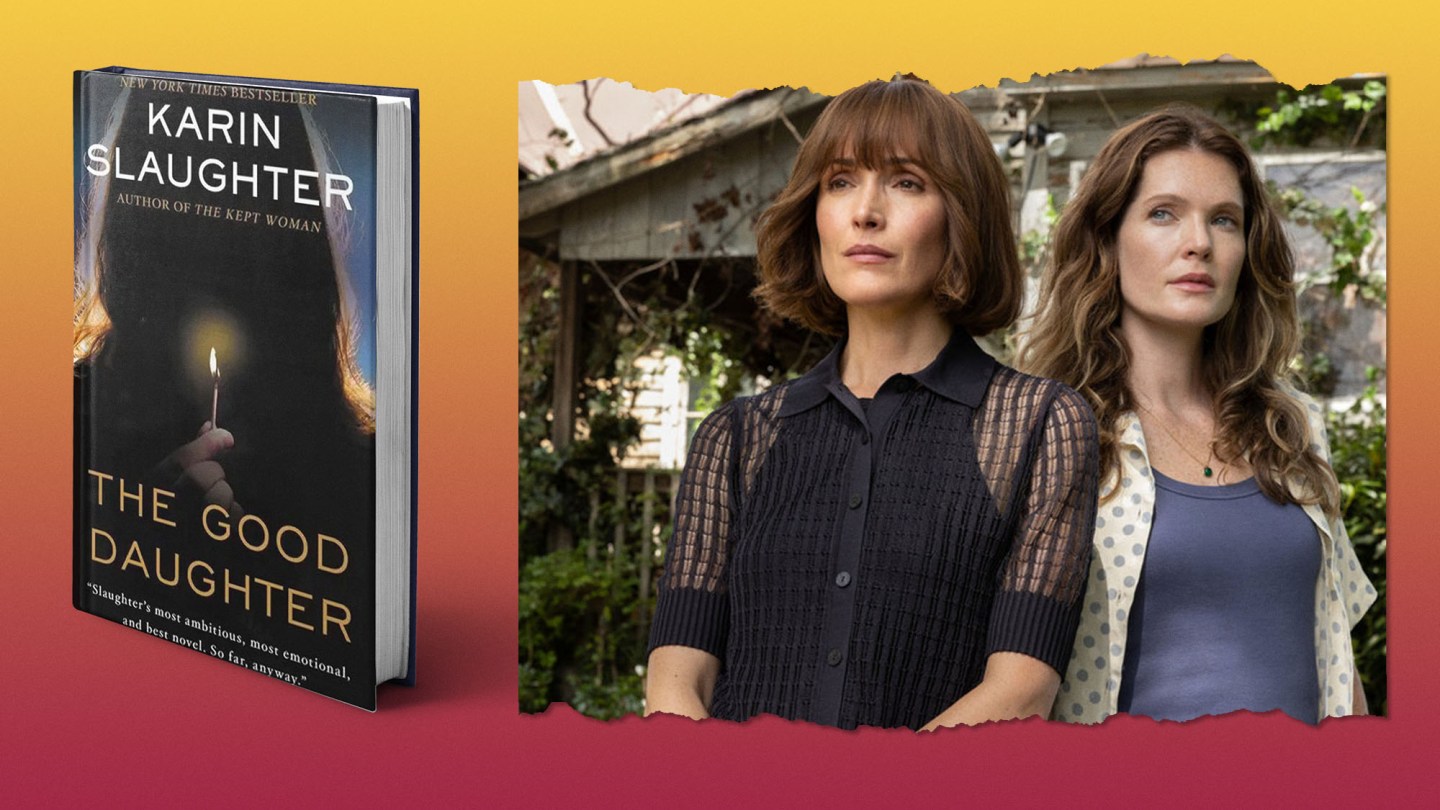
Logo text Some stories refuse to stay on the page. The Hollywood Reporter’s Beyond the Book column explores what happens when books make the leap to screen and beyond — unpacking what stayed, changed, how it was done and why it matters with the creatives who made it. *** Karin Slaughter never planned to adapt The Good Daughter. When producer Bruna Papandrea asked whether she’d be interested in bringing one of her novels to the screen herself, the author’s answer was immediate. “I said, ‘Absolutely not,’” Slaughter tells The Hollywood Reporter. “I don’t have time.” She’d already watched two of her books become hits in other hands: Netflix’s Pieces of Her, adapted by Charlotte Stoudt, and ABC’s Will Trent, run by Liz Heldens. Though she declined, Slaughter couldn‘t move on, and the idea that she might do it herself stuck. So she started writing the scripts, and she told no one. “I wrote them completely on my own because I didn’t want to tell anybody if I’d done a bad job,” she tells THR. When she finally told her agent, she made one request: Don’t tell Papandrea — or anyone for that matter — yet. “Because she’d want an option. I just wanted to do this in secret.” The secrecy also gave her time to take on the creative challenge. “I know from my novel writing that the beginning of a story is important, but just as important is the end,” she says. “People can read a book they think is mediocre, and that’s fine. But if it starts out really great and craps out at the end, they’re furious. So I wanted to make sure I could land the plane.” With the scripts done, Slaughter went back to Papandrea. “I said to Bruna, ‘This is the show. If you’re interested, that’s great. If not, obviously I’ll take notes, but I haven’t wasted your time and money on an option.’ She read it overnight and said, ‘Let’s go, let’s do this.’” The result is The Good Daughter, Peacock’s six-episode adaptation of Slaughter’s 2017 bestseller, which drops on the streamer in full on Nov. 12. Slaughter is the sole writer on every episode and serves as showrunner and executive producer. The series stars Rose Byrne and Meghann Fahy as Samantha and Charlotte Quinn, sisters still living with the aftermath of a single event of violence during their childhood, with Brendan Gleeson as their father, Rusty. The cast also includes Shayna Benardo, Olivia Williams, Harper Steele, Jake McDorman and Michael Dorman. Made Up Stories, Papandrea’s banner, produces with Fifth Season. When the team took the project to streamers, Peacock “just got it,” Slaughter says. “They had thoughtful questions, and they seemed like people who would be good partners.” Though an author taking on the showrunner role for the first time, Slaughter‘s résumé shows why she could afford to skip the usual option-and-develop process. Will Trent was renewed by ABC this spring for a fifth season and had 10 million cross-platform viewers last season, making Slaughter’s catalog one of the more reliable book-to-TV pipelines. The Good Daughter, though, is the first time she’s been in charge of that pipeline herself, and she set ground rules early. Drawing on her long relationship with her book editor, she made a request of the network about notes. “I said, ‘Obviously there are going to be notes, but I need you to speak with one voice,’” she recalls. “You can have all the meetings in the world and discuss it, but I don’t want a note that Kevin from accounting suggested and you don’t agree with.” She also wanted the reasoning behind each note on the table, so she could interrogate it. “I’m not a ‘note behind the note’ person — I want to know the note. So let’s have a conversation so I can figure out what you want, how to do it and how to make sure we’re both happy with the outcome,” she says. As a first-time showrunner, the biggest adjustment, she says, was losing a novelist’s room to explain things. “With a book, I get 500 pages to tell you what people are thinking,” she says. “So it was figuring out how to convey information without making it clunky. I never wanted anything to feel written. As a novelist, dialogue is probably one of my strengths, so it felt natural.” To keep the mystery working and span across six hours, she made clue sheets as her way “to figure out how to make the puzzle work and give all the pieces.” When a note came in on a script, she could show exactly where a detail paid off. “I’d say, ‘We need this piece of information because it pays off in [episode] five or six,’” she says. “After a while, you develop a certain level of trust.” She also kept the season concise. “I learned very quickly that as much plot as a novel has, there’s not enough for eight episodes. I made the decision early on: This is only going to be six episodes, because I’m not going to do a filler episode,” she says. “Pacing is a hallmark of my writing. I wanted you to be emotionally invested and on the edge of your seat. There’s the tension you get from the plot, but this is a story that relies on emotional tension, and I needed those emotions to hit at the right times.” From left: Meghann Fahy as Charlie, Rose Byrne as Sam in The Good Daughter. Mark Hill/PEACOCK She also pushed for Peacock to release every episode at once. “I was scared they’d say no and parcel it out.” The reasoning for the immediate rollout is because Slaughter thought of the series as “a six-hour movie.” That interpretation also shaped the choice of director Steph Green (The Americans), who directs all six episodes. “She understood that it was a movie and not standalone episodes,” Slaughter says. Each installment has its own genre — one is a legal drama, another a family drama then a murder mystery — but Green kept a “symmetry of place, setting and atmosphere” across all of them, Slaughter explains. “I think the first thing I said to her was, ‘I’m so tired of thrillers where everything is dark, even in the daytime. Does anyone have a lamp in this house? I want the bad things to happen in daylight,’” Slaughter says. “That’s what we focused on, and our cinematographer, Zoë White, totally got it.” Slaughter also fought to film in Georgia. “They made us scout in Toronto, and I was such a butt the whole time,” she says laughing. Once the team reached North Georgia, she recalls showing them the red clay — red is a key color in the story — and the kudzu. “Because we’re writing about things that happen to women and girls every single day, we needed to ground this in a naturalistic environment,” she says. A Georgia native herself, Slaughter took the story‘s Southern backdrop seriously. “I was very clear: This is not Southern Gothic. Those words have meaning. This is not grotesque, it is not horror. It’s a story set in the South, but it’s not a Gothic story. Steph put together this beautiful look book, and it felt like a perfect fit because she got what I wanted to do and how I wanted it to look.” The same thinking shaped the score. Composer Jonathan Sanford grew up in Maryland’s Prince George’s County but has family roots in Georgia, and he understood, Slaughter says, “that there’s a way to tell Southern stories that’s just such a trope,” with slide guitar and banjo. “I said, ‘I don’t want to hear any of that. I want a new, crisp Southern musical language developed for this,’” she says. “As a Southerner, it was very important to me to represent the South for what it is, not all these stereotypes.” Slaughter teases that Fahy even sings a track that will be featured on the show‘s soundtrack. “I knew she was a singer — she has a beautiful voice — and from the moment we started shooting I was working on everybody: ‘We’ve got to get Meghann to do something,’” she says. “I think they did it just to shut me up. But she did amazingly well. It’s a beautiful cover.” Fahy and Bryne may star as the leading protagonists, but Jessica Biel was originally attached to star and executive produce the series, which scored a straight-to-series order at Peacock in March 2024. She eventually left the project in September of that year. Slaughter holds no grudge. Biel, instead, went on to star in The Better Sister, based on the novel by Slaughter’s friend and fellow author Alafair Burke. “I loved watching it. What do I have to be angry about?” she says. Slaughter credits Bryne and Fahy for evolving her characters with Byrne’s casting as Sam inspiring a change in the character. “Sam in the book is a lot colder than Sam in the show, and that’s Rose, because she has this natural warmth,” Slaughter says. After watching dailies, she reworked lines to “lean into and support what she was doing.” Fahy’s Charlie called for rewrites, too, particularly in her romance with Ben, played by Dorman. “In the book, Charlie is much more thirsty for Ben — she’s chasing him. Meghann Fahy is not thirsty,” Slaughter says. “So I had to find ways to express that longing for Ben in a way that was believable.” “In the book, Charlie is much more thirsty for Ben — she’s chasing him. Meghann Fahy is not thirsty,” Slaughter says of rewriting the relationship between Michael Dorman’s Ben and Fahy’s Charlie. Mark Hill/PEACOCK And because Fahy handled Slaughter’s Southern rhythms so easily, Slaughter kept writing her more lines. “I’m going to write the hell out of this scene,” she remembers thinking. “It made more work for her.” Slaughter has been candid about using violence in her books to open up a dialogue. With The Good Daughter, she hopes the series grounds the conversation in the fact that violent events happen to “real people” and that “there are real people living their lives after these things happen.” She points to Bryne‘s Sam, who lives with lasting injuries from the shooting she experienced at a young age, including impaired vision and walking with a cane. “I watch a lot of television, and I can’t think of many shows where you see a survivor of gun violence and what their life is like,” she says. “We always hear that horrible statistic — ‘this many people died and this many survived‘ — and we think, ‘Thank God they survived.’ But we don’t think about what that recovery looks like. I wanted to show that.” Byrne, she says, did “so much work with a physical therapist, figuring out how to move in a body like that. She has such physicality, and to distill all of that into this person recovering from a gunshot wound shows the range of her abilities. The fact that she could elevate that performance is remarkable.” From left: Brendan Gleeson as Rusty and Byrne as Sam. Mark Hill/PEACOCK Despite taking on the showrunner title, Slaughter’s work as a novelist never stopped. After finishing the show’s scripts, she went back to work on her most recently published book, We Are All Guilty Here, and noticed the show has already changed how she writes, no longer keeping characters in one place for long stretches. “When I write my Will Trent novels, I can have a whole scene in a car, and it’s a chapter,” she says. “But with Guilty, I was moving people around more.” The reason was a day on the Good Daughter set. “You don’t know guilt until you’ve put Rose Byrne and Meghann Fahy in a car on a trailer in South Georgia, 10,000 degrees in August, and the air-conditioning’s not on,” she says laughing. “I was like, ‘Oh my God, why couldn’t I have set this in an office? Why are they sweating?’” Whether she’ll take another book to the screen herself, Slaughter isn’t saying yet. For now, she’s finishing her next novel and focused on getting viewers to The Good Daughter. “It’s exactly the kind of show I’d love to watch,” she says. “I’m so proud of it!“ *** The Good Daughter is available to stream on Peacock.
Karin Slaughter Said “Absolutely Not” to Adapting Her Novel ‘The Good Daughter.’ Then She Wrote the Whole Series
Full Article
Original Source
Read the full article at Hollywoodreporter →KhanList aggregates and links to publicly available news content. We do not host full articles from third-party sources. Always verify important information with original sources.