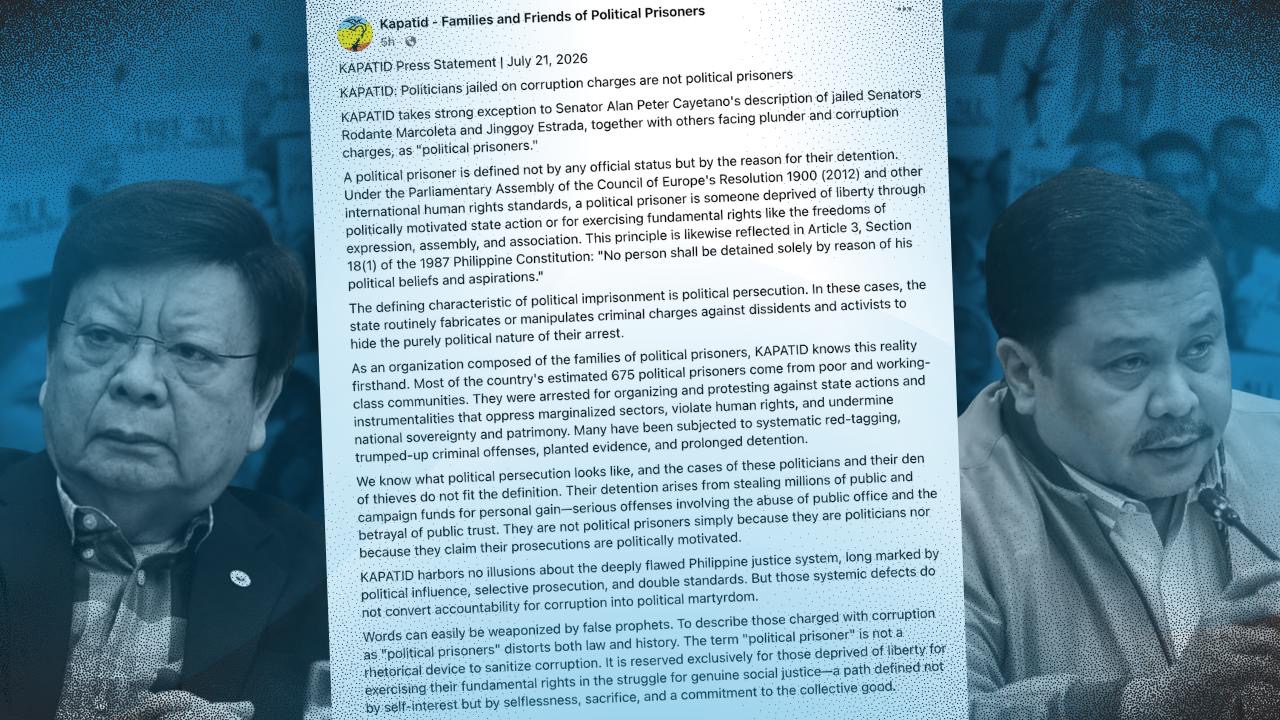
A composite image of the Kapatid statement and Sens. Rodante Marcoleta and Jinggoy Estrada from INQUIRER FILE MANILA, Philippines — A support group for families and friends of political prisoners rejected Sen. Alan Peter Cayetano’s description of jailed politicians Rodante Marcoleta, Jinggoy Estrada and Mike Defensor as “political prisoners,” saying the term cannot be used to “sanitize corruption.” Kapatid spokesperson Fides Lim said political prisoners are detained because of political persecution or for exercising fundamental rights — not merely because they are politicians who claim their prosecution is politically motivated. “A political prisoner is defined not by any official status but by the reason for their detention,” Lim said in a statement Tuesday, July 21. Article continues after this advertisement Over the weekend, Cayetano said in a Facebook Live video that the Department of Justice and the Office of the Ombudsman were being “weaponized” to advance political interests. He also said he believed Marcoleta, Estrada and Defensor would regain their freedom. “I consider Sen. Jinggoy, Sen. Marcoleta, former congressman Mike Defensor, they are political prisoners,” Cayetano said Saturday, July 18. Two days later, during the seventh day of the Senate impeachment proceedings against Vice President Sara Duterte, Cayetano repeated the assertion, saying Marcoleta and Estrada were “political prisoners” and that the Blue Ribbon Committee had been “weaponized.” Lim countered that “the defining characteristic of political imprisonment is political persecution.” “In these cases, the state routinely fabricates or manipulates criminal charges against dissidents and activists to hide the purely political nature of their arrest,” she said. Article continues after this advertisement Lim cited Resolution 1900 (2012) of the Parliamentary Assembly of the Council of Europe and other international human rights standards, under which a political prisoner is someone deprived of liberty through politically motivated state action or for exercising fundamental rights such as freedom of expression, assembly and association. The principle is also reflected in Article III, Section 18(1) of the 1987 Philippine Constitution: “No person shall be detained solely by reason of his political beliefs and aspirations.” Article continues after this advertisement “As an organization composed of the families of political prisoners, Kapatid knows this reality firsthand,” Lim said. She said most of the country’s estimated 675 political prisoners come from poor and working-class communities. Lim said they “were arrested for organizing and protesting against state actions and instrumentalities that oppress marginalized sectors, violate human rights, and undermine national sovereignty and patrimony.” “Many have been subjected to systematic red-tagging, trumped-up criminal offenses, planted evidence, and prolonged detention,” she said. “We know what political persecution looks like, and the cases of these politicians and their den of thieves do not fit the definition,” Lim said. She said their detention arose from allegations of election offenses for receiving and providing undeclared campaign contributions, and collecting illegal kickbacks from government-funded public infrastructure projects. These were serious offenses involving the abuse of public office and betrayal of public trust, she said. READ: Marcoleta, 3 others arrested for plunder Estrada was arrested on plunder and graft charges, while Marcoleta was charged with plunder and violation of Presidential Decree No. 46. Defensor’s case was related to the complaint against Marcoleta, who received millions in campaign donations from him. READ: Jinggoy Estrada to be committed to Payatas jail “They are not political prisoners simply because they are politicians nor because they claim their prosecutions are politically motivated,” Lim said. She said Kapatid harbors no illusions about the “deeply flawed” Philippine justice system, which has long been marked by political influence, selective prosecution and double standards. “Those systemic defects do not convert accountability for corruption into political martyrdom,” she said. “To describe those charged with corruption as ‘political prisoners’ distorts both law and history,” Lim said. She said the term “political prisoner” is not a rhetorical device to sanitize corruption. Your subscription could not be saved. Please try again. Your subscription has been successful. “It is reserved exclusively for those deprived of liberty for exercising their fundamental rights in the struggle for genuine social justice — a path defined not by self-interest but by selflessness, sacrifice, and a commitment to the collective good,” she said. /dm
Kapatid to Cayetano: ‘Political prisoner’ label cannot sanitize corruption
Full Article
Original Source
Read the full article at Newsinfo →KhanList aggregates and links to publicly available news content. We do not host full articles from third-party sources. Always verify important information with original sources.