
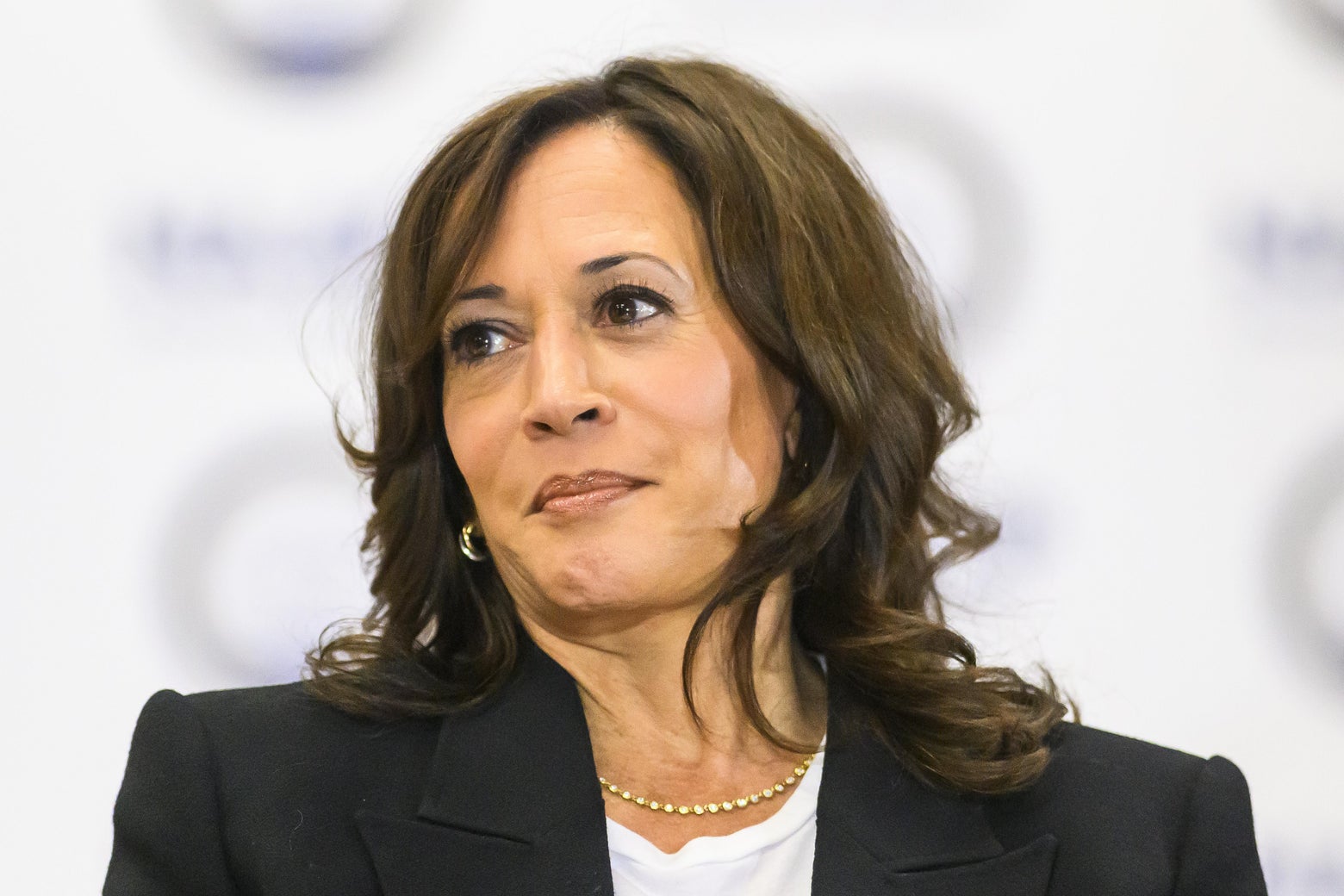
Politics Kamala Harris’ endorsement of Abdul El-Sayed in Michigan is telling. By Enter your email to receive alerts for this author. Sign in or create an account to better manage your email preferences. Unsubscribe from email alerts Are you sure you want to unsubscribe from email alerts for Aymann Ismail? Sept 25, 20265:40 AM Michigan Democratic Senate candidate Abdul El-Sayed and Kamala Harris at a roundtable in Detroit on Tuesday. David Guralnick/Pool/Getty Images Sign up for the Slatest to get the most insightful analysis, criticism, and advice out there, delivered to your inbox daily. As the national political environment for Democrats shifts rapidly, Kamala Harris is teasing another run for president. At Al Sharpton’s National Action Network convention, when a crowd began chanting “Run again!,” Harris smiled. “I might. I am thinking about it,” she said. In recent months, apparently as an early step, Harris reportedly reached out to New York Mayor Zohran Mamdani and others on the Democratic left. She also called someone named James Zogby. Zogby had been a leading voice warning Democrats in 2024 that their support for funding Israel’s war in Gaza would cost them the election. When Axios reported that Harris had privately called Zogby and others to try to mend the rift, he wouldn’t comment at the time. But in a recent interview, he confirmed the call to me—and said he liked what he heard. “We had a long talk,” he said, describing the call as Harris wanting to “correct the historical record” about what happened in 2024 and where her support lies. “I felt very—I felt very good about it. I think she’s a good person.” I met Zogby—the head of the Arab American Institute and, at 80, a seasoned Arab activist—two years ago at the Democratic National Convention in Chicago. He was trying to convince a band of activists and around 30 delegates of the Uncommitted National Movement, representing some 700,000 voters opposed to the war, that the Democratic Party might actually be listening to them. For the first time in the party’s history, he noted then, the DNC had officially sanctioned a panel on Palestinian human rights. Dr. Tanya Haj-Hassan, a pediatric intensive care physician who had volunteered in Gaza, described the horrific scenes she witnessed. Hala Hijazi, a longtime Democratic organizer, talked about relatives she had lost. Layla Elabed, one of the co-founders of the “uncommitted movement,” sat on the panel alongside Zogby, who had been having versions of this fight inside the Democratic Party for almost four decades. “We’ve come a long way,” he told the crowd, explaining what it meant that the conversation was happening at all. “It is something I do not want to dismiss for a minute as to how significant this is, about what message the Harris campaign is sending by saying, ‘We want to talk about this and hear you talk about it.’ ” At the time, that did not sound entirely naive. Joe Biden had dropped out of the race less than a month earlier. Harris had taken over the campaign, and people in the uncommitted movement were cautiously hopeful that that might mean a change in policy. Harris and her campaign had recently spoken privately with uncommitted organizers Elabed and Abbas Alawieh in Michigan. And behind the scenes, conversations continued over a particularly modest request: Let a Palestinian American be one of the 236 speakers to address the convention from the main stage. They had spent months being told some version of the same thing: Donald Trump would be catastrophically worse for Palestinians, and therefore anything that endangered Harris was irresponsible. But they pressed ahead. “The people are with us on this,” Alawieh told me at the convention. Change became harder to see as the week went on. The conversations behind the scenes at the convention culminated in Harris’ final answer for their request: no. There would be no Palestinian speaker. Protests broke out. In her address to the convention, Harris did describe the suffering in Gaza as “devastating” and said Palestinians deserved “dignity, security, freedom, and self-determination.” That part received intense applause. It wasn’t enough. Harris lost Michigan to Trump by under 100,000 votes and lost the election. Trump returned to the White House. The activists I spoke to argued that Harris lost because she didn’t heed their warnings, though there was ultimately a lot that went wrong. Since 2024, Democratic voters have moved substantially further away from Israel. Candidates attacking unconditional support for the Israeli government have won Democratic primaries. More than 100 House Democrats recently voted to eliminate billions in military assistance to Israel. And several of the people who spent the 2024 convention trying to convince Democrats that they were attempting to save the party, not sabotage it, have spent the intervening years burrowing further into Democratic politics. Zogby told me he is still angry about what happened in 2024 but doesn’t squarely blame it on Harris’ position on Gaza. He mostly thinks the campaign failed by overrelying on political consultants and pollsters. He said he had reason to believe that Harris’ own instincts might have led somewhere different in that election but that she never had enough control over her own campaign to follow them. He had spoken with her earlier in the war, before she became the nominee, and told her to give a speech acknowledging what Palestinians were enduring and offering some recognition of their rights and their future. She told him she was already scheduled to speak that night. “Perfect. Do it. Work it in,” Zogby recalled telling her. When she told him the teleprompters were already prepared, he advised her to go off script. “Bill Clinton’s best lines were off script,” he said, laughing, as he recalled the conversation. The next day, he said, someone from her staff sent him a clip of Harris speaking about Palestinian rights. Gaza, Zogby predicts, will play an outsized role in the upcoming election. “It’ll be a litmus test for ‘Are you ready for primetime or not?’ ” he said. “And not just ready for primetime in terms of the Middle East, but are you willing to stand up for a principled approach to foreign policy? Are you going to continue to mouth the nonsense that has gotten us into this hole and has discredited the Democratic Party in the eyes of its base for not being able to take a principled position not just on Gaza, but on so many other issues? “We’re wimps,” Zogby said. “And one of the ways you show you’re not a wimp is Gaza, because that was the key way you became a wimp.” Leaders of the 2024 uncommitted movement are also watching these developments carefully. Elabed was among the Democratic activists organizing locally, then nationally. She and Alawieh briefly met Harris at a campaign stop near Detroit before the convention. Two years later, Elabed still remembers the encounter more favorably than someone hearing her criticisms of Harris might expect. “I always tell people, even to this day, when I spoke with her and I spoke about what my community was experiencing, what I personally was experiencing as a Palestinian American that had family in Palestine, her sympathy and empathy toward me and my community did feel really genuine,” she told me. “And I think that she was at that moment interested in talking more about the impact of U.S. funding to Israel on everyday people living here in Michigan and across the country, and what that meant for our families back home.” Harris later wrote in her memoir 107 Days that she told Biden that his public comments about innocent Gazans could come across as “inadequate and forced.” She also wrote that activists threatening to withhold their votes had felt “reckless” to her. I asked Elabed if she felt that line was directed at her. “I wish that her memoir was a little bit more telling,” she said. “I always wondered throughout her campaign why she would not deviate from Biden. Not just on the genocide, but, like, on any policy.” Elabed told me that if Harris runs again, “I would hope that she would be able to run genuinely and authentically as herself, by herself.” Headed into 2028, Congress is beginning to reflect the movement among Democratic voters. In July, Rep. Thomas Massie, a Kentucky Republican who opposes foreign aid, prompted a House vote on eliminating $3.3 billion in annual assistance to Israel. The amendment failed 314–104. But 103 of the 104 votes to cut the aid came from Democrats—nearly half the caucus. That would have been unthinkable a decade ago. The activist infrastructure has changed too. Alawieh, one of the people who spent the 2024 convention pressing Democrats for a Palestinian speaker, recently won the Democratic nomination for a Michigan state Senate seat. (Alawieh also got a call from Harris.) Abdul El-Sayed and other candidates running on staunch anti-war and economic-populist politics have won high-profile Democratic contests. The people who were standing outside the convention two years ago aren’t waiting outside anymore. In a further sign of the times, this week, Harris endorsed El-Sayed and was stumping for him in Michigan. Near the end of our conversation, I asked Zogby the question that hangs over Harris now. Given everything that happened, after what he heard on the call, did she really overcome 2024 and become the kind of candidate Democrats like him can support? “I think she could,” Zogby said. “I do. I do, I do. I think she deserves the chance to do it. And I hope she takes advantage of that chance and does it.” Democrats Donald Trump Israel Palestine Kamala Harris Michigan 2024 Campaign 2026 Midterms
Kamala Harris Is Quietly Reaching Out to the Voters She Thought She Didn’t Need in 2024. They’re Listening—Carefully.
Full Article
Original Source
Read the full article at Slate →KhanList aggregates and links to publicly available news content. We do not host full articles from third-party sources. Always verify important information with original sources.