
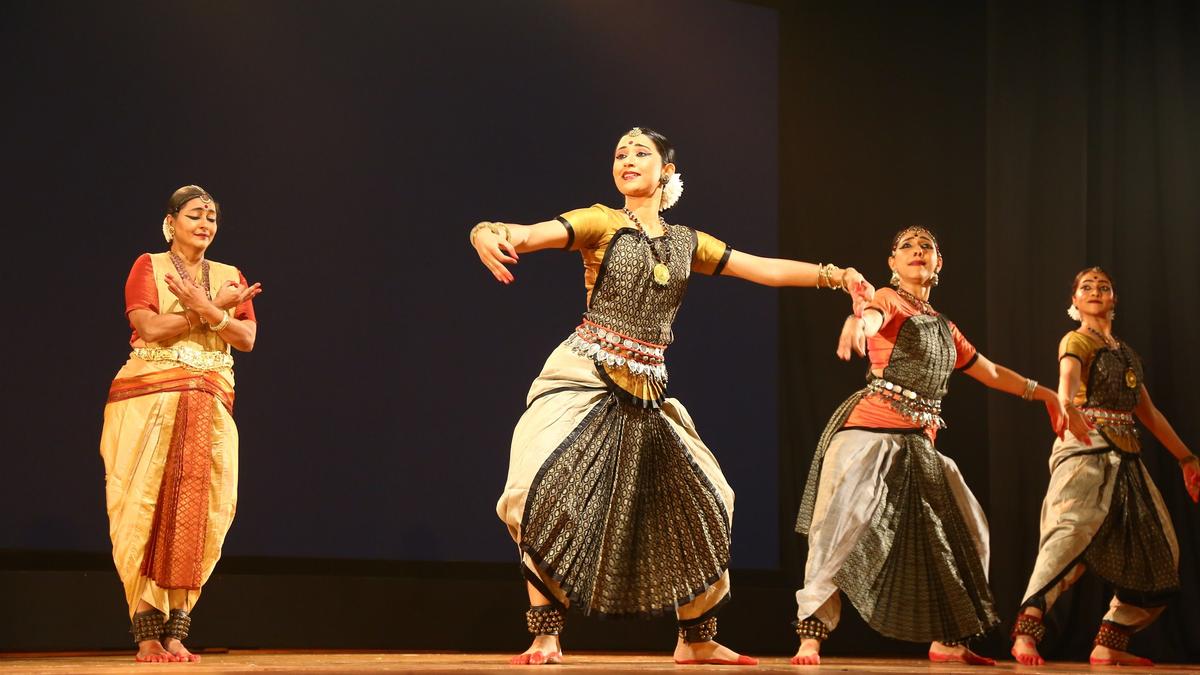
Jayanti Subramaniam’s ‘Jyotirgamaya’ is based on Richard Bach’s novella Jonathan Livingston Seagull. | Photo Credit: Special Arrangement About five decades ago, classical dance forms transitioned from temples and royal courts to the concert stage. Pioneers such as Rukmini Devi Arundale and Guru Kelucharan Mohapatra were instrumental in this change. As classical dance gained popularity, artistes sought themes and narratives to resonate with evolving audience sensibilities. At the same time, it was also important to retain the purity of the classical style. So, dancers began to delve deeply into religious texts to bring lesser-known aspects of Indian philosophy to life through dance dramas. However, some leading dancers adopted modern, long-form novels for their productions with an aim to reach modern audiences.One such interesting production was ‘Jyotirgamaya’, an adaptation of Richard Bach’s allegorical novella, Jonathan Livingston Seagull, presented recently at The Music Academy as part of the Provoke Art Festival 2026.Choreographed and produced by Jayanthi Subramaniam, with music composed by Rajkumar Bharati, it captured the concept of guru-sishya parampara and the deep bond between a teacher and a disciple. It also highlighted how sustained practice leads to perfection, while reflecting on the higher virtues of life including love, forgiveness and compassion. It further explored the freedom to pursue one’s aspirations breaking free from limitations of the body and mind.Jonathan Livingston Seagull is the story of a seagull who believed that life has a larger purpose than the daily struggle for food. Driven by a passion to fly great heights, Jonathan constantly experiments with new ways, each time striving to reach greater levels. Yet, Jonathan is cast out of the gull society due to his failure to adhere to the established tradition of the seagull society. Jonathan feels depressed because the other gulls refuse to believe that there is more to life than the mundane pursuit of food.Against this backdrop, the performance commenced with a joyful, vibrant musical passage that gradually rose to a crescendo. Sumithra Subramaniam, as Jonathan Livingston Seagull, and the dancers depicting the group of seagulls. | Photo Credit: Special Arrangement In the opening scene, the dancers established the setting by tracing the course of a river as it flowed from the mountains, through valleys and plains, before merging with the ocean. This was followed by a lively depiction of a group of fishermen setting out to sea and gulls flocking around to fight over scraps of fish. Performed with gusto to a vibrant tune in Thodi raga, the scene was particularly engaging. The hastamudras and neck movements vividly recreated the image of birds flying back and forth in search of food.In the following scene, Sumithra Subramaniam, portrayed the Seagull’s sustained practice. His initial movements were grounded, much like a dancer beginning with the thattu adavu. Gradually, these slowly progressed into leaps and circular brahmaris. The gati bedam and the different types of tanams used in the music were able to capture the variations in Jonathan’s movement. The Hamsadhwani segment traced Jonathan’s steady progress in speed. The range of emotions that the gull might have experienced during this journey was conveyed with clarity.Next, the narrative shifted to the flock, which admonishes Jonathan for daring to be different, and eventually banishes him from the gull society. Here, red colour was used effectively in the costume to evoke rowdra. The subtle and muted shades enhanced the visual appeal.Undeterred by the admonishment, Jonathan continues his quest for flight and encounters two luminous gulls (S. Aparajitha and Shruthi Vidyashankar) who lead him to the Elder Gull (Jayanthi Subramaniam). The Elder Gull imparts Jonathan the highest truths of life and flight. The final sequence depicted Jonathan returning to teach his flock. Presented as a thillana, the finale culminated with the chanting of the Pavamana Mantra ‘Asato Ma Sadgamaya’ from the Brihadaranyaka Upanishad.Through out the production, the music seamlessly intertwined with the movements of the dancers. Rajkumar Bharathi’s soulful rendition, with Nandini Anand lending vocal support, enhanced the aural appeal. The orchestra also included Jayanthi Subramaniam (nattuvangam), V. Veda Krishnan (mridangam), S. Ganapathy (tabla), Embar Kannan (violin), Vishnu Vijay (flute), T. Bhavani Prasad (veena) and Kishore Kumar (sitar). The jathis were composed by Prof. C.V. Chandrashekar. The voice-over by Govind Venkateshwar seamlessly tied the scenes together. The music was recorded and mixed by Sai Shravanam. The LED projections (paintings by Sumithra Subramaniam, and animations for LED by Team Provoke), and lighting (V. G. Jayant) captured the mood of the scenes. Published - November 10, 2026 12:15 pm IST
Jyotirgamaya: A Seagull’s quest for freedom portrayed through Bharatanatyam
Full Article
Original Source
Read the full article at Thehindu →KhanList aggregates and links to publicly available news content. We do not host full articles from third-party sources. Always verify important information with original sources.