
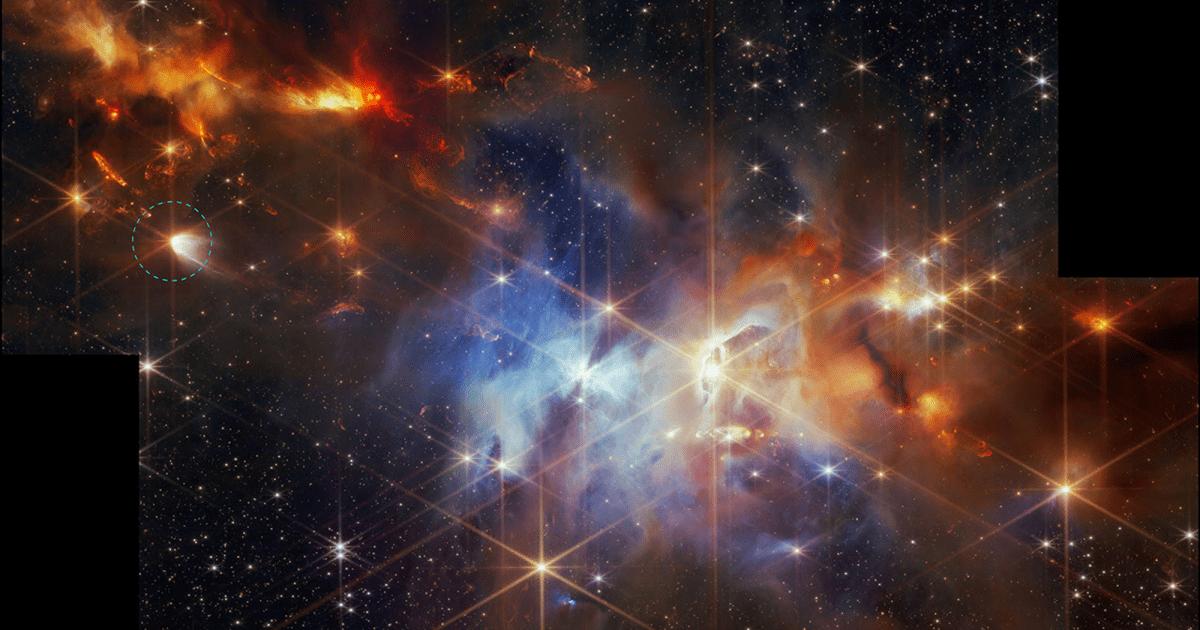
New observations from the James Webb Space Telescope reveal how silicate crystals forged in heat could inhabit ice-cold comets. | Published: August 25, 2026 The protostar EC 53 (circled) in Serpens shows one set of winds and scattered light emanating from its protoplanetary disk. (The disk itself is too small and shrouded in dust to appear.) Astronomers using JWST found where the object creates crystalline silicates and how it transports them outward. Credit: NASA, ESA, CSA, STScI, Klaus Pontoppidan (NASA-JPL), Joel Green (STScI) The protostar EC 53 (circled) in Serpens shows one set of winds and scattered light emanating from its protoplanetary disk. (The disk itself is too small and shrouded in dust to appear.) Astronomers using JWST found where the object creates crystalline silicates and how it transports them outward. Credit: NASA, ESA, CSA, STScI, Klaus Pontoppidan (NASA-JPL), Joel Green (STScI) Astronomers have a problem. The comets in our solar system formed some 4.5 billion years ago in its frigid outer regions, beyond the current orbit of Jupiter. These “dirty snowballs” naturally contain lots of ices, but they also hold a surprising amount of rock. Key components of this rocky material are crystalline silicates such as forsterite and enstatite. And that creates a conundrum: It takes a lot of heat to forge these crystals. They can’t develop at temperatures below about 1,160 degrees Fahrenheit (900 kelvins), far hotter than the bitter cold of the outer solar system. Astronomers have spent decades trying to figure out where the crystals came from and how comets got hold of them. New observations from the James Webb Space Telescope (JWST) seem to show the path. A unique protostar Scientists chose to investigate the proto-star EC 53. The object resides in the Serpens Nebula, a star-forming region only 1,300 light-years from Earth. Its proximity gives astronomers a close-up view of star birth, from youthful proto-stars still wrapped in their swaddling clothes to objects well on their way to stardom. Because most of these protostars are destined to mature into bodies no larger than the Sun, they make good analogues to our early solar system. A protostar grows by drawing matter from the gas cloud surrounding it. The shrinking cloud has to spin faster to conserve angular momentum, like an ice skater pulling in their arms, so the material can’t rain directly onto the protostar. Instead, it forms an accretion disk that allows gas to flow onto the nascent sun the way water circles a drain. The outer part of the disk is where planets typically form. Previous studies have shown that protostars typically nibble on their accretion disks (quiescent phase), but also rarely settle down for a hearty meal (outburst phase). EC 53 stands apart because it’s the only protostar known that undergoes periodic outbursts and shines brightly enough to observe throughout its cycle. About every 18 months, EC 53 experiences a 100-day-long outburst that sees it grow 3.3 times brighter. Jeong-Eun Lee of Seoul National University in South Korea led a team that used JWST’s Mid-Infrared Instrument to take the spectral fingerprint of EC 73 in its quiescent phase (on Oct. 5, 2023) and during outburst (on May 10, 2024). The researchers discovered both forsterite and enstatite being forged in the hot inner part of the protostar’s disk during outburst. In our solar system, this region would coincide with the area between the Sun and Earth. Cosmic superhighway The observations also revealed a high-velocity jet of hot gas enclosed within a slower molecular outflow. The team reported its findings online in Nature on Jan. 21, 2026. “EC 53’s layered outflows may lift up these newly formed crystalline silicates and transfer them outward, like they’re on a cosmic highway,” said Lee in a press release. “Our research team mapped how the crystals move throughout the system,” adds co-author Joel Green of the Space Telescope Science Institute in Baltimore. “We’ve effectively shown how the star creates and distributes these superfine particles.” And in the process, revealed how the icy comets in our solar system likely gained their heat-forged crystals. Contributing Editor Richard Talcott wrote about JWST’s observations of the earliest supernova in the June issue.
JWST shows astronomers how to make a comet
Full Article
Original Source
Read the full article at Astronomy →KhanList aggregates and links to publicly available news content. We do not host full articles from third-party sources. Always verify important information with original sources.