
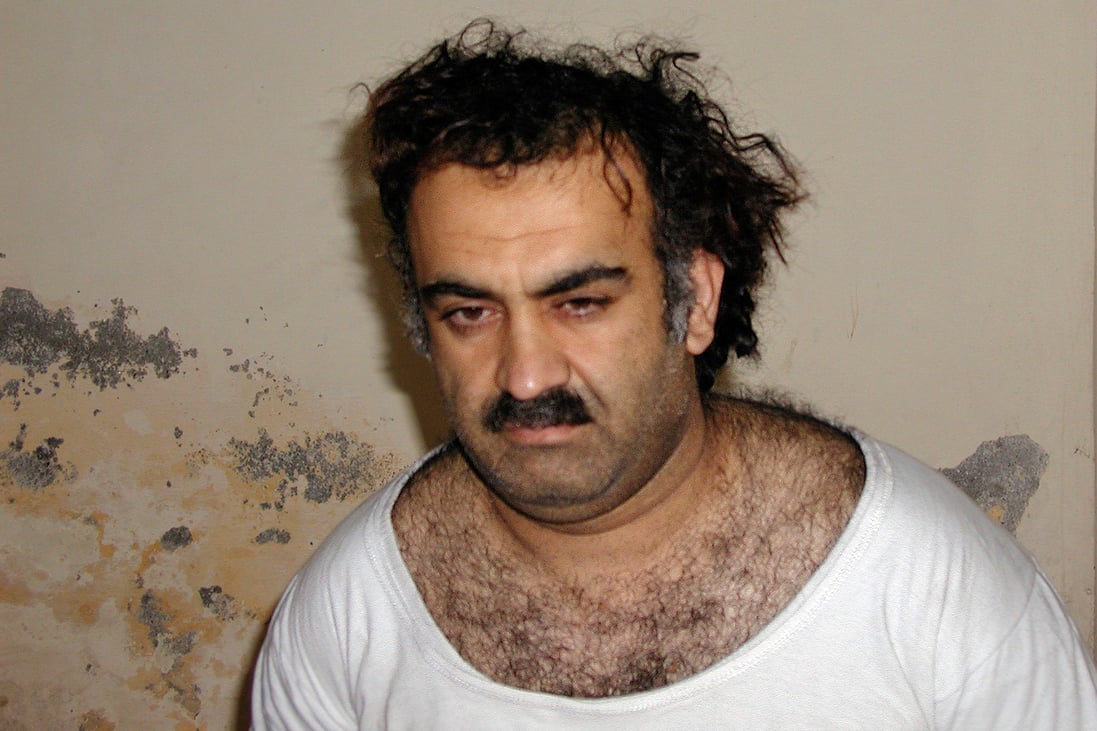
(CN) — The Supreme Court declined Monday to weigh in on the disposal of controversial plea agreements that could have provided closure to the long-delayed death penalty trial against two perpetrators of the 9/11 attacks.Khalid Sheikh Mohammed, the man accused of plotting the attacks, and one of his co-conspirators, Mustafa al Hawsawi, sought to enter guilty pleas under a deal that would have spared them the death penalty.Almost two decades into their prosecution and captivity in Guantanamo Bay, the plea agreements were viewed by victims, the defendants and prosecutors as a way to bring closure to the case after it was derailed by the government’s now-infamous torture program.But former Secretary of Defense Lloyd Austin tried to withdraw the agreements; the D.C. Circuit overturned two military courts that found the withdrawal unlawful.The justices did not explain their reasoning for denying the petition but noted Justice Brett Kavanaugh, a Donald Trump appointee, took no part in the decision.The government opposed the Supreme Court’s review, arguing the D.C. Circuit ensured that political appointees get to decide whether Mohammed and al Hawsawi should face the death penalty.Mohammed, also known as KSM, was named the principal architect of the Sept. 11 attacks in a 2004 report by the 9/11 Commission. He and al Hawsawi were detained in 2003 and held in secret CIA prisons, where they were tortured, until being transferred to Guantanamo Bay in 2006.Prosecutors aren’t able to use confessions obtained during the CIA interrogations because the government used torture — including 183 rounds of waterboarding. During subsequent interrogations in 2007 at Guantanamo, Mohammed also confessed to his role in the attacks.But earlier this year, a military judge also ruled the 2007 confessions — described as crucial evidence in the government’s case — couldn’t be used against Mohammed at trial. The blow to prosecutors’ case could further delay a potential trial, scheduled for June 2028.Several Sept. 11 victim groups filed an amicus brief in support of Mohammed and al Hawsawi’s appeal. The victims argued the plea agreements, while imperfect, were a crucial step in holding the men responsible. They argued the D.C. Circuit’s ruling deprived them of closure.Mohammed and al Hawsawi’s attorney could not immediately be reached for comment.Sotomayor questions Chicago impoundment schemeIn a separate denial, Justice Sonia Sotomayor wrote that a challenge to Chicago’s ability to seize a vehicle over as few as two unpaid parking tickets needs further litigation.Justice Neil Gorsuch, a Donald Trump appointee, joined her statement.Sotomayor noted lower courts are divided over how far police can go in taking property without providing just compensation under the Constitution.The Seventh Circuit upheld Chicago’s vehicle forfeiture scheme as consistent with the Fifth Amendment’s takings clause. The federal appeals court reasoned it is “an exercise of the city’s police power to enforce its traffic code.”Sotomayor wrote: “I have serious concerns about that conclusion, which implicates a circuit split over whether, and under what circumstances, exercises of the state’s police power are immune to takings claims. Because that split would continue to benefit from further percolation, however, and because this case is not the best vehicle to resolve the split, I concur in the court’s denial of certiorari.”Ryan O’Donnell and Michael Goree sued after the city impounded their vehicles.O’Donnell said in his complaint he got two tickets for an expired meter and one for time-restricted parking, totaling about $524. When he couldn’t pay, the city impounded and sold his vehicle.The city also took Goree’s vehicle and added tow and storage fees, even though he didn’t have outstanding fines. A co-signer on his vehicle faced about $560 in ticket debt from a different vehicle.The city sold O’Donnell’s vehicle for its scrap value of $273 and gave Goree’s vehicle to the lienholder.Neither petitioner received any compensation.Meanwhile, Chicago generates roughly $264 million in traffic-ticket revenue and leads the nation in Chapter 13 bankruptcy filings, prompted in part by parking, traffic and vehicle compliance tickets.“The result is devastating and counterproductive,” O’Donnell and Goree wrote in their petition. “The owner loses a car — usually their most important asset and only way to get to work, school, worship, etc. — and is left saddled not only with the existing ticket debt, but also new towing and storage fees. Often, drivers are left to pay off car loans on vehicles they no longer own.”The Seventh Circuit rejected their argument that Chicago’s scheme is like the tax-forfeiture statute the high court invalidated in Tyler v. Hennepin County, for failure to return any surplus to the homeowner after a tax sale.Instead, it compared the case to Bennis v. Michigan, where the justices held the government may seize property used in violation of a law without compensating the owner.However, Sotomayor said the wrong precedent may have been applied: Unlike the laws discussed in Bennis, Chicago does not only impound vehicles involved in violations of its traffic code, such as in Goree’s case.“Those features strongly suggest that ’the purpose of vehicle impoundments’ under Chicago’s scheme ‘is to collect a debt, not enforce public safety laws,’” the Barack Obama appointee wrote. “The city’s practice of surrendering cars to lienholders or selling them for their scrap value, rather than at a fair auction, only amplifies the potential constitutional infirmity.”She encouraged courts to ensure that due deference to state police powers does not eclipse constitutional rights.Subscribe to our free newslettersOur weekly newsletter Closing Arguments offers the latest about ongoing trials, major litigation and rulings in courthouses around the U.S. and the world, while the monthly Under the Lights dishes the legal dirt from Hollywood, sports, Big Tech and the arts.Additional Reads
Justices refuse to take on plea deal for 9/11 perpetrators
Full Article
Original Source
Read the full article at Courthousenews →KhanList aggregates and links to publicly available news content. We do not host full articles from third-party sources. Always verify important information with original sources.