
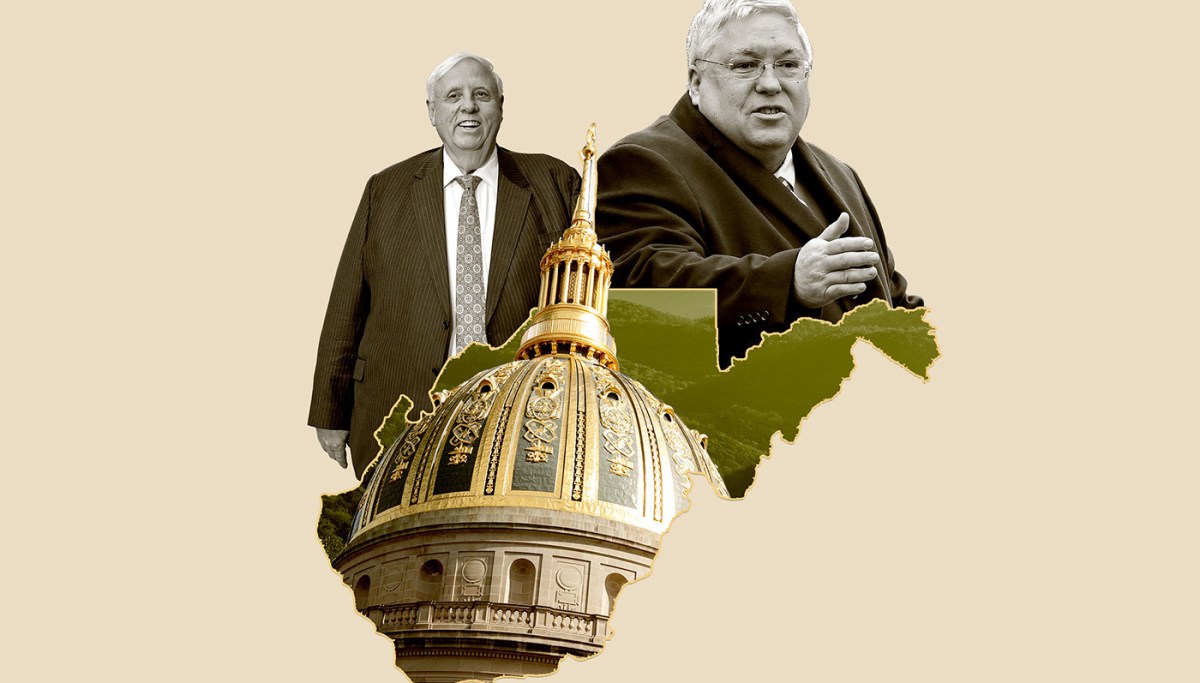
The 1971 John Denver song, an ode to West Virginia, could double as a campaign theme if Sen. Jim Justice (R-WV) attempts a gubernatorial comeback after having previously spent eight years running the Mountain State. Justice’s emerging 2028 GOP gubernatorial campaign theme, to the extent one exists, looks to be a return to his emphasis in previous bids for statewide office on economic development in the impoverished state.It’s a potentially potent message in West Virginia, which, long battered by its rugged geography, has had a tough time luring industry. Still, Justice, in a possible 2028 primary bid against Gov. Patrick Morrisey (R-WV), would have to explain how the state can turn around its historical overreliance on coal mining and tackle worsening health and demographic challenges. After all, West Virginia’s population fell by 3.2% (nearly 60,000 people) between the 2010 and 2020 U.S. Censuses. The population bleed continues, with deaths outpacing births, and young people fleeing the state for job opportunities elsewhere. Per 2025 Census Bureau estimates, West Virginia’s population dropped another 1.5% in the decade’s first half.Sen. Jim Justice (R-WV), left, has not announced a campaign. Gov. Patrick Morrisey (R-WV) says he wants to focus on governing. But the rivalry has already spilled into public view. (Washington Examiner illustration; J. Scott Applewhite/AP; Chris Jackson/AP; getty Images) It makes for a grim demographic backdrop as Justice, a Charleston-born politician, considers his political moves in a state to which he has deep ties. He left the governor’s mansion in January 2025 after winning an open Senate seat. Justice, a seemingly larger-than-life personality (he’s 6-foot-7), who, in better financial days, was West Virginia’s richest man, seemed to be starting a new chapter in his decadelong political career.Now, less than two years later, Justice, 75, is considering trying to nab his hold job.Justice is weighing a GOP primary challenge to Morrisey, who succeeded him and whose growing independence has exposed a public rift between the two men. What began as a disagreement over Justice’s family-owned Greenbrier resort in the Allegheny Mountains has turned into a fight over political legacy, influence, and who gets to define the Republican Party’s future in a state where Democrats have struggled to compete.For now, a 2028 primary remains hypothetical. Justice has not announced a campaign, and Morrisey says he wants to focus on governing. But the rivalry has already spilled into public view, from competing legislative endorsements to sharp criticism over one of the Mountain State’s best-known landmarks.The governor who wouldn’t go away The Greenbrier dispute brought the tensions into sharp relief.The Justice family bought the historic resort in 2009. The 11,000-acre site is famous for its mineral springs, luxury history, celebrity and presidential guests, and a longtime secret Cold War-era bunker to house all 535 members of Congress and support staff in the event of a nuclear attack (its existence was confirmed in a 1992 Washington Post article).The Greenbrier has been central to the former governor’s image as a businessman investing in his home state. It was part of a business empire built by Justice, with a considerable financial head start from his late coal baron father, James Conley Justice Sr. When Justice Sr. died in 1993, Jim Justice inherited the family’s coal and agricultural businesses, which were valued at around $25 million at the time (about $58.4 million today).Jim Justice won the West Virginia governorship in 2016 as a Democrat, running with a West Virginia-style sense of noblesse oblige. He cultivated an image of a wealthy populist who uses his fortune to save West Virginia institutions and help everyday residents. Justice also displayed an acute sense of political timing. With West Virginia now strongly a Republican state — President Donald Trump’s second-best in each of his three presidential bids — Justice switched parties during his first year in office.The Greenbrier resort, established in 1778, is located in White Sulphur Springs, West Virginia. (Steve Helber/AP) Yet while Justice’s political fortunes have risen — he won reelection in 2020 and then an open Senate seat in 2024 — his family’s financial situation has sunk. They face ongoing, multimillion-dollar financial and legal troubles centering on unpaid taxes and court battles over debt. On Nov. 10, Justice was publicly admonished by the Senate Ethics Committee for failing to file his annual financial disclosure report by the legally required deadline. The panel said it had not encountered such a violation in the 47 years since the Senate financial disclosure was enacted.As for the Greenbrier, the Justice family’s financial troubles led to a deal with the New York-based Kennedy Lewis Investment Management. The investment group took a 51% controlling interest and left the Justice family with 49%.In August, Morrisey, who replaced Justice as governor in early 2025 after 12 years as state attorney general, welcomed Kennedy Lewis Chairman Lloyd Nathan as the resort’s new board chairman. Morrisey, 58, said he hoped the new owner would bring “much-needed financial stability” and address deferred maintenance.Justice responded on social media, accusing Morrisey of taking shots at people who “actually take risks, build businesses, and create jobs in West Virginia.”“My family saved The Greenbrier, invested hundreds of millions of dollars in West Virginia and helped put thousands of people to work,” Justice wrote. “Now the resort has a strong new partner and a bright future. Patrick can keep playing politics. We’ll keep building.”Morrisey answered within half an hour: “I wish you the best, but you can’t blame me or anyone else for your financial mismanagement in losing The Greenbrier.”For West Virginia political expert Mike Fahey, the dispute has become about more than the resort.“This may have started as a personality clash, but it’s quickly becoming a custody battle for the West Virginia Republican Party,” Fahey told the Washington Examiner. “Jim Justice may have left the governor’s mansion, but he clearly hasn’t handed over the keys.”Morrisey has the title, Fahey said, but Justice retains name recognition, political relationships, and a loyal following. “At its core, this is a fight over who gets to be the face of Republican politics in West Virginia, and neither man seems particularly interested in sharing the spotlight.”A rivalry years in the making The friction predates the Greenbrier fight.Justice did not back Morrisey to succeed him as West Virginia’s governor. Instead, in the 2024 GOP West Virginia gubernatorial primary, he endorsed Moore Capito, a former state delegate and son of Sen. Shelley Moore Capito (R-WV). Morrisey won a divided field with roughly one-third of the vote, then defeated the Democratic nominee by 30 points.Their political networks competed again this year, backing different groups of Republicans in key legislative primaries. In September, Justice told MetroNews he was “100 percent” considering another run, saying the decision centered on whether West Virginia had “lost our spark.”And there’s no law stopping the former two-term governor from a return to the state capital of Charleston. West Virginia governors are limited to two consecutive, four-year terms. But a former governor can return to office for up to eight years at a stretch.Then-Gov. Jim Justice sits on stage with his English bulldog, Babydog, before the Republican National Convention in Milwaukee, Wisconsin, on July 16, 2024. (Jae C. Hong/AP) Justice’s brand rests on an accessible, folksy image, often accompanied by Babydog, his 60-pound English bulldog. But a return campaign would require him to explain why he wants to leave Washington so soon. His Senate term runs through January 2031, though he would not have to relinquish his Washington perch to launch a gubernatorial campaign.Fahey said the prospect of a sitting senator seeking his old job is striking. Most politicians spend their careers trying to get to Washington, he noted, while Justice has arrived there and is already looking back toward Charleston. It could reflect an extraordinary commitment to West Virginia, Fahey said, or “one of the most expensive cases of political buyer’s remorse we’ve ever seen.”Morrisey, meanwhile, has tried to avoid being drawn into a campaign nearly two years away. Asked about the possibility of a Justice challenge at a Chamber of Commerce business summit at the Greenbrier, he said: “It’s literally, what, 20 months into my first term? That’s the last thing I want to focus on.”“I want to deliver,” Morrisey added. “I want to keep delivering on big wins for West Virginia … That’s what my focus is.”When Republicans fight A contested primary could complicate Morrisey’s ability to advance his agenda before voters even cast a ballot.Republican strategist Greg Thomas told MetroNews that a Justice announcement could make it harder for the governor to move legislation through the statehouse. Morrisey has secured priorities including a tax cut and a data center bill, Thomas said, but a looming primary could make lawmakers more cautious.“If Justice announces, I think you get even less done,” Thomas said.The policy differences between the men may be less pronounced than their rivalry. Marybeth Beller, a political science professor at Marshall University in West Virginia, told the Washington Examiner that Morrisey and Justice both support an energy-first approach and tax cuts, while the state faces challenges involving public education, healthcare, and poverty.The state has a population disproportionately reliant on Medicaid and rural healthcare, Beller said. She also cited pressure on public schools from the Hope Scholarship and an inadequate funding formula.“Whoever becomes governor in 2028 is going to have education, poverty, and healthcare crises to contend with,” she said.Political strategist Mary Elizabeth Elkordy warned that Republicans should not mistake electoral dominance for party unity.“One of the biggest mistakes political parties make is assuming that electoral dominance equals internal unity. It doesn’t,” she told the Washington Examiner. In West Virginia, where the general election is rarely competitive, the primary becomes the central contest over leadership, loyalties, and political priorities.Dave Spencer, host of the podcast Practically Political, said the tensions also reflect divisions playing out nationally, including disagreements over the Republican Party’s direction after President Donald Trump.“The Republican Party is going through a lot of internal turmoil, with divisions between MAGA and the ‘America First’ crowd,” Spencer said. “We’re seeing this play out across the country, and West Virginia is no exception.”Fahey warned that a bruising contest could leave lasting damage, even if a Republican retains the governor’s office.“Every dollar Justice and Morrisey spend attacking each other is a dollar that isn’t being spent advancing the Republican agenda,” he said. “And every negative ad gives Democrats opposition research they didn’t have to pay for.”Daniel Schatz, a political scientist, said the competition has already given Republican lawmakers a practical reason to pay attention.“One of them could be campaigning for your primary opponent next time,” he told the Washington Examiner.The people left out The political drama risks overshadowing the problems facing West Virginians regardless of who occupies the governor’s mansion. West Virginia is consistently ranked among the poorest states. Roughly 16% of the state’s population lives below the federal poverty line, with childhood poverty rates exceeding 21%. The median household income in West Virginia is around $61,000, significantly lower than the national median of roughly $84,000.Steve Dodge, host of the independent political commentary show Facts Still Matter, told the Washington Examiner that his documentary travels brought him to Gauley Bridge, where residents faced an infrastructure crisis that had persisted for years and across multiple administrations.Dodge said the question should be what residents need from their government, not whether the state needs Justice back.“If Justice believes he can do a better job, he should explain specifically what he would do differently,” Dodge said. “Morrisey should be held to that same standard.”Spencer also questioned whether economic and healthcare concerns could give Democrats an opening in a state that has become reliably Republican. West Virginia has been hit particularly hard by Medicaid cuts, he said.“If that starts happening in West Virginia, the GOP could have much bigger problems than a Justice-Morrisey primary,” he said.And while the gubernatorial primaries are likely to be held in May 2028, there are blue shoots of hope for Democrats. In the Nov. 3 midterm elections, Sen. Moore Capito won reelection to the seat she’s held for a dozen years — but by a much smaller margin than most Republican statewide candidates in recent years.Moore Capito prevailed over Democratic rival Rachel Fetty Anderson 58% to 38%. Yet the Democratic nominee won in the only parts of the state with growing populations. In Monongalia, the third-largest of West Virginia’s 55 counties and home to West Virginia University in Morgantown, voters backed the Democratic candidate with 58% of the vote to the incumbent GOP senator’s 40%. In 2024, Trump won by 4% in the county, now effectively a Pittsburgh exurb to which many West Virginians commute for jobs in western Pennsylvania. While much of West Virginia cratered in population, Monongalia’s rose by 2.1% from 2020, per 2025 Census Bureau estimates.And in Jefferson County, home to Harper’s Ferry on West Virginia’s far eastern edge, the 2026 Democratic Senate nominee beat Sen. Moore Capito 50% to 45%. Jefferson County’s population grew by an estimated 9.4% over the decade’s first half, thanks to commuter jobs in the Washington, D.C., region and, to a lesser extent, the Baltimore area. That’s after Trump in 2024 won Jefferson County by a whopping 16%.In a state where one party holds overwhelming power, voters also need ways to hold officials accountable between elections.“A political party can dominate the ballot box and still leave communities feeling politically powerless,” Dodge said.WEST VIRGINIA SUES TIKTOK, CITING SAFETY CONCERNS FOR CHILDRENFahey said West Virginia Republicans have built one of the safest political strongholds in the country, only to risk turning their internal dispute into an expensive and distracting fight. Democrats are unlikely to turn the Mountain State blue simply because Justice and Morrisey are at odds, he said. But the party could make its own path harder.“The biggest threat to Republican dominance in West Virginia may not be a Democrat,” Fahey said. “It may be another Republican.”Barnini Chakraborty (@Barnini) is a senior political reporter at the Washington Examiner.
Justice, while at odds with Morrisey, eyes return to West Virginia governorship
Full Article
Original Source
Read the full article at Washingtonexaminer →KhanList aggregates and links to publicly available news content. We do not host full articles from third-party sources. Always verify important information with original sources.