
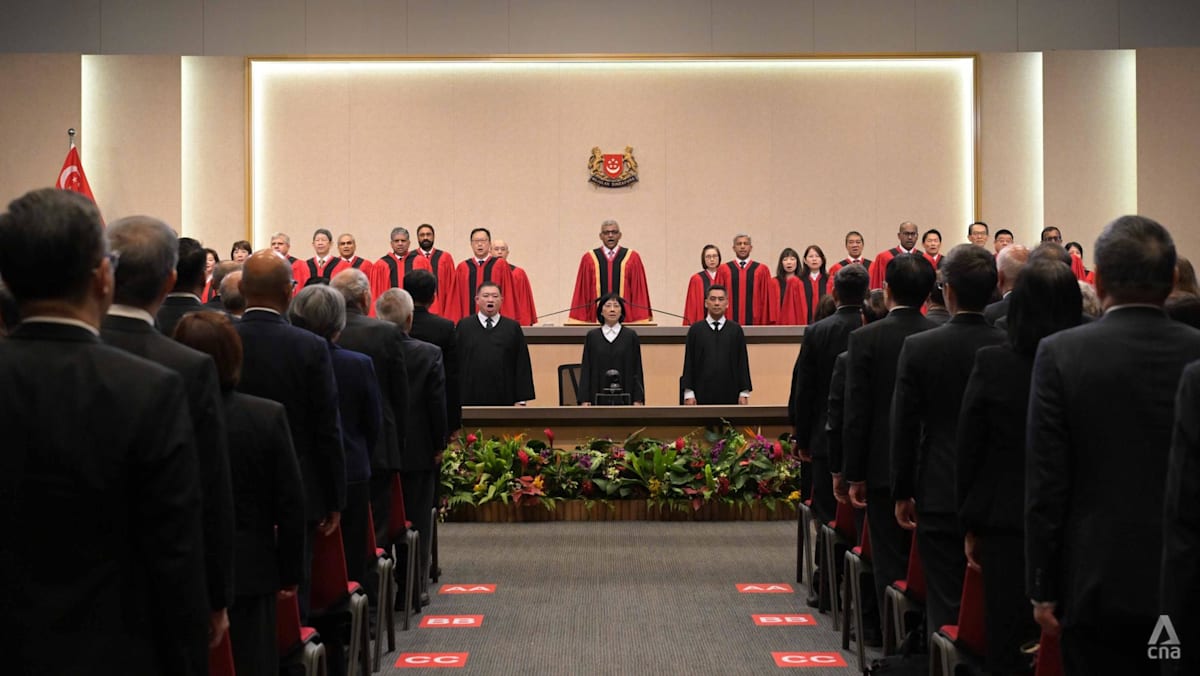
SINGAPORE: As Singapore marks 200 years of the rule of law, leaders of the legal fraternity on Friday (Nov 27) stressed that the law and the institutions built around it must serve the people first.Minister for Law Edwin Tong said the success of Singapore's legal system should be measured not only by the standing of its courts and lawyers, but by whether people can understand their rights, get the help they need and obtain remedies that work in practice."We must ... never lose sight of the fact that it is our people whom the rule of law is meant to serve," he said at a historic bicentennial sitting of the court attended by judges and lawyers both local and foreign.Mr Tong said that what appears to be a legal issue or policy question often concerns someone's livelihood, family, or a business they spent years or a lifetime building."To them, it is their life. That is a perspective we must never lose," said Mr Tong, who is also Second Minister for Home Affairs. Minister for Law Edwin Tong at the Bicentennial Sitting on Nov 27, 2026. (Photo: CNA/Lim Li Ting) He flagged the law ministry's efforts to expand legal aid, institutionalise criminal defence aid, simplify dispute resolution and strengthen the enforcement of court and tribunal orders."The purpose behind these efforts is simple: Justice must make a meaningful difference to people's lives," he said to an audience of several hundred."We will therefore continue to support a legal system sophisticated enough to support the most complex, innovative international transactions and disputes, yet accessible enough to help an ordinary person facing an everyday problem."This year marks two centuries since the Second Charter of Justice 1826, which established the modern legal and judicial system in Singapore.Friday’s sitting was held with solemn pomp in the auditorium of the Supreme Court, opened by trumpeters and bagpipers, followed by various speeches, including from Mr Tong, Attorney-General Lucien Wong, and Chief Justice Sundaresh Menon.The Chief Justice struck a similar note as Mr Tong, saying the judiciary must see the legal system as it is experienced by those who seek justice.It matters not only that judicial processes are sound in law, but that they are also suited to the problems that people bring to court and can be navigated by court users, he said."Processes that are intuitive to judges and lawyers can bewilder a litigant who encounters a court for the first time in her life," said the Chief Justice, adding that the judiciary has sought to make its processes more accessible and intelligible.Justice as seen from the user's perspective counts for little unless the judiciary keeps examining how it is impacting its users, said Chief Justice Menon. Chief Justice Sundaresh Menon speaking at the Bicentennial Sitting on Nov 27, 2026. (Photo: CNA/Lim Li Ting) He cited how the communications, outreach and service delivery functions of the three courts were consolidated into a single division in 2022 so that users of any court encounter one judiciary held to one standard of service.The Access to Justice Division was later established to identify and remove barriers faced by court users, complemented by the Office of Transformation and Innovation, which redesigns processes and harnesses technology to similar ends, he said."In all of these efforts, we have been guided by the insight that court users experience the justice system not only in the courtroom, but at every touchpoint in their journey through the courts," said the Chief Justice.Mr Wong, the Attorney-General, said that the rule of Law must “work in practice” and not be an abstract aspiration.“It requires clear and stable laws that people can find and understand, independent and effective courts, equality and accountability before the law, and public powers exercised within legal limits,” he added.“These principles provide the certainty and predictability which individuals and businesses need to order their affairs with confidence, and also sustain public trust that the law will be applied fairly and consistently.” Mr Wong added that the law must also evolve with society, noting that in the past decade, the Attorney-General's Chambers had drafted legislation in areas ranging from cybersecurity and online safety to racial harmony, scams, platform workers and workplace fairness."The law must be stable to provide certainty, yet responsive to meet the changing needs of society," he said. Attorney-General Lucien Wong speaking at the Bicentennial Sitting on Nov 27, 2026. (Photo: CNA/Lim Li Ting) PUBLIC TRUST, AI AND TECH POSE CHALLENGES AHEADLooking ahead to the third century of the rule of law, Chief Justice Menon identified preserving public trust as one of the key challenges facing the courts.Confidence in public institutions is under growing strain, with polarisation and disinformation in some other jurisdictions creating conditions where judicial decisions risk being judged more by the popularity of their outcomes, than by the quality of their reasoning, he said."This is deeply corrosive, because trust underpins both our legitimacy and our ability to discharge the judicial function effectively and independently."Another test is in accelerating change that is becoming harder to anticipate, with the use of artificial intelligence (AI) a clear example, said Chief Justice Menon."Used well, it may widen access to justice and help us master complex material more efficiently," he said."Yet its fluency can invite uncritical reliance and conceal serious errors. The difficulty is that we cannot defer decisions about the use of AI in the courts, even as the technological frontier is constantly being redrawn."Mr Tong similarly pointed to AI as one of several forces reshaping society and the legal system, alongside an ageing population, changing social expectations and growing geopolitical tensions. The Bicentennial Sitting on Nov 27, 2026. (Photo: CNA/Lim Li Ting) THE IMPORTANCE OF DEVELOPING PEOPLEThe leaders of the local legal fraternity also stressed the importance of developing the people making up the profession.Mr Tong said the strength of any legal system lies not just in its laws and institutions, but in the quality, character and commitment of its people."I know from my own years in practice that this is not an easy profession. The hours are long, the pressures are real, and the responsibilities are heavy," he said.While legal practice will not be the right option for everyone, those who choose it will find "so much worth staying for".Having people turn to lawyers for counsel in more ways than one is in itself "an extraordinary privilege" that makes the demanding profession so deeply fulfilling, said Mr Tong.He said the government will strengthen training, mentorship and the professional development of lawyers to make legal practice more sustainable and rewarding."We want our young lawyers to have every opportunity to grow, excel and build lasting careers, and our law firms to thrive and flourish," he added.Investing in lawyers is investing in the long-term sustainability of the legal system, he added. Chief Justice Sundaresh Menon speaking at the Bicentennial Sitting on Nov 27, 2026. (Photo: CNA/Lim Li Ting) The Attorney-General similarly stressed that the AGC must be a learning institution against the backdrop of changing technology such as AI, and with legal questions confronting the government becoming more specialised and increasingly interdisciplinary.Mr Wong said AGC provides structured training by senior officers, specialised instruction by leading practitioners and academics, as well as opportunities for officers to deepen expertise through their work."Increasingly, we also equip our officers with skills to work effectively and responsibly with new technologies, particularly AI," he said."This means not only understanding how these technologies affect the law and the government, but also harnessing them in our own work, including through developing in-house AI and technology tools."He said the quality of tomorrow's prosecution decisions, government legal advice and legislation depends upon the capabilities, judgment and professional values developed in AGC's officers today.Chief Justice Menon said another test is in building a legal profession in which talent can flourish and a sense of vocation can endure, as the demands of modern practice can leave too little room for mentorship, collegiality and the formation of professional judgment.He said lasting renewal depends not just on reforms but on the people and a culture in which judicial excellence is a lifelong pursuit rather than a settled achievement.The Singapore Judicial College was established in 2015 to place judicial education on a structured, judiciary-wide footing and to undertake research to inform the continuing reforms, he said.A dedicated judicial service was created in 2022, enhancing the ability to attract, nurture and retain judicial talent through more specialised professional development.In closing his speech, Mr Tong said the legal fraternity's legacy will not be measured only by the laws passed, the institutions built, or the reforms undertaken."It will be measured by the lives we touch, the trust we sustain, and the future we make possible for those who come after us. That will be the true legacy of this bicentennial year," he said.
Justice must serve the people, legal leaders say as Singapore marks 200 years of rule of law
Full Article
Original Source
Read the full article at Channelnewsasia →KhanList aggregates and links to publicly available news content. We do not host full articles from third-party sources. Always verify important information with original sources.