
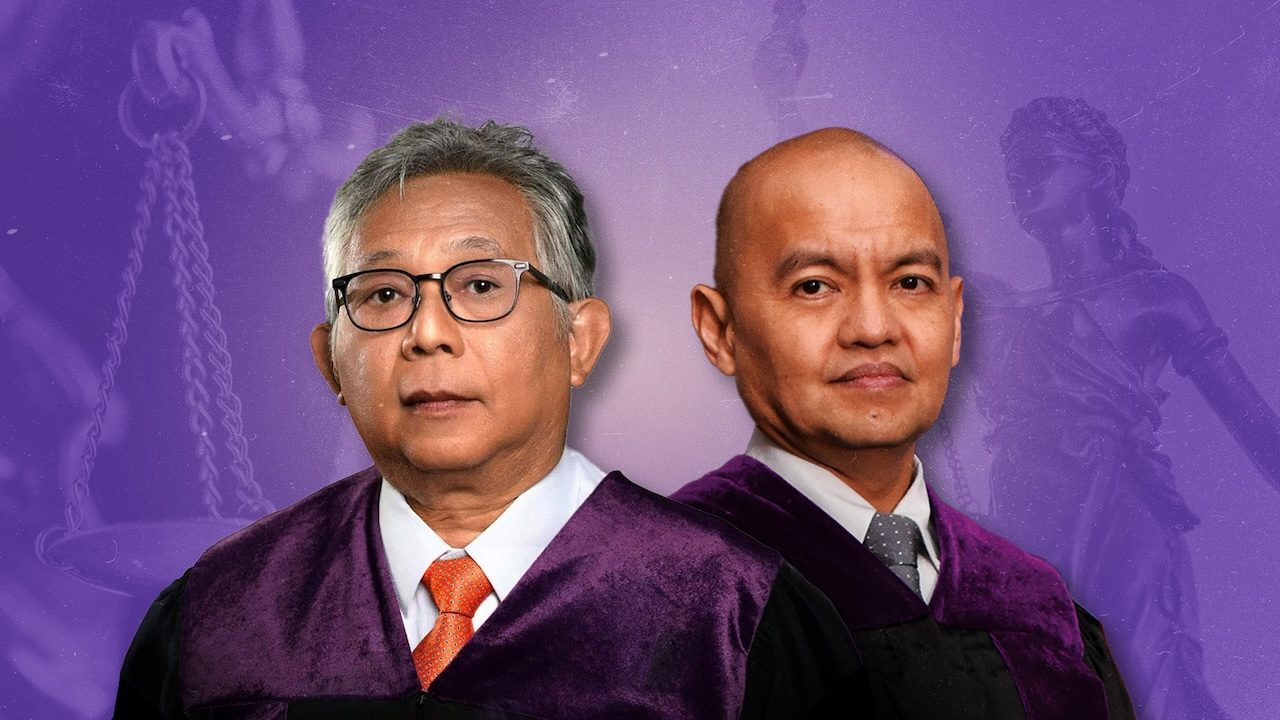
Caguioa is known for his disciplined, rule-based approach to law, emphasizing statutory discipline and procedural fidelity, while Leonen advocates for a transformative legal philosophy that prioritizes human dignity and social justice Justice Alfredo Benjamin Caguioa and Justice Marvic Leonen are both exceptional candidates for the Chief Justice position in the Philippine Supreme Court, each bringing unique judicial philosophies. Their contrasting styles create a dynamic environment for legal discourse, with Caguioa focusing on the law's foundational principles and Leonen challenging the court to evolve in response to societal needs. This is AI-generated. Read the article for full context. Report any errors. For me, it is a toss-up between Justice Alfredo Benjamin Caguioa and Justice Marvic Leonen. Viewing the bench dynamics of the Philippine Supreme Court as an amicus curiae offers a rare window into how Caguioa and Leonen elevate oral arguments through distinctly brilliant judicial intellects. Whether guided by Leonen’s transformative legal philosophy or anchored by Caguioa’s masterly doctrinal discipline, the Bench would be led by a chief justice capable of commanding immense respect and elevating the standard of Philippine law. The comparison of Justice Caguioa to Justice Oliver Wendell Holmes Jr. captures his sharp, disciplined approach to the law. Holmes was famous for his surgical legal precision, masterly grasp of statutory limits, and an incisive interrogation style that stripped away rhetoric to get straight to core doctrine. Justice Caguioa brings that same crisp, pragmatic rigor to the en banc, holding counsel strictly accountable to evidentiary standards, civil law foundations, and procedural fidelity with zero tolerance for fluff. Drawing a parallel between Justice Leonen and Justice William O. Douglas is equally evocative. Douglas was the iconoclastic legal philosopher who viewed constitutional law as a living safeguard for human dignity, marginalized voices, and personal liberty. Justice Leonen reflects that expansive, socio-philosophical ethos. His questioning during oral arguments routinely forces advocates to confront systemic inequality, historical context, and the broad human impact of legal decisions, yielding jurisprudential insights that push the boundaries of Philippine law. What makes their presence on the Bench so compelling is how their complementary styles test counsel from every angle: one anchoring the Court in exacting statutory discipline, the other challenging it with transformative constitutional vision — all while remaining distinctly their own jurists shaped by Philippine realities. In the oral arguments for Baluyot v. Antonio-Baluyot (G.R. No. 257575) — where the Court revisits the issue of whether or not foreign divorce of Filipinos (married to each) should be locally recognized, abandoning the ancient 1939 prohibitory precedent on the matter — that exact contrast in judicial philosophy was on full display. Justice Leonen’s progressive ethos was unmistakable as he reframed the dispute away from cold codal rigidity and toward lived human realities. By pressing counsel on whether misery could ever serve as the legitimate foundation of a family or state sovereignty, he pushed the Court to treat legal fictions as dynamic instruments designed to serve human dignity rather than perpetuate legal limbo. His questioning characteristically sought to expand constitutional horizons, prioritizing equity and modern social context. Justice Caguioa’s circumspect, rule-based approach, on the other hand, anchored the deliberation in statutory discipline and structural logic. Rather than dismissing progressive outcomes, Caguioa tests whether a proposed shift can be reconciled with established civil law doctrines, conflicts of law rules, and legislative intent. His willingness to adapt is rarely driven by sentiment; it is unlocked when an advocate demonstrates how a forward-looking interpretation fits cleanly into the broader architecture of the legal system without creating doctrinal chaos. Together, their dynamic creates an ideal crucible for testing novel legal questions: Leonen asks where the law ought to go to do justice, while Caguioa demands to know precisely how the law can get there without breaking its own foundations. Reexamining Justice Caguioa through Ateneo Law’s true formation reveals that his approach goes far deeper than mechanical codal adherence — it is anchored in Ateneo’s rich teleological tradition, searching for the spirit of the law (ratio legis) and applying critical analysis to fulfill the law’s underlying purpose. Justice Caguioa’s judicial craftsmanship reflects this Jesuit Ignatian legal ethos: his circumspection is not cold legalism, but a principled search for purpose, justice, and moral intent within the statutory structure. He tests advocates not simply on the literal text, but on whether their interpretation honors the law’s true spirit without causing institutional chaos. Justice Leonen, shaped by the UP College of Law’s tradition of critical legal studies and grand constitutionalism, approaches the Bench from a macro-transformative lens. He challenges established doctrine by dissecting power structures, historical inequities, and the human cost of legal rules, treating jurisprudence as a living instrument for social justice. Where Leonen asks how the law must evolve to reshape society, Caguioa interrogates the law’s spirit to ensure that evolution stays true to its fundamental purpose. Placing either jurist at the helm of the Supreme Court would be a tremendous boon to the Philippine justice system, carrying the genuine potential to usher in the judiciary’s next golden era. That said, if forced to break what is essentially an intellectual dead heat between two absolute powerhouses of the Bench…well, school pride has to take the wheel! As a fellow Atenean, if it ever comes down to a tie-breaker, I’d have to shamelessly tip the scale for Justice Caguioa — because bringing a little One Big Fight spirit to the chief justice’s seat is just too good to pass up. – Rappler.com How does this make you feel? Loading
[Just Saying] The next chief justice
Full Article
Original Source
Read the full article at Rappler →KhanList aggregates and links to publicly available news content. We do not host full articles from third-party sources. Always verify important information with original sources.