
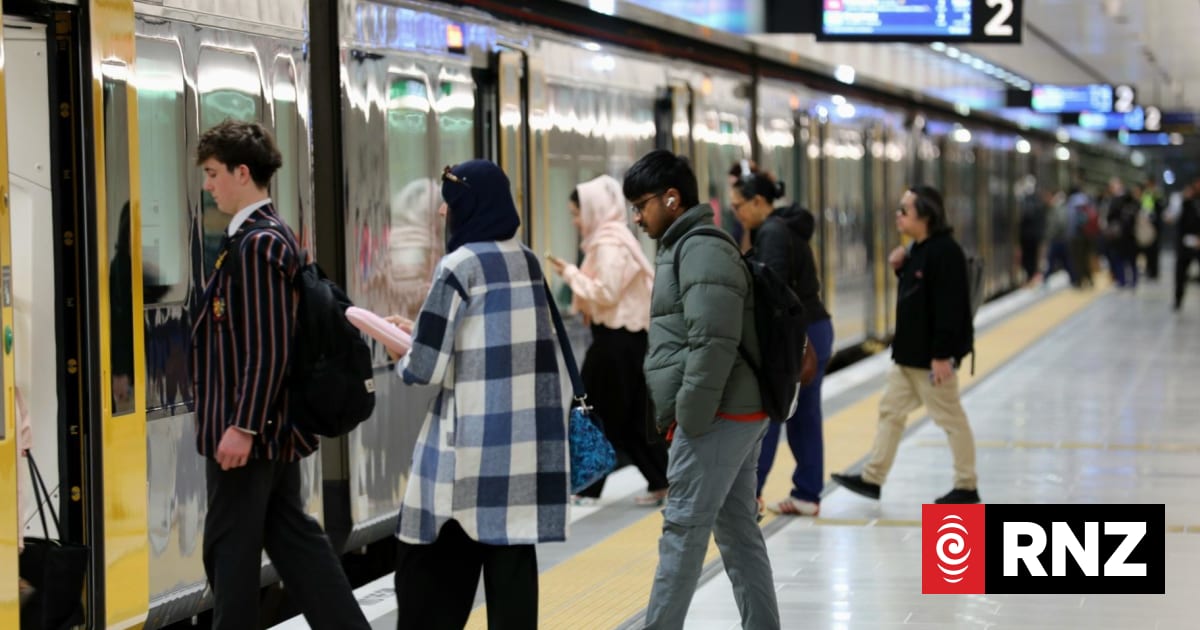
Thousands of people are hopping just one city-centre stop on Auckland's new City Rail Link, new data shows.Two months after it opened, overall passenger numbers on the network have surpassed pre-Covid levels already, with huge increases in people travelling in from some west Auckland stations.Weekend numbers were especially high, running at double the same period in 2019, when public transport usage in Auckland hit its previous high-water mark, and triple what they were this time last year.Auckland Transport said the network was on track to meet its unofficial target of 21 million train trips within this financial year, which ends on 30 June.Ridership had increased across the whole network, but included thousands of people using the new Te Waihorotiu and Karanga-a-Hape stations to get around within the central city.Bespoke preliminary data supplied to RNZ by Auckland Transport showed more than 3000 people were travelling between just the three city stations each weekday, and that rose to nearly 4500 a day on weekends.There was a slight uphill bias, with about five uphill journeys for every four downhill.Shelly - a resident living near Karanga-a-Hape Station - said she had not thought about that pattern, but it rang true."I'd probably walk there because it's easier downhill… and then I get [the train] back."The city rail link had been "life-changing", she said."It's absolutely just turned Auckland into a normal big city."Even Auckland Transport general manager of rail services Mark Lambert confessed to getting in on Auckland's new life-hack."It's probably something I didn't think about prior, but certainly I can speak from my own experience of using the network, I quite often board at Waitematā and take the train up to the city."Auckland Transport's Mark Lambert has found himself using the train to hop up the hill.Jason Dorday / StuffThe inner-city trips were a "stand-out" for him from the early data, he said."The more people use the public transport network to improve their daily lives, to get to different destinations, to try new things out, hopefully that will - if it hasn't already - translate into more regular and longer-term use of the network as well."Across the entire train network, weekday passengers had jumped about 60 percent in the first eight weeks the CRL had been open, compared to the same time period last year.They were as high, if not higher, than before Covid, Lambert said."Getting back to pre-Covid levels is actually quite an achievement in itself, because travel patterns have changed for people," he said."A lot of people, as we know, work from home on one, two, three, even more days a week sometimes."Weekend growth was even stronger - double what it was before Covid and nearly triple what it was this time last year.Some of the biggest growth was coming from West Auckland stations, Lambert said."If you're coming from some of the more inner-west stations such as Kingsland or Grafton, the journey times have effectively halved in some cases, so that's obviously going to be a big benefit to people."Even those travelling from stations further west, such as Henderson, had culled their journey times by 30 to 40 percent, he said.The data supplied to RNZ bore this out.Average weekday boardings from Henderson to the city had more than doubled (from 139 a day to 368) while Kingsland boardings to the city had quadrupled, from 122 to 507 trips a day.Kingsland resident Simon said the train was the fastest way into the city now."Previously we'd either drive or bus or Uber - usually Uber for work."Passengers head out of Karanga-a-Hape Station.RNZ / Nick MonroThe train took about five minutes to travel the two stops to Karanga-a-Hape Station, with a five-minute walk to work to complete the journey, he said."It's just a no-brainer, it's literally the fastest way in and out. It's also the cheapest."He laughed when told that more people used the CRL to travel uphill than downhill within the CBD."That makes sense - humans are lazy."Charlotte Ryan from the Karangahape Business Association said there had been at least a 35 percent increase in foot traffic on Karangahape Road since the CRL had opened."Of course it helps the businesses and the retail and everything like that, but I think it changes the energy of the street in a really positive way," she said."It makes it way more social, it makes it way more accessible - the more people we have on the street, the safer it is."Charlotte Ryan says the new Karanga-a-Hape Station has improved the energy of the surrounding area.Lucy XiaTrains across the network had been running on preliminary timetables for the first weeks of the CRL's operation.From today, the number of services would increase, Lambert said.That included boosting the frequency of trains on the East-West line from six per hour to eight, and extending the 15-minute frequency of services later into the evening.Reliability and punctuality was also the highest it had been for many years, Lambert said."If you've left, come back, try it again."
Just one stop for thousands of Aucklanders on City Rail Link
Full Article
Original Source
Read the full article at Rnz →KhanList aggregates and links to publicly available news content. We do not host full articles from third-party sources. Always verify important information with original sources.