
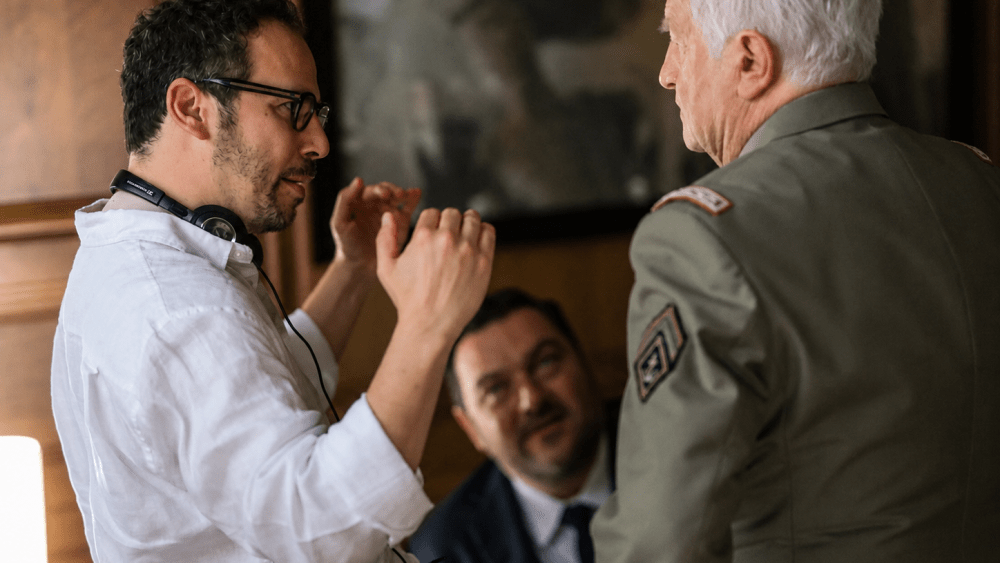
When Alexandre Smia began writing “Jupiter,” his gripping feature directing debut about a newly elected French president confronted with the possibility of nuclear war with Russia, Joe Biden was still in the White House. A year and a half later, as the film prepares to world premiere out of competition at the Venice Film Festival, the geopolitical landscape around it has moved with unsettling speed, making “Jupiter” feel more timely than Smia ever imagined. Produced by Hugo Sélignac and Nicolas Dumont’s Chi Fou Mi Productions, one of France’s leading production outfits part of Mediawan, “Jupiter” stars Denis Ménochet as Paul Archambault, a newly elected French president summoned to the Jupiter command post, the highly secretive anti-atomic bunker beneath the Élysée Palace, after an assassination attempt against the Russian president triggers a rapidly escalating international crisis. Russia blames Ukraine and threatens retaliation, leaving Archambault and his political and military advisers facing an impossible choice as nuclear war looms. Popular on Variety “I don’t think we’re dealing with a dystopian hypothesis at all,” Smia says about his gripping film. “I think we’re dealing with a form of plausible reality. And that’s what’s completely frightening: it’s totally plausible.” For decades after France became a nuclear power in 1960, Smia argues, the country essentially remained a spectator during global nuclear confrontations. Russia’s invasion of Ukraine changed that. “We’ve entered what experts call the third nuclear age,” he says. ”This is the first time that France has become an actor, whether it wants to or not,” he says, noting its singular position as a nuclear power within the European Union, NATO and the U.N. Security Council. For a first-time feature director, it’s an unusually ambitious swing, but Smia is already well-versed in geopolitical fiction, having previously co-written episodes of the hit spy thriller series “The Bureau” and Martin Bourboulon’s Afghanistan evacuation thriller “13 Days, 13 Nights.” Politics, he says, has fascinated him since adolescence, and the nuclear threat gave him the impulse to step behind the camera. “It was the discovery of this subject that created the raw material for wanting to make the film,” he says. “It generated an obsession in me, because you pull one thread and discover something incredibly particular. Beyond how disturbingly timely it is, it’s an absolutely fascinating subject and contains extraordinary cinematic material.” Surrounding Ménochet, Smia pulled together a stellar French ensemble. Kateb’s character drew partly on Henry Kissinger and Robert McNamara, while Dominique Blanc’s character was inspired in part by Madeleine Albright. Sallette, meanwhile, was chosen for the sheer force Smia felt was required to credibly stand opposite Ménochet. Before shooting, the cast spent a week rehearsing together in a chapel behind Paris’ Saint-Ambroise church. Smia compares the experience to forming a theater troupe. That preparation was essential because the characters speak in political and military slang which Smia describes as “almost a foreign language.” Determined to make the film as realistic as possible, Smia sought out Bruno Tertrais, one of France’s leading experts on nuclear deterrence and the author of “Jupiter à l’Élysée,” who was able to advise extensively throughout the screenplay’s development. Smia also went directly to the Élysée. His discussions included General Fabien Mandon, then chief of the French president’s personal military staff and now chief of defense staff, who reviewed the screenplay and offered highly specific technical notes, down to dialogue that would not realistically be spoken in a particular way. “They needed to know that I was approaching this seriously and responsibly. That it wasn’t a pretext for action or sensationalism,” Smia says. Smia was then allowed to shoot for two days at the Élysée with a crew of roughly 200 people, including scenes in its gardens. Other areas were meticulously recreated, including the presidential office, while the Jupiter command center, which is essentially a bunker, was reconstructed at the Cité du Cinéma outside Paris using visual references Smia had obtained. The filmmakers even combined details from different eras of the real bunker, including a ceiling design Smia preferred from the Mitterrand years. That realism is crucial because much of “Jupiter” unfolds as a chamber piece with minimal action sequences. “That’s a directing challenge I love — How do you infiltrate the nuclear threat into an office 40 meters underground, which is fairly austere, with not much there except a table and chairs?” Smia quips. The French helmer cites Akira Kurosawa’s “High and Low” as the film’s primary visual reference, saying he watched the Japanese master’s largely contained thriller roughly 50 times with his cinematographer Nicolas Loir while developing “Jupiter.” He also points to Steven Spielberg’s use of off-screen menace in “Jaws.” But “Jupiter” is perhaps even more deeply rooted in the American political cinema of the 1970s. Smia describes Alan J. Pakula’s informal paranoia trilogy — “Klute,” “The Parallax View” and “All the President’s Men” — as a kind of cinematic summit. For Smia, what made those movies radical wasn’t simply their politics but their willingness to look directly at the present. “The era we’re living through means that we filmmakers have to connect ourselves to the contemporary world and look it straight in the eye,” he says. Ultimately, “Jupiter” depicts the nuclear authority invested personally in the French president. “There can be a collective process of reflection and analysis, but the decision itself — and the French president is elected for that — is made alone.” That’s why Smia imagined President Archambault almost as a Shakespearean figure. “For me he’s a cursed king in his castle,” Smia says. “He’s Richard III.” “The decision he makes is tragic, impossible, terrible, apocalyptic,” Smia says. “At the same time, what fascinates me is that he does it for values he believes in.”
‘Jupiter’ Director Alexandre Smia on Making a Nuclear Thriller That Suddenly Feels Terrifyingly Real: ‘We’ve Entered the Third Nuclear Age’
Full Article
Original Source
Read the full article at Variety →KhanList aggregates and links to publicly available news content. We do not host full articles from third-party sources. Always verify important information with original sources.