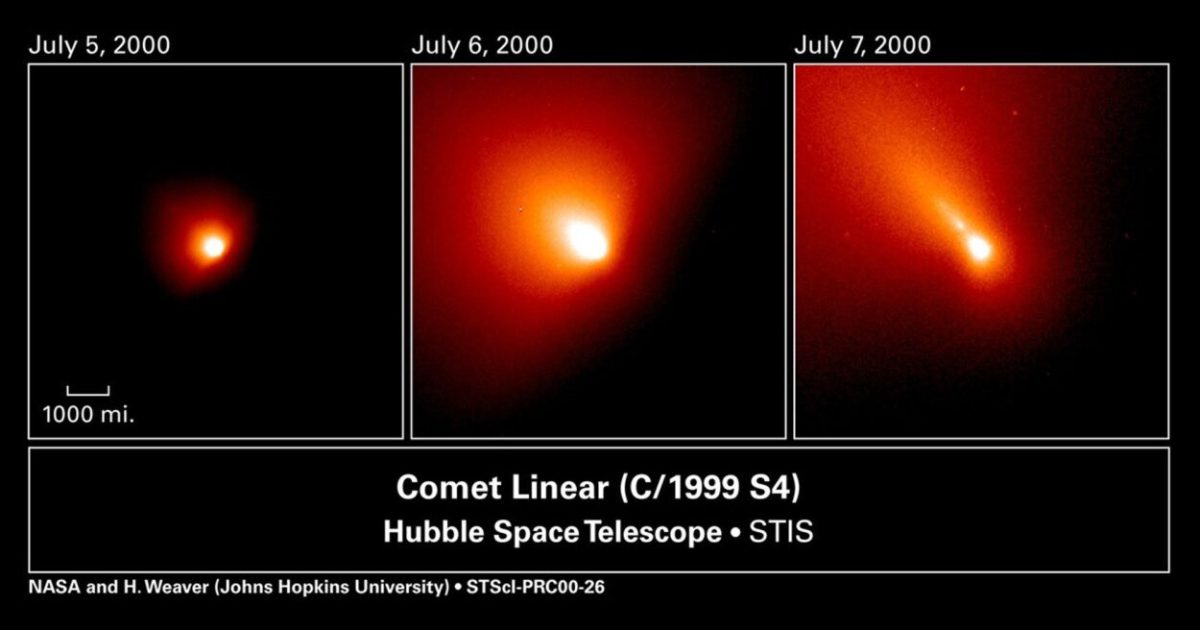
Today in the history of astronomy, a weird and wonderful comet breaks up. | Published: July 26, 2026 Over three days in 2000, the Hubble Space Telescope watched Comet LINEAR blow off a piece of its crust. The explosion generated a lot of dust, which in turn reflected a lot of light, increasing its brightness. Credit: NASA and H. Weaver (Johns Hopkins University)/STScI-RPC00-26 In September 1999, the Lincoln Near Earth Asteroid Research (LINEAR) project discovered a comet – Comet C/1999 S4, or Comet LINEAR – on a course for the Sun. Its unusual behavior drew attention: By July 5-7 of the following year, the Hubble Space Telescope had watched a piece of its crust blow off as if in an eruption. Such an explosion offered tantalizing insight into the composition of the comet’s nucleus. On July 14, the Chandra X-Ray Observatory observed its X-ray emissions, and on July 26, the comet began to fragment. Its disintegration played out across several weeks, until by mid-August nothing visible remained. Analysis of its characteristics and behaviors suggested it formed in the Jupiter-Saturn region, not a usual location for comet creation. Elisa Neckar is senior production editor of Astronomy magazine, and the editor of the Today in the History of Astronomy feature on Astronomy.com.
July 26, 2000: Comet LINEAR disintegrates
Full Article
Original Source
Read the full article at Astronomy →KhanList aggregates and links to publicly available news content. We do not host full articles from third-party sources. Always verify important information with original sources.