
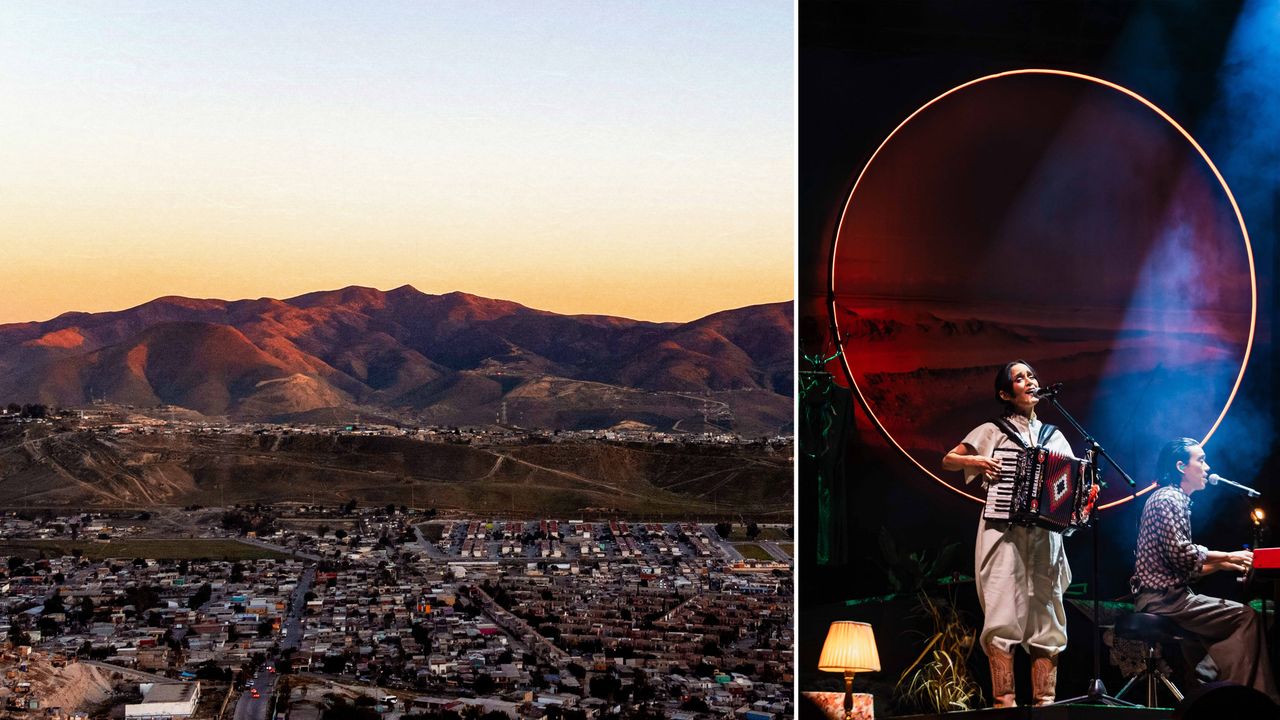
For singer-songwriter Julieta Venegas, homesickness has proved a powerful drug. Her latest album, Norteña, is the Mexican singer's ode to life in northern Mexico, and specifically Tijuana, where she grew up—but it took eight years of living abroad in Buenos Aires to make her return, musically and literally.Singer Julieta Venegas' latest album, Norteña, was released in May 2026. Yvonne VenegasIn her latest album, which was released in May, Venegas pays tribute to the sounds, stories, and art of this part of Mexico. To do so, she dug into both her family history in Baja California, and also turned to the work of generations of authors and artists who were inspired by the liminal space that is Tijuana, from its Spanglish inclinations to the fact that the city sits physically closer to major US cities like Los Angeles than it does to Mexico's capital. “It's an aesthetic choice to write from the border,” Venegas tells me over the phone, speaking of how languages, culture, and a sense of place collide in Tijuana.And yet, this album—inflicted with the sounds of northern Mexico's folk tradition of norteño music—so beautifully captures the blur of influences that shapes Tijuana itself, which is why Venegas is also joined by other artists with cross-border sounds, like the band Yahritza Y Su Esencia, and musicians who have dedicated themselves to reviving regional acoustic styles, such as Natalia Lafourcade. It's a fitting homecoming for an artist whose music has explored the range of Mexican pop and indie music (and even stepped in on a Bad Bunny single) over a three-decade-long career, and continues to do so—not squarely fitting into one genre or another, but bringing together a variety of Mexican traditions.The US-Mexico border is a fact of life in Tijuana, and a lifetime of coexisting with it inspired several songs in Venegas' latest album. GettyBelow, we chat with Venegas about the city that raised her, and what about the border town experience she hopes listeners will come to understand.What was the inspiration behind your last album?I was living in Buenos Aires, and I was missing home. It all started because my sister, who is a photographer, has a project about a town called Santa Rosalia in Baja California and my grandfather: When he was very young, like 10 years old, [the rest of] his family died in Santa Rosalia because of a cyclone.That memory has always been present in my family and her project was a way to heal. My grandfather eventually had a lot of kids, and even though he didn't live such a long life, he was an inspiration. My sister's project detonated in me something about Baja California, and about Tijuana. I started reading a lot about the state, a lot of history and poetry, and novels by writers from Tijuana. I explored scenes that had to do with missing someone, with crossing the border, and going to the other side. I feel like it has a lot to do with separating from someone because you live somewhere else, which is in Spanish called añoranza.Singer-songwriter Julieta Venegas is known for blending elements of pop and Mexican regional music. Yvonne VenegasMissing someone feels like such a defining feature of being in a border town, particularly Tijuana. How has a childhood on the border shaped your life and work?We're a border family, so our relationship to it is very much an everyday thing. But it's very different when you have the possibility of crossing the border versus when you don't. In my family, we've always had that possibility. There are things that you choose to take from each side, and culturally, it's interesting. I grew up bilingual because I watched a lot of TV when I was a kid—well, before my dad took it away.In my family, Mexico was the center of everything that was discussed, but in an everyday sense, we had the US right beside us. We listened to American radio. We would go to the supermarket in the US whenever we needed to. But there is a big contrast, and you see it as soon as you cross the border, even just the way the streets are designed and thought of in Tijuana. Tijuana is a city that has been constructed out of necessity, more than design. It's been built the way that people need, and people need every corner of it.A glimpse of Tijuana, the city where Venegas was raised—and to which she credits much of her musical influence. GettyI think it's very hard, because people relate border cities to violence. Growing up there, you see another side: It's a family place, it's a very small city compared to others, and you're very far away from la capital, Mexico City. Culturally, you see that. I'm a fan of the expressiveness that happens in a border city.People who are doing music or literature in Tijuana have to be very independent. They actually self-publish a lot of books in Tijuana, because it's very hard to be seen from Mexico City, where the industry is based. I would love to see more literature written from Tijuana. I went through Luis Humberto Crosthwaite and Rosina Conde's writings, and other people who see their literature as being [rooted in] Tijuana, and it's a very interesting way to see the place. The language is very mixed up. It's an aesthetic choice to write from the border.Venegas, performing in Miami in 2026, adds classic elements of Mexican norteño music to her latest album. GettyAs far as border towns go, what makes Tijuana so singular?All border towns have their own thing. I don't know if it's because Tijuana shares a border with California, but there seems to be a lot more tourism going on, so there's a lot of exchange. And the way it's portrayed is, you know, this place where people sort of invent tourism for people from the US. [Travelers] come and buy artesania (handicrafts) that only exists in Tijuana, and they think they're actually seeing Mexico. It's very much a fantasy. But growing up there I felt that I had the best of both worlds. I had the possibility of living in two countries at the same time, which gave me a very open mind about what culture can be.Venegas's song, “La Línea”, talks about two people being separated by the US-Mexico border: "I just felt that theme had to be in the album," the singer says. GettyThe song “La Línea”, on the album, is all about this idea of the border as a dividing force, and it features another great group of artists, Yahritza Y Su Esencia. How did you think about who you would like to collaborate with on the album?I definitely wanted Mexican guests on it. Yahritza is Mexican, her parents are from a small town in Michoacán and her family has migrated from Mexico to the US where she [was raised]. I can totally relate to that, being from a border city: I know what it's like to be from one country, or your family being from one country, but kind of having grown up in a different one.What Yahritza Y Su Esencia is doing is very much Mexican popular music. They're rewriting the way Mexican popular music is being made right now, and I really wanted them to be on the album. I didn't realize that their story was so close to the story of “La Línea” and it was very emotional when we eventually talked about the song and talked about them being on it. She told me her experience of recording her part, which is the exact moment when two people are being separated by deportation, and it's actually something that happened to her family. I think these things can be very healing.Why was now the time in your life to release an album like this?I was missing home. But I also started this project without really knowing why. I mean, I wrote “La Línea” before things got really bad in the US with the Trump administration. I didn't feel like it's a political song, I just felt that theme had to be in the album, because in any border city, you're going to see people struggling to cross the border, or people coming back because they've been deported. That's something I saw every single day growing up in Tijuana. It has always been there. There's also the fact that a lot of people pass through Tijuana [coming from elsewhere] just to cross to the other side. It's just a step they take to their final destination, though some of them end up staying in Tijuana, accidentally building their lives there along the way.
Julieta Venegas's Latest Album, Norteña, Is an Ode to Her Hometown of Tijuana
Full Article
Original Source
Read the full article at Cntraveler →KhanList aggregates and links to publicly available news content. We do not host full articles from third-party sources. Always verify important information with original sources.