
“This is a story about the family that sustains you when all your other family ties break,” says Julián Delgado Lopera, a 38-year-old trans writer from Bogotá, Colombia. His latest novel, Pretend You’re Dead and I Carry You (2026), is a finalist for the National Book Award, one of the most prestigious literary prizes in the United States. Delgado has lived outside of Colombia for 23 years and teaches creative writing in New York City. And yet, his very Colombian story has been shortlisted for the award. In it, he travels to the rural world of Tolima, one of the country’s 32 departamentos (states) — where he experiences the fear of being gay in a conservative home — and to Bogotá, where a trans community understands that fear all too well.“Most of the catastrophic violence in our history can be traced back to a man who hasn’t allowed himself to feel tenderness,” he affirms, in an interview with EL PAÍS in the Colombian capital. He’s referring to a kind of violence that goes beyond the long-running armed conflict. The book is humorous, while still telling a tragic story. In the narrative, a man organizes fashion shows alone, in front of his cows, to “dazzle the cattle with all that glamour” — the glamour of a “country diva.”Question. This is a novel that tells a very Colombian story. Why did you decide to write it in English?Answer. Actually, it wasn’t written in English, but in Spanglish. The English version of the book has a lot of Spanish in it. Because I arrived in the United States so young, it’s the linguistic space that comes most naturally to me, since I’ve always lived in immigrant communities. Spanglish is an invention of languages; the phonetics are different. It’s a way of playing with the English grammar, while using Spanish words. My writing process is very melodic; it has a lot to do with music and rhythms, something that we also looked for while working with the Spanish translator. Q. It’s definitely a very melodic book. Did you want to do justice to trans slang?A. Yes, exactly. I have a trans family; for a long time, I was raised by a trans Cuban woman, back when I moved to San Francisco in my twenties. She had a huge linguistic influence on me: she spoke Caribbean Spanish, mixed with English. And, being trans, she had a whole repertoire of hilarious words. With her, this trans and queer linguistic world opened up to me, and it fascinated me. Then, when I returned to Colombia in 2019 to do research, I encountered that same trans and queer linguistic experience. I began to notice all the linguistic nuances. It’s a language that people dismiss, but it’s actually very poetic.Q. What was that research process like?A. I spent eight years writing the novel, which originated from a short story I wrote about a very depressed father who lived with his daughter. They were both obsessed with a model named Natalia, who only had one leg. I kept developing the story. And the father eventually became this closeted gay man, named Ignacio. I then thought about going to Colombia to see how this figure — the closeted man — would manifest itself in this historical period [the 1990s]. But I didn’t know exactly what I needed. I’ve been living as a trans person for about 10 years, but I was still very young when I traveled there. I found Colombia’s trans history in people’s homes; it’s very oral. For example, I went to the Trans Community Network (RCT) a lot, to have coffee. That’s how I began to immerse the characters in that whole history.Q. You’ve lived longer in the United States than in Colombia, so why did this trans story have to be set here and not there?A. My sense of home — my emotional core — is Colombian. I grew up here; leaving wasn’t my decision. I was underage and I left with my mother. I think something broke... something I’m still trying to figure out. I’m fascinated by the nuances of the local dialect, and at the same time I feel like I’ve never adapted to living there [in the U.S.]. I didn’t assimilate; I never wanted to lose my accent; I never wanted to pass as a gringo. I never wanted to live the American dream. I’ve always been a queer dissident. I don’t want to romanticize Colombia, but it’s still part of my story. In this novel, there’s a closeted father. And I thought, “Wow, I’m the first person to come out in my family.” But that’s not true. There must have been a lot more people who never came out, who were never able to live their truth. I found it interesting to explore masculinity with a Colombian texture, the rigidity within that masculinity — the masculinity of the men I grew up with.Q. Several male characters are afraid to allow themselves to express any femininity.A. This was a topic of exploration, because I was following the story of this person, this closeted character in Tolima. There’s a scene where, as a teenager, he moves his hands in front of a mirror. I spent a lot of time thinking about that, in front of the mirror: the hand movements that men don’t allow themselves to make. That’s how rigid [things are]; making certain movements makes you gay. Masculinity is about learning the rigidity of the body.Q. “T-R-U-T-H is found only through fiction, through story, where forgetting is the only way of staying alive.” This is a quote from a character named Miss Mamadora Eléctrica (“The Electric Blowjob Girl”). With this novel, are you trying to do justice to a forgotten story? A. Yes, because this has been an oral history. The trans history of Colombia is unknown; it hasn’t been given enough space to allow for a complex trans history to exist. All human beings are complex, including us. I didn’t set out to create a trans history within the Colombian context, but the characters are definitely narrating a trans history that’s mostly unknown.Q. What has been left unsaid? A. There’s a moment when the character of Tía Mama (Miss Mamadora) tells stories about when she went to Italy, after passing through Hungary — something that trans women did a lot in the 1990s. They would exchange passports and go to Italy to work as prostitutes and bring money back [to Colombia]. Many of them bought houses in Bogotá with that money. I saturate the novel with those stories. That bit about Italy seemed incredible to me, because a woman would get a loan to go, then she would lend [the airfare] to another woman; it was a whole underground system for survival. I’ve also heard that, during the AIDS epidemic, there were clubs where a lot of information about the virus was shared. That’s what Aquario was like: a club Ignacio goes to, where his Electric Family lives. Incredible things have happened in Colombia. People who only look to the United States and Europe celebrate Stonewall, but they haven’t acknowledged that these women have been here their whole lives, paving the way.Q. The book is the story of two families: Ignacio’s biological family and his trans Eléctrica Family. A. I think family histories never enter into queer stories, [even though] the family — let’s say the original one — makes and breaks Ignacio.Q. This book was shortlisted for the National Book Award. How do you explain its publishing success at a time when governments — be they in Washington or Bogotá — have adopted increasingly hostile policies toward the trans population?A. There are like these little trans angels out there who help with these things [laughs]. I think that, in all super-fascist governments, there’s always a resistance, and these kinds of [literary] awards depend on the judges they choose. The other books on the shortlist are really cool: there are two by trans people and three by Black people. I was incredibly surprised to be shortlisted, because it’s very difficult to win this award. Just being a finalist is unbelievable. The level of attention makes me a little nervous, especially because of both governments. But I have to keep making art, doing what I want to do. This is where my heart is.Sign up for our weekly newsletter to get more English-language news coverage from EL PAÍS USA Edition
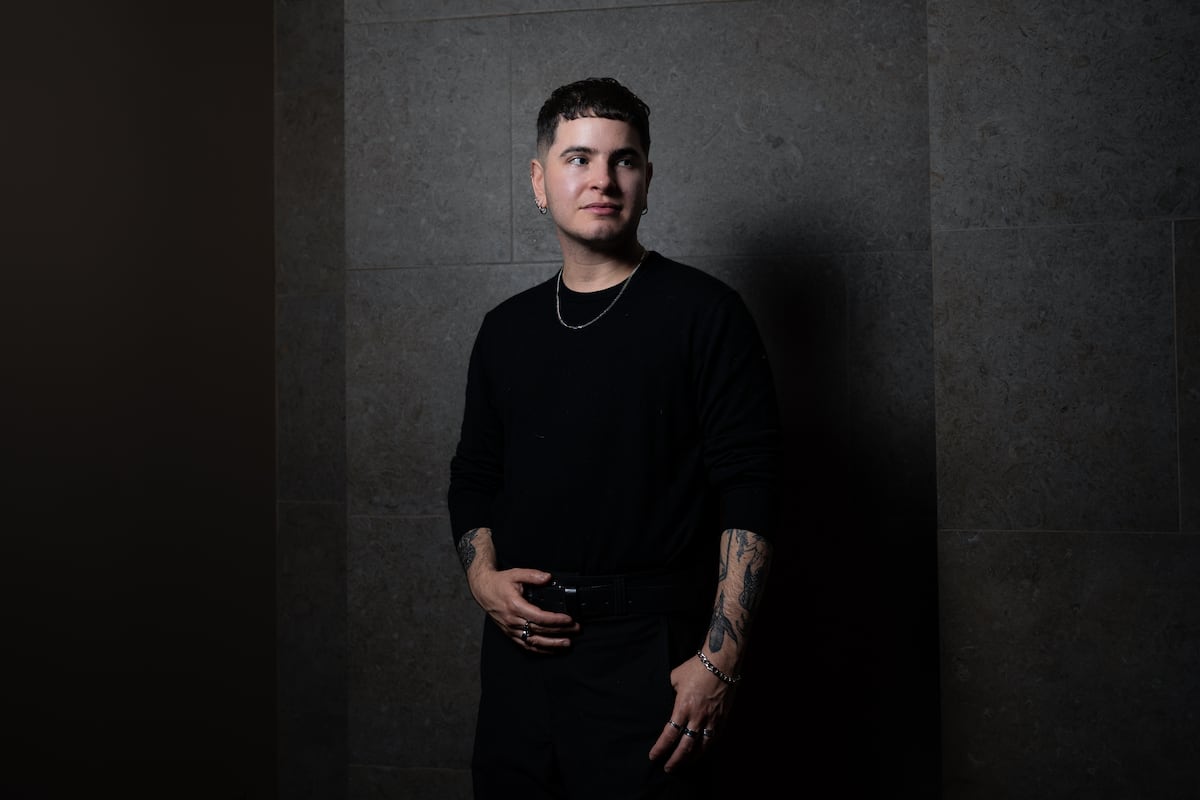
Julián Delgado Lopera, writer: ‘Trans and queer language is poetic’
Full Article
Original Source
Read the full article at English →KhanList aggregates and links to publicly available news content. We do not host full articles from third-party sources. Always verify important information with original sources.