
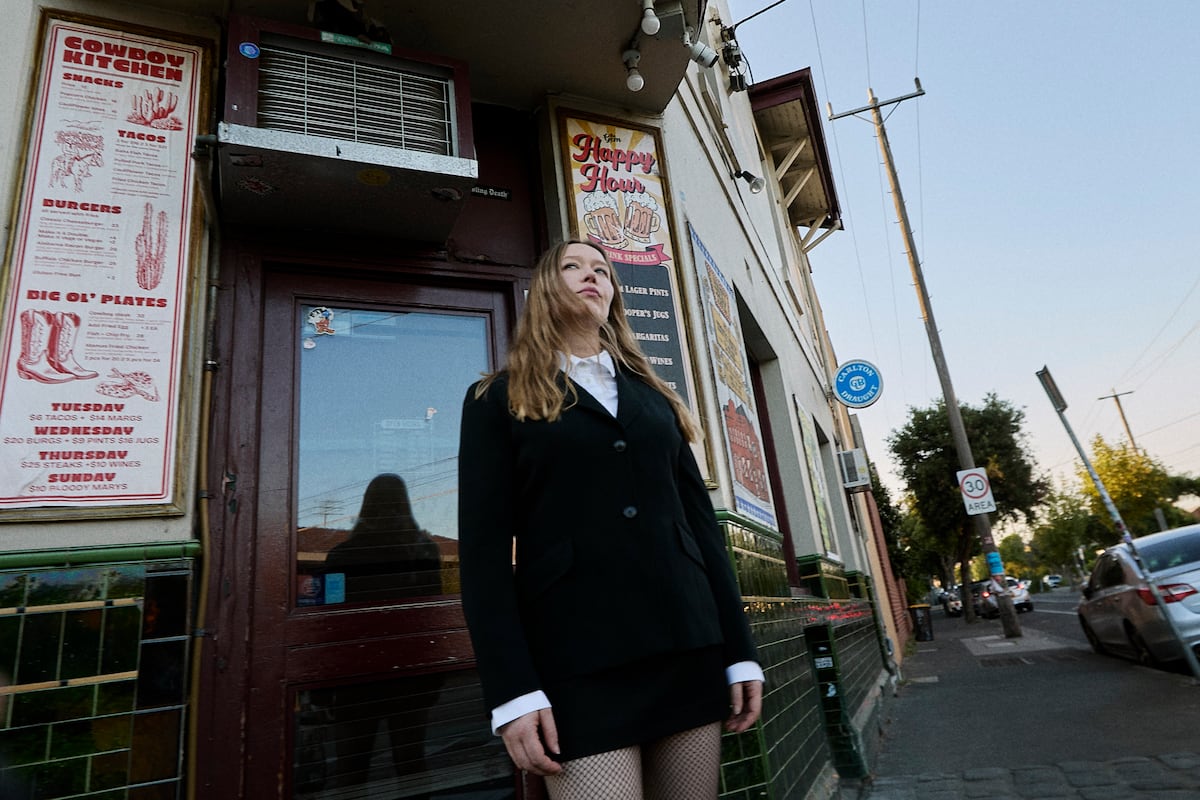
Four years have passed since Julia Jacklin released her third studio album, Pre-Pleasure. The record — just like her first two — was critically acclaimed, cementing the Australian artist’s place as one of today’s best singer-songwriters. And although she could have used that momentum to release new music right away, after coming home tired from touring and the whirlwind of the music industry, she decided to hit the brakes.“I just took a step back from the industry for a chunk of time, and that was just good to reconnect with myself and my regular life,” she explains to EL PAÍS via video call from Melbourne, where she recorded her new album, The Gem. “I just needed to take a step back and reassess why I was doing this, which I think everybody needs to do—especially artists. Once you intersect with the machine, it can get very confusing if you don’t step back and remember why you started in the first place.” That break meant more than just a pause. In a way, the folk singer-songwriter connected with her roots and her land like never before. In Melbourne, she began frequenting a pub called The Gem, where artists like her performed on an impromptu stage for anyone willing to listen. There, she conceived new songs, and other local musicians — longtime friends — who visited the pub became the band that would accompany her on this new journey.But The Gem, her new album, not only borrows its name from the pub; it also references the opal, a gemstone she describes as “very Australian.” Overall, that is the spirit that permeates the entire work. It is an acknowledgment of her homeland, the music born there, and the people who perform it. In conversation, she elaborates on how these 10 new songs were conceived and how she has evolved since her debut album, released 10 years ago.Question. Why did you decide to step away from music after your previous album?Answer. Singing and making music is something I have been doing since I was a child, way before it ever intersected with commerce. When you become a touring musician, you start to have to sell t-shirts with your face on them — there’s something very strange about that experience. And it can affect your relationship to music because it suddenly becomes something that you’re selling instead of just something you do at home by yourself or with your friends. When I was a child, I just loved singing for my family and my friends, and that’s the purest form of it. I just had to step back and remember that deep down I’m still just a kid who loves to sing.Q. You recorded this album in Australia, where you’ve been living for a long time, working with close friends — Jacob Diamond, Mimi Gilbert, and Jess Elwood — who are also well-respected musicians there. In what ways do you think this dynamic benefited the recording sessions?A. Those guys are some of my closest friends and have been for quite a long time; they know me outside of this work and know my heart. Rob Muinos, who I made the record with, is someone I’ve known for a really long time as well. Sometimes I find my personal life and my music life quite separate, and this was a really nice way of bringing them together. Working with your friends can be precarious because, essentially, I’m their employer, so that can get very complicated. But I’m old enough and wise enough to know how to handle that, and a lot of time, trust, and love have gone into those relationships.Q. Everyone got opal tattoos after the recording sessions. The Gem takes its name from a pub in Melbourne, but it also references the opal. What does that gemstone mean to you?A. I’ve loved opals since I was a kid. They’re a very Australian stone. There was a book I loved and a TV show called Genie from Down Under that I watched as a kid that were both about opals, so it’s just been an image in my mind for a long time. I share that with my mom — she also really loves opals, and I was wearing her opal ring throughout this recording. Every opal looks different, and people don’t always like them; they’re quite colorful and can be seen as a bit tacky, especially the way they’re set into jewelry in Australia. They’re just not a very chic stone. I connect with the opal because I also feel kind of tacky, and I feel like I’m different every day. Making a record is a messy process, and every single song is different. I’ve always found it quite hard to make a coherent body of work in many ways, but the opal felt like a symbol of the whole thing.Q. Recently, you mentioned that you like yourself more on this album. What was it that you disliked about yourself in the past?A. Honestly, I’m just older, and I’ve spent more time with myself. I used to be scared of getting older, but now I realize there’s so much to be gained from the privilege of spending more time with yourself and getting to know yourself better and spending time with people who reflect back off of you. I’m older, I’m stronger than I used to be, and with the privilege of time, I’ve learned what I need and the kinds of people I need to have around me. Q. You also recently mentioned that people perceived your previous work, Pre-Pleasure, as “neurotic.” Why do you think that was?A. I think I was just asking a lot of questions, and the music is quite frantic lyrically. I was really searching for something; I was in a heavy period of overthinking, and I think that comes across in the music. But that’s other people’s opinion of me, and I think it’s correct—it was just kind of funny. Q. Do you think The Gem is less neurotic in that sense?A. I think so. I think I’m more settled in not knowing. On my last record, I was stressed about not understanding everything, whereas with The Gem, I’m a bit more accepting of not understanding everything.Q. Have you ever felt pressure as a songwriter? Do criticisms matter to you?A. When I’m feeling worse about myself, it matters more; when I’m feeling good about myself, it matters less. At the moment, I feel pretty good, so I’m not too stressed. But it would be a lie to say it doesn’t play on your mind, even though you have no control over the critical reception. You can only do this job sustainably if you understand that there are only some things you can control. But even if you see a negative review, you remember that it doesn’t reflect the shows. As soon as I play a show and see that people like it, I know not to stress.Q. On the album’s closing track, I Wish, you are joined by the band The Maes. How did that collaboration come about?A. They live close to me, and they’re some of my favorite musicians of all time. When I wrote that song, I thought this would be really beautiful as a three-part harmony, and they were my dream scenario. They’re always on tour, but it worked out really well; they just happened to be in town, and we pulled it together really quickly. They’re so good at what they do that they heard the song the day before, and that day it sounded like they’d been singing it for years. Q. So, you’re a fan of theirs...A. What I really love about The Maes is that they sing in an Australian accent. In the Australian folk scene, a strong accent is quite unique because a lot of people want to sound American or neutral. I’ve always found it a bit hard to put my own accent into songs because of rhyme schemes and how we pronounce words differently compared to Americans and British people.Q. The release of this album comes almost 10 years after your debut, Don’t Let the Kids Win. What has maturity taught you as a musician that you wish your younger self knew?A. Just how important the people around you are to your experience. You need to be really vigilant about the people you surround yourself with in this work because it’s all-encompassing, and you have to find people you can trust both creatively and on intense tours. I don’t think I could have even told young-me this because she would have said, “You’re old and you don’t know anything; I know everything.” Maturity has just taught me to also be very gentle and forgiving of my younger self, because she was doing her best, and she did good. Q. You’ve mentioned that the central idea of the album is answering the question: “How can one love and be free at the same time?” Did you find the answer?A. Yes, I think it ties to the last answer: You can find freedom in love if you’re with the right person or the right people. If people let you be yourself, there’s so much freedom in that, and you can have both at the same time — though it’s hard to find.
Julia Jacklin, on identity and maturity in her new album, ‘The Gem’: ‘You can find freedom in love with the right person’
Full Article
Original Source
Read the full article at English →KhanList aggregates and links to publicly available news content. We do not host full articles from third-party sources. Always verify important information with original sources.