
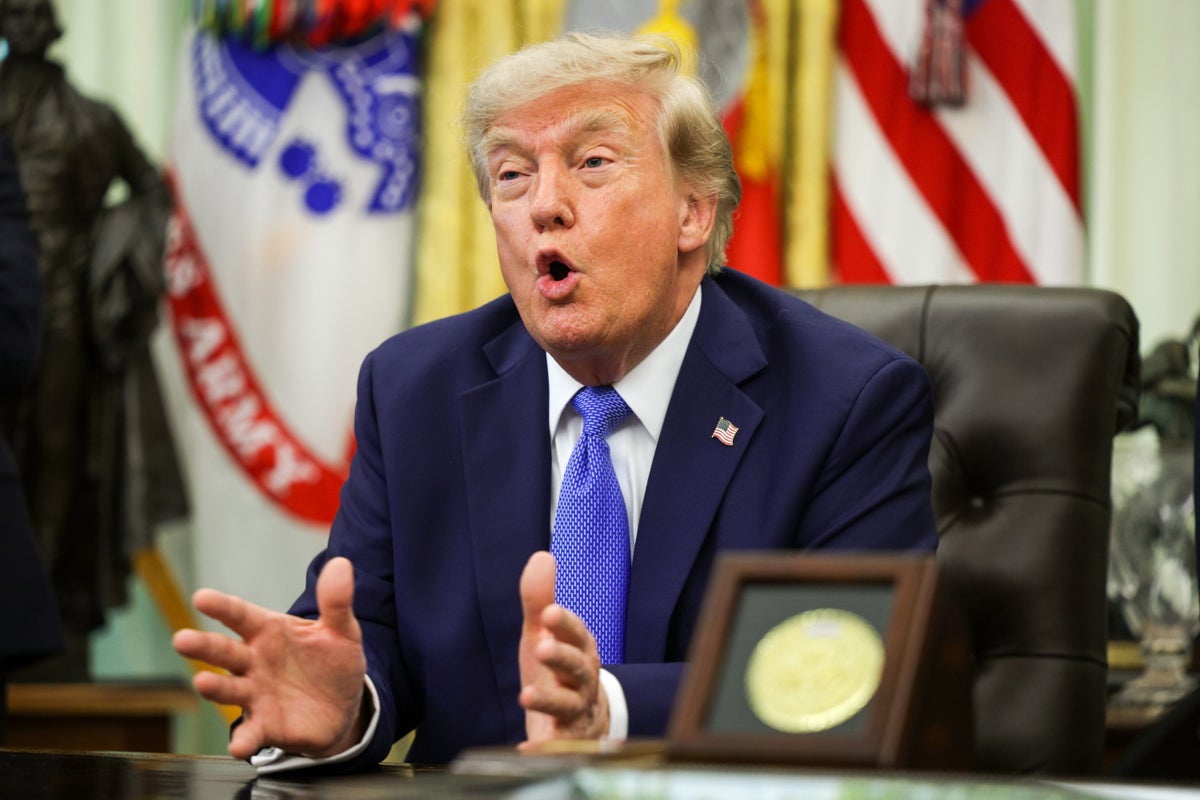
A federal judge has blocked Donald Trump’s second attempt to limit birthright citizenship after the president struck out at the Supreme Court with his sweeping order to unilaterally rewrite the 14th Amendment.The ink on the Supreme Court’s decision affirming birthright citizenship this summer “had scarcely dried” when Trump fired off a second executive order that sought additional restrictions on who qualifies.“As the Supreme Court has made clear, however, the President cannot carve out new exceptions to birthright citizenship for children born within the United States and subject to its laws,” U.S. District Judge Christopher R. Cooper wrote Wednesday.The judge has also certified a broad class of plaintiffs covered by Wednesday’s injunction, including “children who are or will be unlawfully denied citizenship” under the terms of Trump’s latest order.“Children born in the United States and subject to its jurisdiction are American citizens from birth,” a rule that is embedded within the 14th Amendment and “deeply rooted in our legal tradition,” Cooper wrote.A federal judge has issued a preliminary injunction blocking Donald Trump from enforcing an executive order that sought to limit birthright citizenship, again, after losing on the issue at the Supreme Court (Getty)After a protracted legal battle, a divided ruling from the nation’s high court in June determined that children born in the U.S. to parents “unlawfully or temporarily present” are indeed “subject to the jurisdiction” of the U.S. and thus citizens at birth.One month later, Trump unveiled a pair of executive orders seeking to circumvent the Supreme Court decision.The president signed executive orders taking aim at children who were born to employees of foreign governments as well as the children of mothers who are accused of lying about their intentions for visiting the country while pregnant.Trump also tried to block citizenship to children whose parents are accused of being terrorists, as well as newborns in U.S. territories.But the Supreme Court “reaffirmed that birthright citizenship extends to all but three narrow categories of children, each long understood to be beyond the nation’s governing authority at birth,” including children of foreign officials with diplomatic immunity, children of enemy forces in hostile occupation of U.S. territory, and children born aboard foreign public ships.Outside of those long-established, rare circumstances, all children born on U.S. soil are citizens at birth, the Supreme Court affirmed.White House chief of staff Stephen Miller is among administration officials and Republican allies who want to redefine the 14th Amendment’s birthright citizenship principle, which determines that ‘all persons born or naturalized in the United States, and subject to the jurisdiction thereof, are citizens of the United States and of the state wherein they reside’ (Getty)“Citizenship is man’s basic right for it is nothing less than the right to have rights,” Cooper wrote Wednesday, quoting the Supreme Court’s 1958 decision in Perez v. Brownell.“The Citizenship Clause promises citizenship to practically all children born in the United States,” Cooper said.“Earlier this year, the Supreme Court kept that promise,” he added. “This Court does so again today by enjoining [the executive order’s] application as to the certified class.”The 14th Amendment’s citizenship clause plainly states that “all persons born or naturalized in the United States, and subject to the jurisdiction thereof, are citizens of the United States and of the state wherein they reside.”The Supreme Court’s 2026 decision on birthright citizenship marked the second time it has affirmed the principle, which has long been a target of anti-immigrant policymakers, including White House chief of staff Stephen Miller.Cooper’s injunction follows a lawsuit brought by the American Civil Liberties Union and other groups on behalf of people impacted by Trump’s latest executive order.“Enough is enough,” ACLU Immigrants’ Rights Project’s deputy director Cody Wofsy said in a statement in response to Judge Cooper’s latest ruling.“The Supreme Court has twice rejected efforts to gut birthright citizenship, in 1898 and again earlier this year,” he added. “Third time is not the charm, and the president needs to accept that birthright citizenship is the law of the land.”
Judge throws Supreme Court in Trump’s face in birthright citizenship rebuke
Full Article
Original Source
Read the full article at Independent →KhanList aggregates and links to publicly available news content. We do not host full articles from third-party sources. Always verify important information with original sources.