
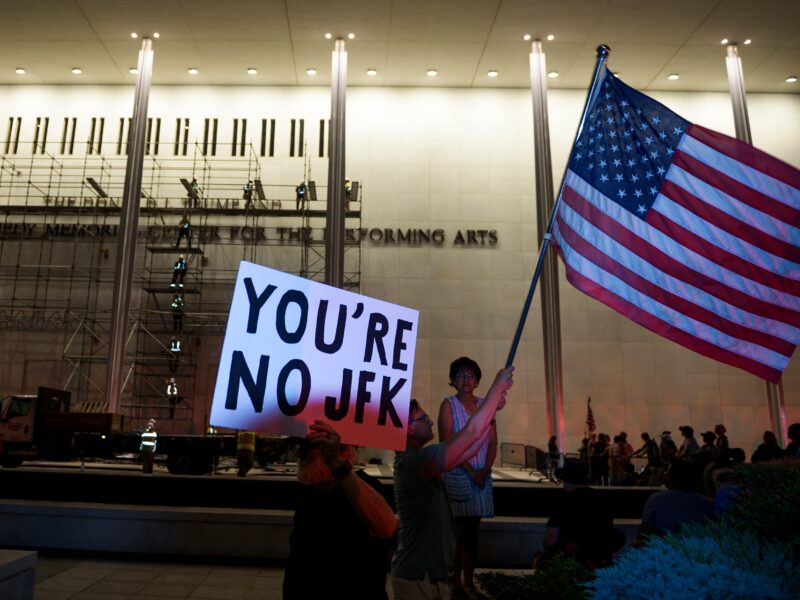
A Justice Department attorney suggested the government could rename other portions of the Kennedy Center complex after additional presidents or generous donors, as a congressional statute only protected the building itself.WASHINGTON (CN) — A federal judge expressed concern Thursday that the Kennedy Center Board of Trustees’ vote to again add President Donald Trump’s name onto the facade of the cultural center would violate his prior order to remove Trump’s name.U.S. District Judge Christopher Cooper ordered the hearing after Ohio Democratic Representative Joyce Beatty filed an emergency motion to block the resolution approved at an Aug. 13 board meeting that would begin work to install the inscription on Sept. 8.The new inscription would be placed under President John F. Kennedy’s name to read “Endowed by the Trump Kennedy Center Fund,” and the full complex surrounding the center would be further renamed the “President Donald J. Trump Plaza.”On May 29, Cooper ordered the government to remove Trump’s name from the building’s facade, where it read “The Donald J. Trump and the John F. Kennedy Memorial Center for the Performing Arts,” and further blocked the government from shutting the center down for two years that was set to begin July 6.Cooper found the board of trustees had overstepped its statutory authority by unilaterally renaming the Kennedy Center after the current president, citing the 1964 congressional bill that rechristened the building from the “National Cultural Center.”“Congress gave the Kennedy Center its name, and only Congress can change it,” Cooper wrote in his opinion.Justice Department attorney Brantley Mayers argued the inscription was intended as an acknowledgment of the president’s ongoing fundraising and restoration efforts and thus did not count as a memorial.He pointed to his opposition brief, in which he argued the center was in such a state of disrepair that any further judicial intervention would result in further structural and financial harm. Further, Mayers argued that even if the inscription counted as a memorial to Trump, Congress barred additional memorials only on the building itself, not on the surrounding complex or other buildings.Cooper seemed skeptical, noting the only additional names in the center — the Eisenhower Theater and the Sousa Concert Hall stage — were named before Congress specifically barred any additional memorials in 1983.“It’s your position that the board is authorized, consistent with Congress’ statutory intention, to maintain the building as the John F. Kennedy Center, but name the garage the Obama Center and the complex the Bush Center?” Cooper asked. “So that every single parcel could recognize a president or acknowledge a generous donor, the whole thing is up for sale?”Mayers said yes, also suggesting it could name a parcel after Cooper, a joke the judge quickly shot down.Nathaniel Zelinsky of the Washington Litigation Group, representing Beatty, argued the government was in “direct defiance” of the Barack Obama appointee’s permanent injunction against unilaterally adding the president’s name.He compared the government’s warning in its reply brief that it would demolish the Kennedy Center and replace it with an outdoor amphitheater if further blocked from closing it for renovations to a cartoonish mafia member making veiled threats.“My, what a nice Kennedy Center you have; it’d be a shame for something to happen to it,” Zelinsky said, asking Cooper to “put an end to this charade.”Cooper spent a significant portion of the hearing determining whether he still had jurisdiction to issue additional relief, as his May 29 decision was still pending before the D.C. Circuit Court of Appeals.If the new inscription and plaza renaming issues were related enough to the government’s first attempt to install Trump’s name on the building, he could issue a decision enforcing his initial injunction or modify it or issue a new order entirely.However, if the issue before him amounts to a new problem, he would be limited to an “indicative ruling” that would indicate to the D.C. Circuit how he would resolve the issue but carry no legal force behind it.Zelinsky argued Cooper clearly still held jurisdiction, as allowing the government to move forward would risk further harm to the building, as happened when contractors moved overnight in December to install Trump’s name onto the building’s facade.“They drilled into one-of-a-kind Italian marble; talk about an irreparable injury,” Zelinsky said.The fact contractors placed a white tarp covering where Trump’s name was installed shows the damage remains and would only worsen if his name were reinstalled, Zelinsky said.The Justice Department claims the center has lost tens of millions of dollars each year for decades and is projected to lose over $100 million per year moving forward. Congress approved $258 million in the Big Beautiful Bill last summer for the center’s restoration.According to the Washington Post, the center suffered significant revenue losses after Trump’s takeover and name change — through lost donors, decreased ticket sales and canceled artist shows — with projections showing the center earned about $100 million less in total revenue than anticipated.Secretary of Commerce Howard Lutnick, whose wife Allison Lutnick sits on the board, was also present in the courtroom.Subscribe to our free newslettersOur weekly newsletter Closing Arguments offers the latest about ongoing trials, major litigation and rulings in courthouses around the U.S. and the world, while the monthly Under the Lights dishes the legal dirt from Hollywood, sports, Big Tech and the arts.Additional Reads
Judge grills feds over bid to reinstall Trump’s name to Kennedy Center
Full Article
Original Source
Read the full article at Courthousenews →KhanList aggregates and links to publicly available news content. We do not host full articles from third-party sources. Always verify important information with original sources.