
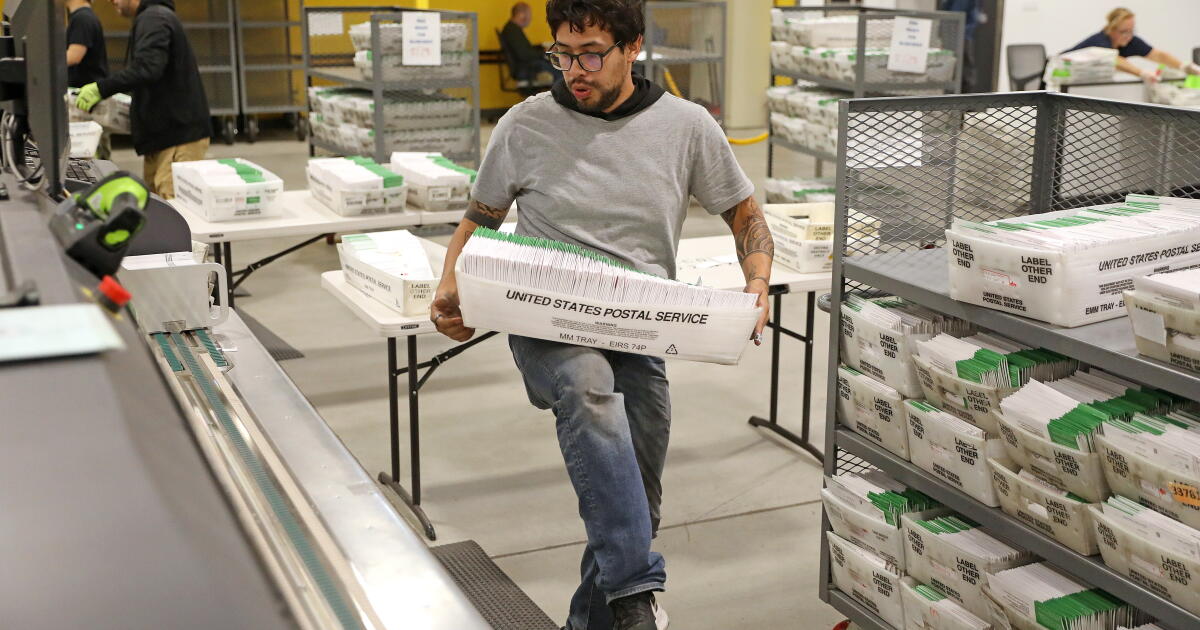
A federal judge again Friday blocked the U.S. Postal Service from enacting President Trump’s sweeping new mail ballot rules for the November election, finding that the Postal Service lacks such authority over elections and that neither it nor states such as California are capable of implementing the changes without causing chaos and disenfranchising voters.U.S. District Judge Indira Talwani noted that election officials from across the country told the court that it is “likely impossible” to comply with the rules, which “makes disenfranchisement more than likely, if not probable” if the Postal Service were to proceed with them. Talwani’s order — her latest of several halting the plan since this summer — came after a Postal Service whistleblower alleged the agency’s new computer systems for the project are fundamentally flawed; a top Postal Service official acknowledged a key online portal was unfinished; and the Trump administration filed an emergency petition asking the U.S. Supreme Court to allow the plans to proceed anyway.All this unfolded this week as some of the first mail ballots of the election cycle started going out.The new rules — which Trump required in a March executive order — would require states to submit complete voter lists to the Postal Service and to adopt new ballot envelopes with individualized voter bar codes designed by the Postal Service, and empower the Postal Service to reject any mail ballots that don’t match those lists.Trump’s executive order also required the Department of Homeland Security to develop its own lists of eligible citizen voters, ostensibly to be compared against the state lists. Trump has said the changes are necessary to combat widespread voter fraud, including by non-citizens, though independent election experts say there is no evidence that such fraud exists in large numbers.Leading Democrats and elections officials in California and other states say the new rules constitute an unlawful federal overreach into state-run elections and a thinly veiled effort by the Trump administration to suppress the vote in a midterm election the GOP is poised to lose. Talwani, an appointee of President Obama, agreed, finding that the states and voting rights groups are likely to succeed in their claims that the U.S. Constitution reserves the right to regulate elections to the states and Congress — not the executive branch.Talwani issued her order after holding a contentious hearing in federal court in Boston on Thursday, where she questioned the Postal Service and the dozen conservative-led states supporting it on their ability to implement the changes in time for the Nov. 3 elections. She also heard from California, other liberal-led states and voting rights groups that it would be impossible.California Atty. Gen. Rob Bonta, whose office is helping lead the states’ challenge, hailed Talwani’s order as a crucial reprieve.“We’ve now secured longer-term relief that will keep the USPS changes blocked while our case moves forward,” Bonta said in a statement to The Times. “We will continue to take all steps to stop the Trump Administration from trampling on voting rights and restricting mail voting.”Bonta’s office also criticized Department of Justice attorneys for rushing to the Supreme Court before Talwani could issue her order or the U.S. 1st Circuit Court of Appeals could weigh in on an appeal the department had already filed on the matter.Walter Garcia, a Bonta spokesman, said the Justice Department had “flouted standard procedural rules” by approaching the high court before the lower courts had weighed in, despite the fact that the Postal Service acknowledged Thursday that it was not ready to launch its new portal.“It defies common sense that they would seek emergency relief from the U.S. Supreme Court when USPS is unprepared to implement the rule now,” Garcia said. State law requires that all registered voters be sent a ballot in the mail, and more than 80% of California voters have used those ballots to vote in recent elections. In its emergency petition to the Supreme Court, the Trump administration argued that an earlier temporary restraining order by Talwani to halt the new rules from taking effect was “baseless” and would cause “serious irreparable harm” to the federal government, states and voting public.“To forestall those harms and protect the public interest, this Court should grant an immediate stay, making clear to States that they should begin efforts to comply if they have not done so already,” wrote Solicitor Gen. D. John Sauer. The swirl of litigation has created uncertainty around the Nov. 3 election. It also reflects the Trump administration’s desperate race to get the lower court orders lifted and the new rules implemented in time for that election — the rushed nature of which was a prime focus of the whistleblower.The unidentified Postal Service employee alleged in a statement released Tuesday by congressional Democrats and submitted in court by Bonta’s office that the agency has been rushing to implement the changes — in defiance of an earlier court order — using “an entirely new and untested set of IT systems” that could cause “catastrophic problems” and disenfranchise millions of voters nationwide.The Postal Service in a statement Friday said that while its system was developed on an “accelerated schedule,” quality and security standards “were not compromised,” and the agency stands behind “both the rigor of our process and the resulting system.”At Thursday’s hearing, Talwani appeared frustrated when a Justice Department attorney was unable to tell her the status of the portal.In a subsequent declaration hours later, Steven W. Monteith, the Postal Service’s chief customer and marketing officer, said officials were still making “refinements” to the portal, but anticipated being able to make it available “for voluntary use by sometime next week.”Talwani previously issued an order blocking the Postal Service changes from being implemented in California and more than 20 other suing states in June. The Trump administration appealed that decision to the 1st Circuit, which declined to lift it, and then on an emergency basis to the U.S. Supreme Court. In early August, Talwani issued a second ruling for the League of Women Voters and other voting rights groups, blocking the changes nationwide.On Aug. 24, the Supreme Court set aside Talwani’s order in the states’ case, finding that the states’ challenge was essentially premature because the Postal Service had yet to formally initiate the changes or require state compliance. However, the court explicitly noted that it was not reaching any conclusions as to the legality of the pending rules themselves. “On that score, time will tell,” it said.The states and voting rights groups promptly filed new lawsuits challenging the legality of the rules, which the Postal Service formally issued Aug. 21. And it is in those cases that Talwani issued her ruling Friday.She wrote that the voting rights groups had standing to challenge the Postal Service rules nationwide in part because the “chaos” created by the rules’ stiff deadlines significantly interfered with their mission to provide voters with accurate and reliable information about how to vote — and whether to use mail ballots to do so.David Becker, executive director of the nonpartisan Center for Election Innovation & Research, said in remarks prior to Talwani’s Friday order that he was “very, very confident” that the Postal Service changes will be blocked for the upcoming elections, and that “mail voting is going to go forward as conveniently and securely as it always has.”That’s in part because election officials nationwide are “telling the courts that even if they wanted to, they could not implement it,” he said — including in a legal filing Becker helped nearly 100 local elections officials from red and blue states file in separate litigation challenging the rules. More to Read
Judge again halts USPS mail ballot plan as Trump administration seeks Supreme Court relief
Full Article
Original Source
Read the full article at Latimes →KhanList aggregates and links to publicly available news content. We do not host full articles from third-party sources. Always verify important information with original sources.