It is a name that comes up almost reflexively whenever a very large sum of money is involved, in a bailout, a mega IPO, a government bond sale, or a headline about Wall Street. JPMorgan Chase has now given the world fresh reason to say it again.The bank has just reported a record profit for the second quarter, the highest ever posted by a US bank in a quarter, according to LSEG data, as cited by Reuters. It is also, independently, the best quarter in JPMorgan's own 226-year history. Two different records, set at the same time, by the same set of numbers.That combination is large enough, and strange enough, to make a genuine case study out of a question that sounds simple but isn't: how big is the world's biggest bank, actually?THE TRIGGER: A RECORD QUARTER, AGAINJPMorgan Chase reported second-quarter 2026 net income of $21.2 billion, or $7.70 a share, up sharply from $14.99 billion, or $5.24 a share, a year earlier, Reuters reported. Analysts polled by LSEG had expected only $5.78 a share. Revenue rose across every business line at the bank, per Reuters. A wave of big-ticket IPOs and dealmaking pushed investment banking fees to their highest level since 2021, led by Elon Musk's SpaceX, whose Nasdaq listing was the largest in history and on which JPMorgan was a lead underwriter. Equity trading revenue jumped 86% year-on-year, and the value of global mergers and acquisitions announced so far in 2026 has crossed $3 trillion, according to Dealogic data cited by Reuters."The US economy has demonstrated notable resiliency this year, with stronger business investment and hiring," CEO Jamie Dimon said, adding that the strength was being supported by AI-driven capital investment, fiscal stimulus and more efficient regulation. The stock actually fell more than 2% in premarket trading despite beating estimates, after the bank raised its full-year 2026 expense forecast to $107.5 billion from $105 billion, a reminder that even a record quarter gets scrutinised by investors on the fine print.Dimon also flagged risks sitting beneath the surface: geopolitical tensions, sticky inflation, large fiscal deficits and elevated asset prices, according to analysts who covered the earnings call. JPMorgan and Bank of America's results are widely watched as an early barometer for the health of the US economy, since they offer a direct read on consumer spending, borrowing and business activity.ASSETS VS VALUE: TWO WAYS TO MEASURE "BIGGEST"Here is the twist most headlines miss: JPMorgan is not the world's biggest bank by assets. That title belongs to China's Industrial and Commercial Bank of China (ICBC), which held $7.65 trillion in assets at the end of 2025, according to S&P Global Market Intelligence.TOP 5 BANKS BY TOTAL ASSETS (end-2025)ICBC (China): $7.65 trillionAgricultural Bank of China: ~$6.98 trillionChina Construction Bank: ~$6.2-6.3 trillionBank of China: ~$5.6-5.8 trillionJPMorgan Chase (USA): $4.4 trillionAll four of China's state-owned lenders outrank JPMorgan on sheer balance sheet size. But flip the metric to market capitalisation, essentially what investors think the bank is worth, and the picture reverses entirely.TOP 10 BANKS BY MARKET CAPITALISATION (April 2026)JPMorgan Chase (USA): $844.2 billionICBC (China): $426 billionBank of America (USA): $382.2 billionChina Construction Bank: $375.4 billionAgricultural Bank of China: $362.7 billionHSBC (UK): $314.1 billionMorgan Stanley (USA): $300.6 billionBank of China: $275.8 billionGoldman Sachs (USA): $275 billionWells Fargo (USA): $250.8 billionJPMorgan is worth more, by market value, than Bank of America, Citigroup and Wells Fargo combined. Investors are effectively paying up for US banks relative to their Chinese peers, largely because of profitability, capital efficiency and regulatory transparency, rather than raw balance sheet size, analysts tracking global banking stocks say.THE $10 TRILLION-A-DAY BANKThe most striking illustration of JPMorgan's scale comes from Dimon himself. In a CNBC "Money Movers" interview, he described the bank's payments operation running non-stop, saying: "We already move $10 trillion a day quite effectively, efficiently, safely." CNBC's own separate reporting corroborates this independently, noting that more than $10 trillion moves over JPMorgan's global payment rails every day.Dimon has also spoken, across various interviews over the years, about the sheer breadth of who the bank serves: multinational corporations across dozens of countries, as well as institutions including the IMF, the World Bank and the US government itself. It is, by his own framing, precisely why a bank at this scale is structurally necessary rather than merely large for its own sake.For scale, JPMorgan's single day of payment flows is worth more than double India's entire projected 2026 GDP. Put differently, its payment rails move more money in roughly six months than India produces in economic output across a full year.JPMORGAN VS INDIA'S BIGGEST LENDERSSet against India's largest banks, the gap is stark on both metrics. On total assets, State Bank of India (SBI) held 83.21 lakh crore (about $870 billion) in the latest FY26 figures, HDFC Bank 49.08 lakh crore (about $510 billion), and ICICI Bank 29.14 lakh crore (about $300 billion).That makes JPMorgan roughly five times the size of SBI, India's biggest lender, 8.6 times HDFC Bank, and nearly 15 times ICICI Bank on assets alone. Stack all three together and JPMorgan is still around 2.6 times bigger.On market capitalisation, HDFC Bank (~$137 billion), SBI (~$109 billion) and ICICI Bank (~$106 billion) add up to roughly $352 billion, meaning JPMorgan alone is worth close to 2.4 times India's three biggest banks combined.Interestingly, the valuation gap is slightly narrower than the assets gap, a sign that markets are pricing in India's long-term credit growth story even as the absolute size gap with JPMorgan remains vast, according to analysts who track Indian banking stocks.Worth noting: S&P Global's data showed SBI briefly overtaking ICICI Bank for India's number two spot after a sharp sell-off tied to Middle East tensions earlier in 2026, a reminder that these rankings shift with market conditions.BIGGER THAN NATIONSJPMorgan's balance sheet dwarfs entire economies. Its $4.4 trillion in assets exceeds India's projected 2026 GDP of $4.15 trillion (IMF estimate), and roughly matches the UK's ($4.26 trillion) and Japan's ($4.38 trillion) entire national output.It is also larger than the combined GDP of the entire African continent, all 54 countries put together, at roughly $3.56 trillion.By market value, JPMorgan alone is worth more than double Pakistan's GDP (~$386.5 billion) and more than double Nigeria's GDP (~$377 billion), two of the world's most populous nations.It takes South Africa and Egypt's economies combined (~$910 billion) to roughly match what investors believe one American bank is worth. It is worth flagging that assets are a stock (a snapshot of the balance sheet) while GDP is a flow (annual output), so the comparison is illustrative of scale rather than a like-for-like measure, but the gap remains striking either way.FROM A MANHATTAN WATER COMPANY TO WALL STREET'S BIGGEST NAMEJPMorgan Chase's roots trace back further than most realise. In 1799, Aaron Burr founded The Manhattan Company, ostensibly a water utility, whose banking arm eventually evolved into Chase Manhattan Bank. Separately, in 1871, John Pierpont Morgan founded J.P. Morgan & Co, the private banking house that famously organised financial rescues during the panics of 1893 and 1907, decades before the US Federal Reserve existed.The modern company took shape in 2000, when Chase Manhattan Corporation merged with J.P. Morgan & Co to form JPMorgan Chase & Co. A pivotal 2004 merger with Bank One Corporation brought in Jamie Dimon, who became President and Chief Operating Officer, then CEO from January 1, 2006, and Chairman a year later, a role he still holds two decades on.The 2008 financial crisis reshaped the bank considerably. JPMorgan remained profitable through the crash and, at regulators' urging, acquired the collapsing Bear Stearns and the banking operations of Washington Mutual, significantly expanding its footprint.Like other large US banks, it also received capital under the government's TARP programme in 2008, funds Dimon has said the bank did not need but accepted at regulators' request to avoid stigmatising weaker lenders; JPMorgan repaid the funds within a year, with interest.The bank opened a new global headquarters at 270 Park Avenue in New York in October 2025 and has now posted record annual profit in five of the last eight years.THE CONTROVERSIES: LONDON WHALE, MADOFF AND EPSTEINJPMorgan's size has come with a long and expensive legal history. The most infamous episode is the 2012 "London Whale" scandal, when a London-based trader's high-risk derivatives bets resulted in losses of roughly $6.2 billion. The bank ultimately paid around $920 million in fines to US and UK regulators and admitted violating securities laws, with Dimon later calling the affected trading strategy "flawed, complex, poorly reviewed, poorly executed and poorly monitored."Before that, in the run-up to the 2008 crisis, JPMorgan and Washington Mutual had packaged and sold mortgage-backed securities that investors say caused significant losses. The bank agreed to a $13 billion settlement with the US Department of Justice in 2013 to resolve related claims, one of the largest such settlements by any single company in US history.JPMorgan also paid roughly $2.6 billion in fines and penalties over its historical banking relationship with Bernie Madoff, the operator of history's largest Ponzi scheme, after regulators found the bank had failed to flag suspicious activity for years.More recently, in 2023, the bank agreed to pay $75 million to the US Virgin Islands to settle claims that it had turned a blind eye to sex trafficking by the late financier Jeffrey Epstein, a former client, in order to preserve a lucrative business relationship. JPMorgan did not admit liability in that settlement.ACHIEVEMENTS: RECORDS, RESILIENCE AND REACHSet against that legal history is a run of genuine financial milestones. JPMorgan overtook Bank of America to become the biggest US bank by assets in late 2011, a position it has held ever since. It has posted record annual net income in 2018, 2019, 2021, 2023, 2024 and now looks on track to do so again in 2026, having already logged a record-breaking second quarter.Cumulative net income between 2016 and 2025 alone comes to roughly $398 billion, drawn from the bank's own quarterly filings and 10-Ks. Following its record second quarter, JPMorgan is closing in on becoming the world's first bank to reach a $1 trillion market capitalisation, a milestone flagged by financial news outlets in July 2026. Its 2026 technology budget of nearly $20 billion, skewed heavily toward artificial intelligence, payments modernisation and cybersecurity, is also among the largest of any financial institution globally.Its wealth management arm alone posted record client asset inflows of $553 billion in 2025, taking total client assets to $7.1 trillion, larger than the GDP of every country in the world except the United States and China.For a reader in India, JPMorgan's scale is not just a curiosity, it is a preview. As Indian banks like SBI, HDFC and ICICI continue their rapid growth, and as India's economy closes in on becoming the world's third largest, the trajectory of an institution like JPMorgan offers a working model of what banking at true global scale eventually looks like: immense profitability, deep entanglement with sovereign institutions and governments, relentless technology investment, and a legal rap sheet that scales right alongside the balance sheet.JPMorgan's record quarter is, in the end, a reminder that being "the biggest bank in the world" depends entirely on which ruler you use. By assets, it is not even first. By value, by profit, by sheer daily movement of money, and by its reach into the world's financial plumbing, few institutions on earth come close.- EndsPublished On: Jul 18, 2026 12:57 IST
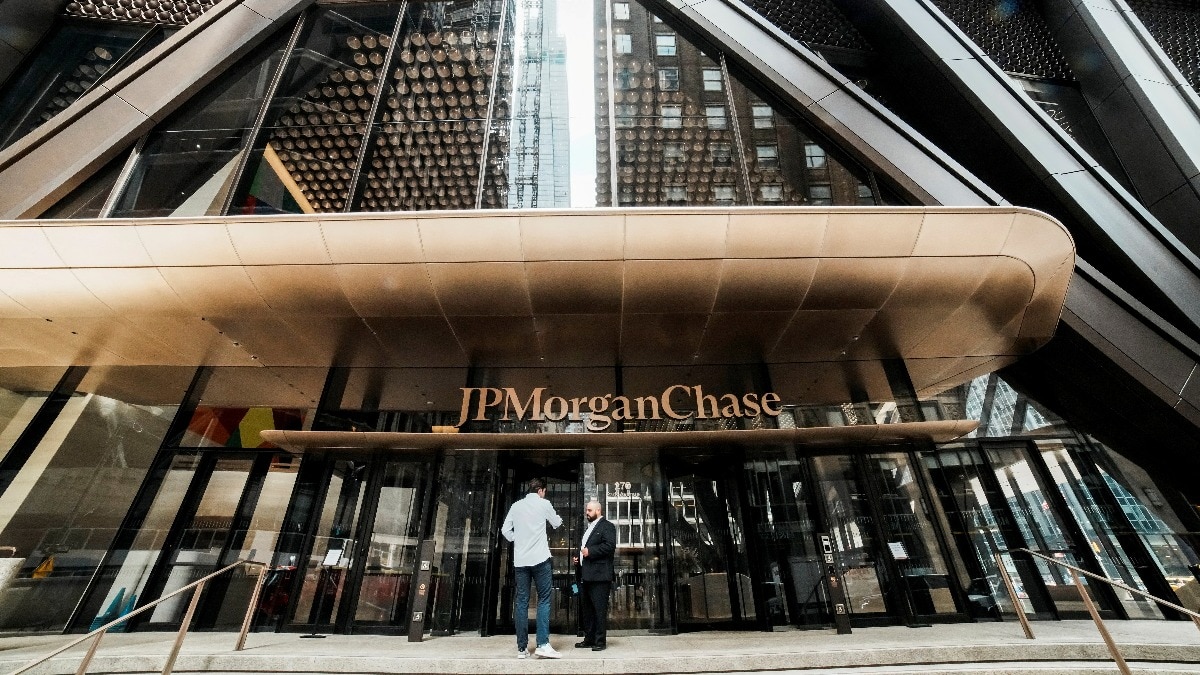
JPMorgan just posted record profit. How big is the world's biggest bank, really?
Full Article
📰 Original Source
Read full article at Indiatoday →KhanList aggregates and links to publicly available news content. We do not host full articles from third-party sources. Always verify important information with original sources.