
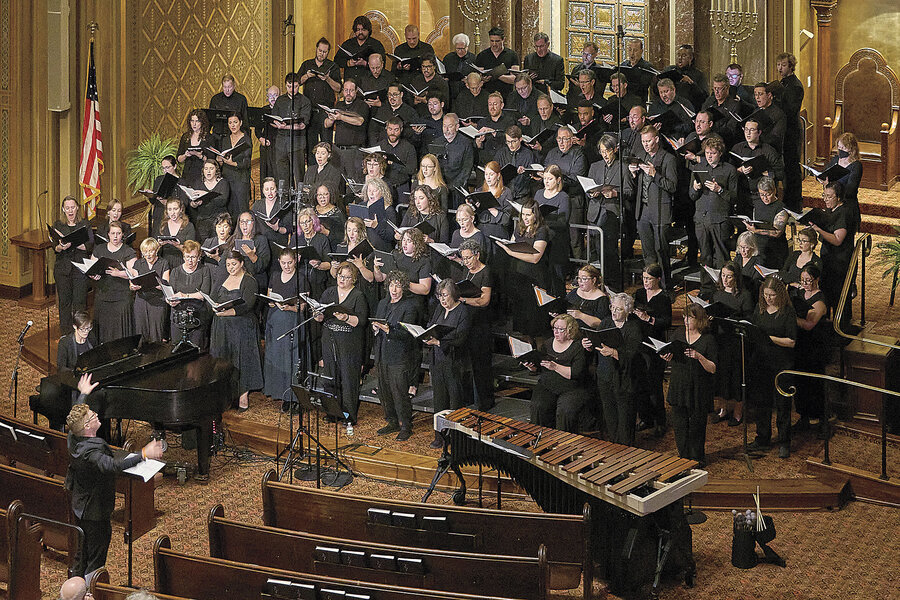
It’s one thing to write a poem. It’s another thing to hand it to 150 singers, and then hope they don’t decide your favorite line needs another syllable. Poets, after all, become attached to their words.I had been paired with Ted Babcock, a composer and percussionist, for Joyful Abundance, a yearlong initiative of the 152-year-old Mendelssohn Chorus of Philadelphia. Under the direction of conductor Dominick DiOrio, the chorus has long looked beyond the traditional choral repertoire, collaborating with living composers and artists in ways that keep a historic institution engaged with the present. We were one of five pairings of poets and composers invited to create new works for ArtPhilly’s What Now: 2026 festival. Ted loved the poem. Then came the difficult part. He gently explained that a three-to-five-minute choral work simply couldn’t accommodate all the words I’d written. He apologized before suggesting that I might read the complete poem before the performance, while the chorus sang a shorter version. His message was gracious yet devastating. I believed every word had earned its place.My mentor poet, Kirwyn Sutherland, understood that it wasn’t about trimming lines, but about learning a new language. “Give the poem a rhythm the voices can ride,” he encouraged. Ride, not merely pronounce. Ride. I was writing for breath, for cadence, for 150 people who would have to inhale together before they could carry a thought into the room. Why We Wrote This A poet is inspired by how a composer and large chorus breathe connection into her work. Mr. DiOrio encouraged us to see collaboration not as surrendering our individual vision, but as inviting another artist to strengthen it. That required trust. I’d spent years learning to hear my own voice. Now, I was being asked to imagine what might happen when it encountered someone else’s.My poem “Electric Bloom” asks a country approaching its 250th anniversary to examine itself. The poem remembers those who have invested their labor, imagination, sacrifice, and hope in America, especially those who were denied full participation in its promises. On the page, the words felt intimate. I had no idea what they would become in choral interpretation. Dominick DiOrio, artistic director and conductor, and Ted Babcock, composer, pose with Octavia McBride-Ahebee, whose poem premiered as part of Joyful Abundance. Having attended Mendelssohn Chorus performances for years, often alongside the Philadelphia Orchestra, I knew the extraordinary musicianship these singers possessed. I trusted that they would discover layers in my poem I hadn’t known were there. Even with that confidence, nothing prepared me for the first rehearsal.Sitting beneath the great skylight inside Rodeph Shalom’s magnificent sanctuary, surrounded by luminous stained glass, painted walls, intricate mosaics, and soaring arches, I shifted in my chair. Then, the chorus began.“Here we are, here we are, and who are we?”One hundred and fifty voices transformed a refrain I had written alone into something both beautiful and urgent. The question no longer belonged only to me, but to everyone in the room. As the voices gathered strength, I heard not only the singers before me but also generations of people who had built this country while being denied its full embrace. I heard Indigenous voices. I heard enslaved Africans and their descendants. I heard women, immigrants, laborers, dreamers, teachers, artists. I heard everyone who had insisted, across centuries, about what America could become. Hearing my words sung revealed intentions I hadn’t fully understood myself. That is a great gift of collaboration: Another artist discovers your meaning before you do.As I watched the rehearsal unfold, I found myself studying the singers. Many were public school teachers, as I had been for over three decades. Their expressions revealed not simply technical excellence, but also emotional investment. Even more remarkable was their response to feedback from both poets and composers. A phrase would be adjusted, a balance reconsidered, an entrance refined. Somehow, the passage would emerge richer than before. There was no defensiveness or bruised ego. There were only artists listening carefully to become better together.It struck me that this rehearsal embodied the very question my poem was asking of the country. What if we approached one another with the same willingness to listen, revise, and begin again? What if collaboration were understood not as compromise but as collective possibility?On performance day, sunlight poured through the stained glass and settled softly over the audience. As the chorus began, Ted accompanied it on the marimba. The instrument, brought to the Americas with the African slave trade, echoed another history of endurance, creativity, and cultural inheritance.When the final line, “This harvest belongs to us all,” arrived, the chorus repeated it with such melodic force that the words seemed to fill every corner of that extraordinary space. For a moment, architecture, music, and poetry became indistinguishable. People often ask what it feels like to hear your own work performed. The truth is, it no longer felt like my work alone. The chorus had breathed life into words that, until then, had existed only in the solitude of my notebook.A poet begins alone. A chorus reminds her that she doesn’t have to stay there.Joyful Abundance, part of ArtPhilly’s What Now: 2026, brought together and premiered the original works of five poets and five composers: poets Evan Wang, Naila Francis, Amy Beth Sisson, Haley Storm, and Octavia McBride-Ahebee, and composers Baldwin Giang, Barbara Lewandowski, Leigha Amick, Adelina DiGiacomo, and Ted Babcock.Drifting I can always Tell when I Begin to drift, Fiddling with things Inconsequential, losing Myself in conversations With the dogs, My foot finding One of their Bellies to rub – Talking while they Listen and nod In agreement as The sun pours Through the windows And the clouds so High and puffed white Pull us away Into the arms Of the muse And a poem From which thereIs no escape.– William Young
Joyful collaboration
Full Article
Original Source
Read the full article at Csmonitor →KhanList aggregates and links to publicly available news content. We do not host full articles from third-party sources. Always verify important information with original sources.