
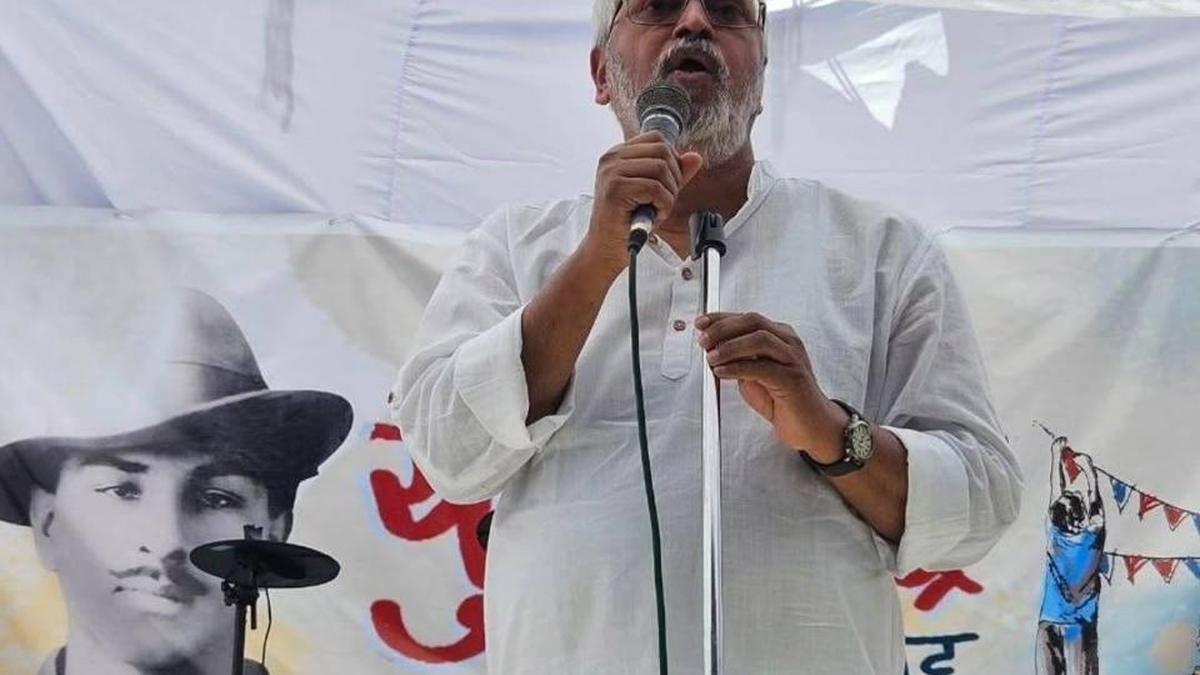
A plea has been taken by counsel for Satyam Verma that he should be granted bail on parity with a co-accused who had been granted bail in the same case on June 23. File | Photo Credit: The Hindu The story so far: The Allahabad High Court on Tuesday (September 15, 2026) deferred the hearing on the bail plea of freelance translator and former journalist Satyam Verma in one of the 11 criminal cases registered against him in connection with the April 2026 Noida workers’ protest after the state counsel sought an opportunity to file objections to his bail plea on the ground of parity.A plea has been taken by counsel for Mr. Verma that he should be granted bail on parity with a co-accused who had been granted bail in the same case on June 23.However, after the state counsel later sought an opportunity to oppose bail on the grounds of parity, the matter was posted by the court for consideration on the State’s objections on September 23.What is the principle of parity?The principle of parity means that individuals involved in similar offences and circumstances should generally receive comparable sentences.However, parity does not mean identical sentences. Courts must consider the individual circumstances of each case, including aggravating and mitigating factors. The principle aims to ensure fairness and prevent unjustified differences in sentencing.The purpose of the parity principle is to ensure that people in substantially similar circumstances are not given disproportionately different sentences. At the same time, it does not replace the need for individualised sentencing.In bail cases, the principle of parity is generally invoked when a co-accused in the same case has already been granted bail. The accused may argue that they are similarly placed and should therefore receive similar relief.The principle can also be raised where a co-accused has been acquitted, but this does not automatically entitle another accused to bail.Parity is not an absolute right. Courts must examine the circumstances and role of each accused separately. For example, an absconding accused cannot automatically seek anticipatory bail merely because other co-accused have been acquitted.An acquittal is based on the evidence relating to the accused who was tried. It does not automatically benefit a person who remained absconding and did not face the trial.Similarly, findings made during the trial of the co-accused cannot simply be treated as deciding the case of an absconding accused.Also read: Ray of hope: On courts and reflexive arrestsGranting an absconding accused anticipatory bail solely on the ground of parity could also undermine the judicial process by rewarding a person who evaded it.What have the courts said about it?On parity, it is necessary to refer to Ramesh Bhavan Rathod v. Vishanbhai Hirabhai Makwana(Koli) and Anr.(2021). The Supreme Court observed that while utilizing parity as a ground for bail, the same must focus on the role of the accused and cannot be utilised solely because another accused person was granted bail in connection with the same offence, and neither can this ground be claimed as a matter of right.The Court observed that in deciding the aspect of parity, the role attached to the accused, their position in relation to the incident and to the victims is of utmost importance.In Neeru Yadav v. State of U.P.(2015), the Supreme Court has held that while applying the principle of parity, the High Court cannot exercise its powers in a capricious manner and has to consider the totality of circumstances before granting bail.In February 2026, the Supreme Court’s recent decision in Balmukund Singh Gautam v. State of Madhya Pradesh dealt with a situation where an absconding accused sought anticipatory bail after his co-accused had been acquitted. The Court held that such an accused cannot claim parity merely because the co-accused was acquitted. It also held that the absconding accused could not automatically rely on findings recorded during the co-accused's trial, since the prosecution was not required to lead evidence against him during that trial.A Bench of Justice Krishan Pahal was hearing Verma’s bail plea in Case Crime No. 164 of 2026, registered at Police Station Phase-2, Gautam Buddh Nagar. The FIR has invoked several provisions of the Bharatiya Nyaya Sanhita (BNS), Section 7 of the Criminal Law (Amendment) Act and Sections 3/4 of the Prevention of Damage to Public Property Act. On June 23, the High Court had granted bail to co-accused Shiv Kumar, also known as Shiva, in the same case. Published - September 16, 2026 04:13 pm IST
Journalist Satyam Verma's bail plea in Noida workers’ protest case: What is the principle of parity in bail cases? | Explained
Full Article
Original Source
Read the full article at Thehindu →KhanList aggregates and links to publicly available news content. We do not host full articles from third-party sources. Always verify important information with original sources.