
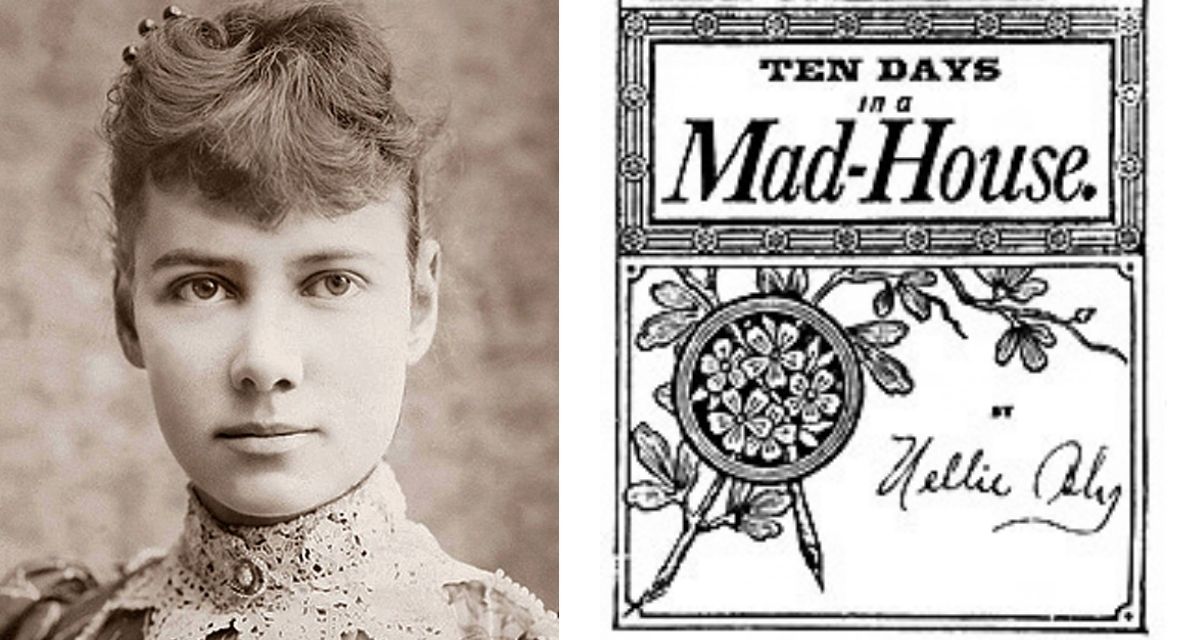
Being sent to an insane asylum in the late 19th century was a tragic sentence, especially for women. Imagine purposefully trying to get committed to one as a woman of a totally sound mind. That’s exactly what 23-year-old journalist Nellie Bly did in 1887. She’d been hired by Joseph Pulitzer (yes, that Pulitzer) at the New York World, and one of her first assignments was a doozy. She was asked to go undercover as a patient at New York City Lunatic Asylum and report on what she experienced there, which meant she had to convince enough experts and authorities that she was clinically insane. She didn’t intend to write a scathing exposé The undercover assignment wasn’t meant to be a “gotcha.” Bly explained in Ten Days in a Mad-House that the goal was to “write a plain and unvarnished narrative of the treatment of the patients therein and the methods of management, etc.” Her editor told her, “We do not ask you to go there for the purpose of making sensational revelations. Write up things as you find them, good or bad; give praise or blame as you think best, and the truth all the time.” In hindsight, Bly’s courage in taking on this task may have been aided by a bit of naivete. “I had no idea that my experiences would contain aught else than a simple tale of life in an asylum,” she wrote. “That such an institution could be mismanaged, and that cruelties could exist ‘neath its roof, I did not deem possible.” Mostly, she went in with curiosity. She did worry a bit about how she would get out once she got in, however. When she asked her editor, he responded, “I do not know. But we will get you out if we have to tell who you are, and for what purpose you feigned insanity–only get in.” How she prepared for her role as an insane woman Bly’s employers left the plan to get into the asylum entirely up to her. The only thing decided ahead of time was that she’d use the name Nellie Brown, so any monogrammed linens she brought would match her real initials. To prepare for her role, Bly practiced faces in the mirror, deprived herself of sleep, and consumed ghost stories. Then she checked herself into a boarding house for unfortunate women, where she would convince her housemates that she was insane. How did she do it? Primarily by acting paranoid, saying that she thought all the women in the house were crazy and that she was afraid she’d be murdered. The other women grew more fearful of her. When a kindhearted woman asked her a series of personal questions, Bly feigned amnesia. “Poor soul! How cruelly I tortured her, and what a kind heart she had!” Bly later wrote. “But how I tortured all of them! One of them dreamed of me—as a nightmare. After I had been in the room an hour or so, I was myself startled by hearing a woman screaming in the next room. I began to imagine that I was really in an insane asylum.” Eventually, one of the women in charge brought the police in, telling them she thought Bly was “a poor unfortunate who had been driven crazy by inhuman treatment.” Nellie Bly pretending to be insane. Photo credit: Public domain Convincing police, a judge, and experts that she was certifiable The police took her to a judge, who suspected that she must have been drugged and should be sent to the hospital for examination. “The judge told him [the doctor] to take me and to be kind to me, and to tell the people at the hospital to be kind to me, and to do all they could for me,” Bly wrote. “If we only had more such men as Judge Duffy, the poor unfortunates would not find life all darkness.” That doctor treated her kindly as he delivered her to the “experts” at Bellevue Hospital. There, she convinced several doctors that she was insane, primarily by pretending to have amnesia or saying she was from Cuba. She shared that one doctor asked if she was “a woman of the town,” along with other “senseless and useless” questions. “Positively demented,” that doctor declared. “I consider it a hopeless case. She needs to be put where someone will take care of her.” So Bly, having never known an insane person in real life, convinced a home full of women, the police, a judge, and four doctors that she needed to be committed to the Women’s Lunatic Asylum on Blackwell’s Island. Sketches of Nellie Bly being declared insane. Photo credit: Public domain Once she was in the asylum, she dropped the act. They still treated her like she was crazy. “From the moment I entered the insane ward on the Island, I made no attempt to keep up the assumed role of insanity,” Bly wrote. “I talked and acted just as I do in ordinary life. Yet strange to say, the more sanely I talked and acted the crazier I was thought to be by all except one physician, whose kindness and gentle ways I shall not soon forget.” Bly was shocked by the asylum’s conditions. She was bathed in ice-cold water and given a bed with a wool blanket too small to cover her whole body. Residents were given inadequate clothing and were freezing much of the time. The food was practically inedible and had to be “choked down.” Aside from the kind, gentle physician she mentioned, the workers treated patients with cruelty and disdain. Bly watched one resident get teased by nurses until she acted out, and then get slapped and choked into submission. She recorded several such instances of patients being deliberately provoked and then punished for losing their tempers. Some of the women there were definitely mentally ill, but some appeared to Bly to be perfectly sane. It didn’t seem to matter. “You have no right to keep sane people here,” she tried to tell the doctors at the asylum. “I am sane, have always been so, and I must insist on a thorough examination or be released. Several of the women here are also sane. Why can’t they be free?” The reply she received: “They are insane and suffering from delusions.” The horrors Bly recorded forced a grand jury investigation “The insane asylum on Blackwell’s Island is a human rat-trap,” Bly wrote. “It is easy to get in, but once there it is impossible to get out.” She had considered trying to get herself into the violent ward, but after hearing stories from fellow patients, she decided not to risk her health (or hair) by getting violent. But there was plenty of violence in the non-violent wards anyway. Bly documented everything she saw and experienced during her 10 days in the asylum. The unsafe and unsanitary conditions. The inadequate provisions. The cruelty and abuse. The fact that there were only 16 doctors for 1,600 patients, only two of whom she ever saw pay any attention to patients. The fact that she was continually treated as insane, despite showing no signs of insanity after her admission. Bly’s exposé made headlines and prompted official action. City aldermen appropriated an extra “$1,000,000 per annum” for improvements to the facility. A grand jury investigation ensued, after which the most abusive nurses and doctors were fired and replaced, translators were sent in for patients who didn’t speak English, and patients were given more nourishing food and sanitary living conditions. Journalist Nellie Bly around 1890. Photo credit: Public domain Nellie Bly changed mental health treatment and journalism forever Before Bly’s undercover work, no one from the outside knew what happened inside insane asylums. The Women’s Lunatic Asylum was not the only place where abuses of people with mental illness (as well as mentally well people confined against their will) took place. Bly’s exposé shone a much-needed light on how mental illness is treated, changing how the public and authorities saw it. Her work in the asylum also catapulted her into stardom as a journalist. Nellie Bly is often touted as the mother of investigative journalism because she pioneered the direct, hands-on approach to reporting. She later became famous for traveling around the world in 72 days, but her asylum investigation put her on the map and left an indelible mark on journalism and mental health treatment forever.
Journalist Nellie Bly faked insanity to secretly investigate New York City Lunatic Asylum in 1887
Full Article
Original Source
Read the full article at Upworthy →KhanList aggregates and links to publicly available news content. We do not host full articles from third-party sources. Always verify important information with original sources.