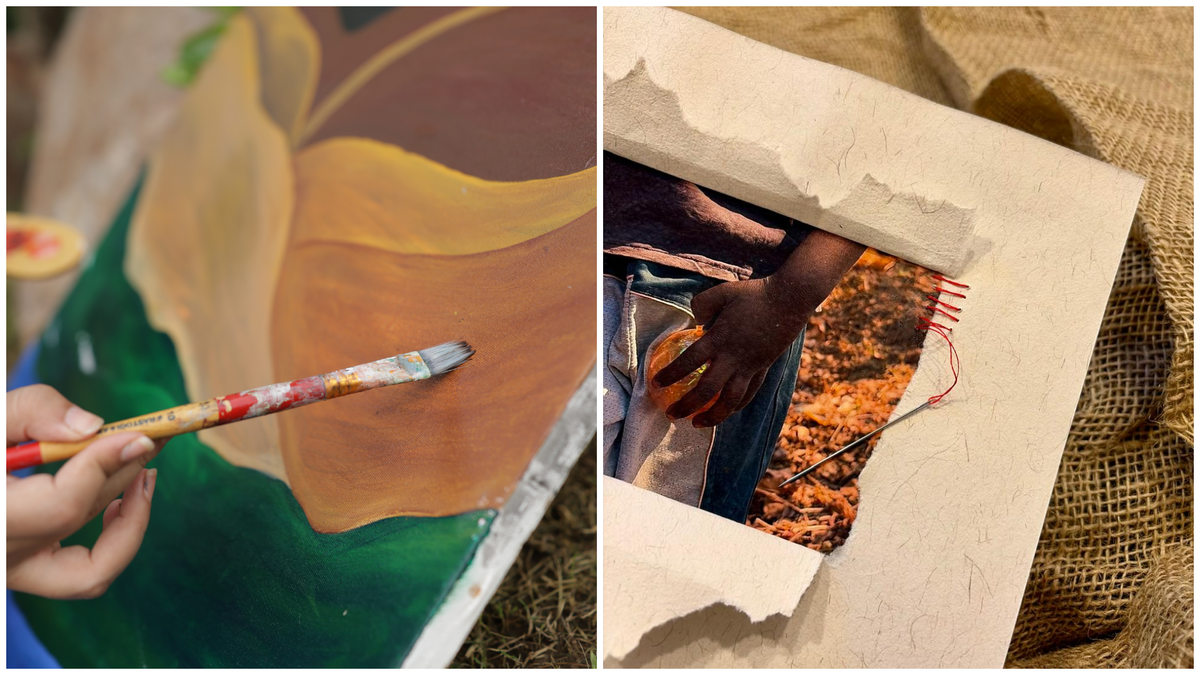
Jigyasa Mishra’s creations | Photo Credit: Special Arrangement A school bag stuffed with bricks. A mother’s breast still leaking milk, days after she was forced to bury her new born. An old book burnt because a 12-year-old bonded labourer dared to read a poem.These are stories journalist Jigyasa Mishra has reported over the past eight years while covering brick kilns, trafficking-prone villages, brothels, and remote settlements across India. Only this time, they do not appear as newspaper reports or magazine features. They have transformed into paintings, photographs, and immersive installations.Opening at Bikaner House on July 30, The Screaming Canvases is more than an art exhibition. It is journalism that has not ended with its date of publication. Jigyasa Mishra | Photo Credit: Special Arrangement The exhibition brings together 40 works: paintings, photographs, illustrations, and installations, drawn from Jigyasa’s years of reporting on human trafficking, bonded labour, child labour, and sexual exploitation. Every work emerges from field visits, interviews, and lived experiences, turning reportage into visual testimony. “I don’t believe in writing about an issue today and forgetting it tomorrow while chasing another story. Art allows me to continue telling those stories. It simplifies even the most complex issues while creating conversations around people who are often invisible,” she says.For the Lucknow-based independent journalist, painting was not a hobby discovered later in life. Her father, Jaishankar Mishra, is an artist and professor of Fine Arts, while her mother, Chandana, is a Madhubani artist. “I painted before I learnt to read and write,” reveals Jigyasa. The rescued 12 | Photo Credit: Special Arrangement Still, writing remained her primary tool for years. That changed while working on assignments for the People’s Archive of Rural India (PARI), where the emphasis on visual storytelling encouraged her to sketch and illustrate alongside her reporting. Gradually, those illustrations evolved into independent works. “I realised photographs, illustrations, and installations are also forms of journalism. Storytelling doesn’t have to remain confined to text,” she emphasises.Among the most moving works is an installation featuring an ordinary school bag filled with bricks. It tells the story of a 12-year-old boy trafficked with his parents to a brick kiln. One day, he paused work to read a poem from an old book to his younger sister. The contractor beat him and burnt the book. Jigyasa Mishra with her art | Photo Credit: Special Arrangement Another series of acrylic paintings focusses on women trafficked into brick kilns during pregnancy. Forced to carry bricks until childbirth, many had no access to medical care. One painting is based on a woman from Uttar Pradesh who escaped bonded labour in Rajasthan. When Jigyasa met her, she had lost her six-day-old baby just two days earlier and had been forced to bury the infant inside the brick kiln. She spoke of the constant pain of lactation that kept reminding her of the child she no longer held.Another striking work, The Trafficking Route, is inspired by survivors from the Sundarbans. Through bands of colour, it traces the journey from climate disaster to human trafficking: blue for floodwaters that swallowed homes, green for the fragile landscape left behind, ochre for Rajasthan’s brick kilns where exploitation often led to forced marriage, and black for the invisibility and captivity that followed.Jigyasa’s art is not intended to shock. Instead, it invites viewers to pause and empathise with lives marked by interrupted childhoods, stolen motherhoods, denied education, and eroded dignity. Even during her pregnancy, Jigyasa continued travelling to remote villages and brick kilns. Later, she often took her infant son along on assignments. “I wanted him to see the realities that exist outside our own lives. We are privileged enough to tell these stories,” she says.The Screaming Canvases will be on view at Bikaner House, Pandara Road, till August 2. Published - July 30, 2026 06:17 pm IST
Journalist Jigyasa Mishra turned years of reporting into art
Full Article
Original Source
Read the full article at Thehindu →KhanList aggregates and links to publicly available news content. We do not host full articles from third-party sources. Always verify important information with original sources.