
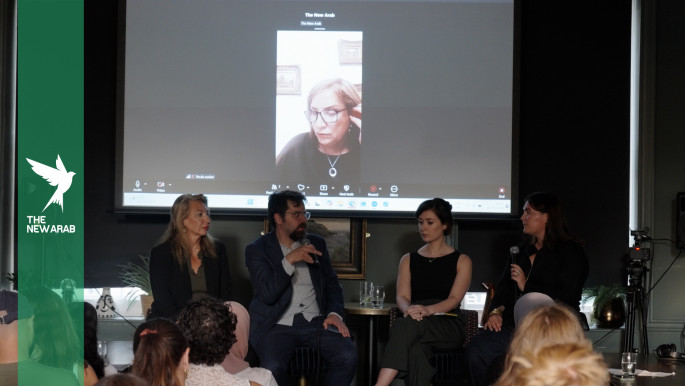
A joint TNA and ActionAid UK panel heard Mona Deeley [L] and Karim Traboulsi [second from left] discuss why Lebanon's overlapping crises continue to be overlooked [TNA]Lebanon's overlapping crises have been pushed to the margins of international attention despite years of war, economic collapse and mass displacement, speakers at a joint panel hosted by The New Arab and ActionAid UK argued in London on Wednesday. The discussion, titled 'Lebanon's Perpetual Crisis', explored why Lebanon continues to be overlooked despite enduring decades of conflict, political instability and humanitarian crises, most recently Israel's renewed military offensive, which has killed more than 4,300 people since 2 March. Part of the Unequal Lens Network, the event brought together journalists, academics, NGO workers and activists to examine the structural inequalities and double standards shaping Lebanon's place in international discourse. The panel also explored the role of women's movements, civil society organisations and the international community in responding to the country's successive crises. Moderated by ActionAid UK's Head of Media Frances Leach, the panel featured Karim Traboulsi, Managing Editor of The New Arab, Mona Deeley, CEO of the Reform Initiative for Transparent Economies, and Roula Zeaiter, Project Manager for the SPA II Project, funded by Danida and implemented in partnership with ActionAid. The discussion focused on Israel's invasion, displacement, economic collapse and the disproportionate impact of repeated crises on women, while also questioning how portraying Lebanese people as endlessly "resilient" can normalise suffering and reduce pressure for international action. "What we fail to do, as journalists and NGOs, is tell the right story about Lebanon. We are too zoomed in on certain crises and flare-ups without context," Traboulsi said. He argued that while Israel's war on Gaza and its military campaign in Lebanon unfolded simultaneously, Lebanon's humanitarian catastrophe received a far more limited international response. "One thing I noticed is that the Gaza genocide and war in Lebanon were happening at the same time, and it's not a competition in death tolls or suffering, but you could argue that in Lebanon, in every offensive from Israel, the death toll is bigger than the previous one," he said. Traboulsi said Lebanon's overlapping crises have been pushed to the margins of international attention despite years of war, displacement and economic collapse [TNA] "The number of IDPs reached around one million people, which is comparable to the displacement of civilians from north Gaza to the south and other parts," he said. "The purpose of this is to ask why one triggered a global wave of solidarity, whereas Lebanon was met with much more limited solidarity and response." According to Traboulsi, one reason for this is that Lebanon's political and social complexities often discourage audiences from engaging with the country. However, he argued that this ultimately reflects shortcomings in journalism, where conflicts are too often reported in isolation without the broader historical and political context. Drawing on Edward Said's concept of Orientalism, Traboulsi warned that preconceived notions about Lebanon create an image detached from reality, shaping both international media coverage and policy responses. "In my view, one of the biggest problems in terms of coverage is the denial of what's really happening," he added. Deeley argued that Lebanon's repeated instability cannot be separated from the failure of Western governments to uphold international law when it comes to Israel. "[One thing] that doesn't really get discussed is how much Western countries, and in this case the U.S. primarily as the main supporter of Israel, but also the EU or Europe, including the U.K. is what role they're playing in the instability of Lebanon by not abiding by international law or by exempting Israel from international law," she said. "Lebanon cannot be an island of stability even if Hezbollah is disarmed and Israel withdraws its occupation. In the midst of a region that is in constant conflict, and the reason it's in constant conflict is because international law is not being applied to Israel. It is in occupation of Palestinian territories, it's in occupation of Syrian territories, and it's in occupation of Lebanon," she added. Deeley said civil society organisations and the media have a responsibility to continue highlighting Israel's alleged violations of international law and the broader consequences of selective accountability. "When you disrespect international law, that has implications at home. It also has implications for domestic economies when the world is unstable. So I think all of us as civil society, but also as media, need to recentre international law," she said. Zeaiter said Lebanon is frequently misunderstood because international coverage often overlooks the cumulative impact of the country's successive crises dating back to the 1970s, while also failing to recognise the central role women have played in responding to conflict. She said women have long led initiatives, participated in conflict resolution and made significant contributions to Lebanese society, before calling for more reporters on the ground and sustained institutional funding for women's organisations. The discussion concluded with a question-and-answer session covering the diverse experiences of war across Lebanon, foreign influence in the country, and the continued portrayal of Lebanese people as inherently "resilient" in international media.
Joint TNA, ActionAid UK panel spotlights Lebanon's neglect
Full Article
Original Source
Read the full article at Newarab →KhanList aggregates and links to publicly available news content. We do not host full articles from third-party sources. Always verify important information with original sources.