
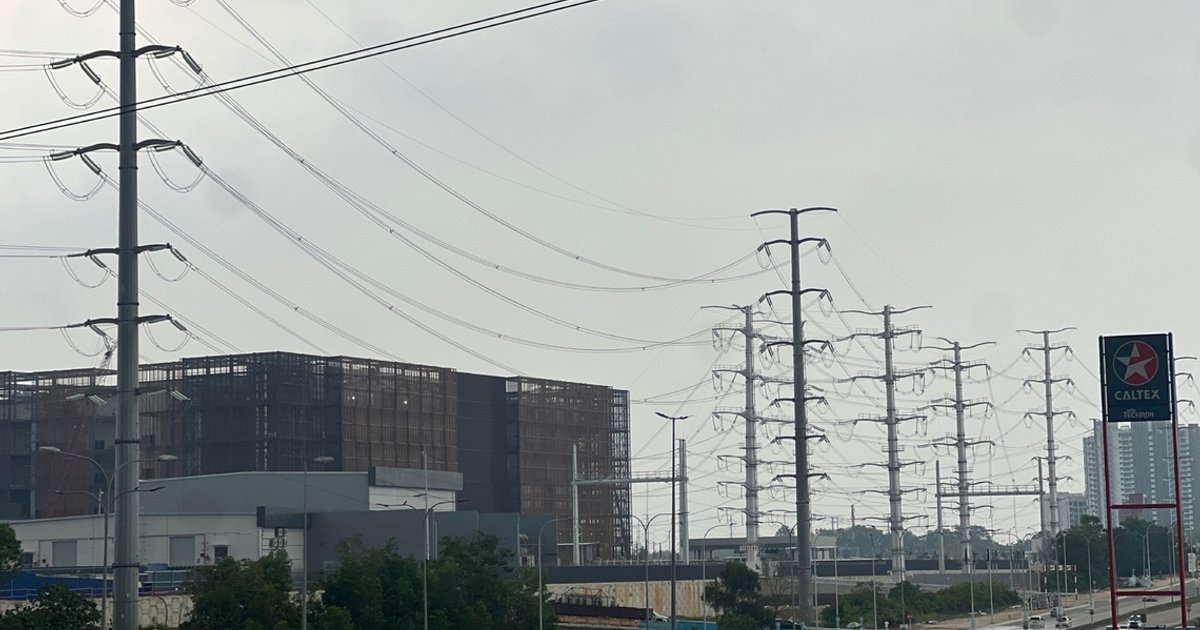
JOHOR BAHRU – In Iskandar Puteri’s upscale Eco Botanic enclave, owners are beginning to receive the keys to European-style terraced homes launched three years ago.Finance manager Lee Shi Qing bought a 2,293 sq ft terraced unit for around RM1 million (S$313,000) as her first matrimonial home in Johor. But after construction began on a nearby data centre and power transmission towers were erected, she put the property up for sale six months ago.“The land clearing for the data centre started last year, and the new pylons went up this year,” said the 38-year-old, referring to the 64-megawatt hyperscale data centre by TM Nxera, a joint venture involving Telekom Malaysia and Singtel’s digital infrastructure unit Nxera.“I do have some concerns about living close to high-voltage lines, which is part of why I’m selling,” she told The Straits Times.Johor’s data centre boom is bringing power transmission lines, pylons and industrial facilities closer to residential neighbourhoods, raising concerns over noise, the environment and the resale prospects of nearby homes. In a housing market already grappling with abundant supply, the new infrastructure could make some properties harder to sell, even if fears over health risks are not borne out by scientific evidence.“In the residential property market, perception heavily dictates pricing. Even if scientific evidence clears low-frequency electromagnetic fields of immediate danger, the real estate market prices in stigma, visual blight, and sensory disruption,” said Samuel Tan, chief executive of Johor Bahru-based property consultancy Olive Tree Property Consultants. “Properties next to or facing high-voltage pylons can lose a significant share of potential buyers.”National utility provider Tenaga Nasional, which is responsible for the country’s energy infrastructure, did not respond to The Straits Times’ e-mail queries by press time, while TM Nxera declined to comment.Near the Eco Botanic site in Iskandar Puteri, grey monopole transmission towers line the road. Residents have called them an eyesore.Lee said only two prospective buyers had made inquiries since she listed her property.“I think Eco Botanic is really a good place, but the problem with the property is that the market is too saturated,” she said, noting that more landed homes were being built nearby.Her concerns come amid a property glut in Johor. The state had 4,222 completed homes and 9,946 serviced apartments left unsold in the first half of 2026, the highest numbers in Malaysia, according to the National Property Information Centre, under the Valuation and Property Services Department.Electric transmission lines running along a row of shophouses at the Eco Botanic estate. ST PHOTO: HARITH MUSTAFFAData centre boom brings infrastructure pressuresThere are 65 data centre projects “in various stages of approval” in Johor, according to Natazha Harris, chief executive of state investment agency Invest Johor. Data centre tracker website Baxtel lists 31 already operational facilities in the state.Johor has benefited from data centre demand spilling over from Singapore, where land and power constraints led to a moratorium on new data centres from 2019 to 2022. Some of the southern state’s capacity was developed during that period.Its data centre capacity has grown from 10MW in 2021 to a live IT load of 1,110MW, making it Asia-Pacific’s third-largest market after Tokyo and Singapore, according to Knight Frank’s Data Centre Atlas 2026, released in August.The rapid expansion has also put pressure on utilities to upgrade infrastructure sooner than planned. “When data centres come in, they require huge loads... Utilities like TNB and (Johor water supplier) Ranhill SAJ had their master plans for 2030 or 2035, but because of this influx, they had to compress that timeline and bring those infrastructure upgrades forward to today,” said Natazha.ST’s checks using Open Infrastructure Map data and Google Earth historical imagery found more than 200 transmission towers around Iskandar Puteri, with about one in five apparently erected since late 2025. But it is not stated how many of these are data centre-related infrastructure.For residents, the question is whether the new infrastructure will affect not just their surroundings, but also their ability to sell their homes.Residents worry about noise, heat, resale prospectsEarlier this year, residents of Nusantara Prima and Nusa Bayu townships voiced objections to a data centre development near Persiaran Bayu in Iskandar Puteri, saying construction had caused dust to spread into their homes.Lim Soon Hai, an Iskandar Puteri municipal councillor, told ST that some residents living near data centres have complained about persistent humming noises and higher-than-usual temperatures, which they believe are linked to cooling-system emissions. “When data centres come online, they emit heat from their cooling system and that can cause the environment to become warmer,” he noted.PropertyGenie data shows median residential property prices of RM452 per sq ft in Nusantara Prima and RM409 in Laman Setia, both located within 500m of the data centre – compared with RM505 in Nusa Bayu, which is farther from the site. The figures provide a snapshot of prices in the three neighbourhoods, but do not establish that the data centre explains the differences.Nusantara Prima resident Mohanambal Rethinam, who runs a nearby kindergarten, said enrolment has fallen from 50 in 2025 to 20 in 2026.“We surveyed about 20 parents for feedback... and their top concern is the environment. ‘We are worried about the data centre in front of your school – your kindergarten is very near to it,’ they say,” she told ST. “If possible, I’d want to shift out of here. The environment has drastically changed – it’s warmer, dusty and it just feels very unconducive.”Another resident considering a move is Nooraini Jaafar, 68, who moved from Singapore to Nusantara Prima with her Singaporean husband 10 years ago. She said the data centre had replaced a once-cherished forested hillside, altering the neighbourhood’s character.The retiree bought her terraced home for around RM400,000 in 2014 and has been told it could fetch about RM600,000 today. “I had to wait 10 years to see some profit for my house, but I worry people might not be interested in it because they will have to contend with living near the data centre.”Cafe owner Danish Nordin, 28, who built his D’Mangan Cafe premises beside a row of around a dozen pylons that were erected in late 2025, said contractors had completed cabling works in recent months. “I’m afraid the pylons are too close to my cafe,” he said, expressing concern that they might topple during bad weather.A power transmission monopole built several metres away beside a cafe in Kampung Ladang in Gelang Patah. ST PHOTO: HARITH MUSTAFFAWhat the evidence says about health risksFor residents living near transmission lines, the question is whether the electromagnetic fields they produce pose a health risk.Mohd Fadhil Md Din, Universiti Teknologi Malaysia’s Campus Sustainability Centre director, told ST that transmission lines produce non-ionising, low-frequency electromagnetic fields (EMFs) that fall to normal background levels within 50m to 100m.“Where residences are genuinely 200m to 300m away, the scientific evidence would not support a blanket conclusion that residents are experiencing dangerous EMF exposure or that relocation is required on health grounds alone,” the professor said.Meanwhile, Olive Tree’s Tan called Johor’s rapid development an “irony”: infrastructure meant to boost Iskandar Puteri’s economic value could instead hurt its residential property market.Burying the connections underground one day could allay residents’ concerns about potential health risks, he said.“This is a classic case of paying a ‘small’ price for rapid development,” he added.Sign up for our weekly Asian Insider Malaysia Edition newsletter to make sense of the big stories in Malaysia.
Johor’s data centre boom brings pylons, noise and property worries
Full Article
Original Source
Read the full article at Straitstimes →KhanList aggregates and links to publicly available news content. We do not host full articles from third-party sources. Always verify important information with original sources.