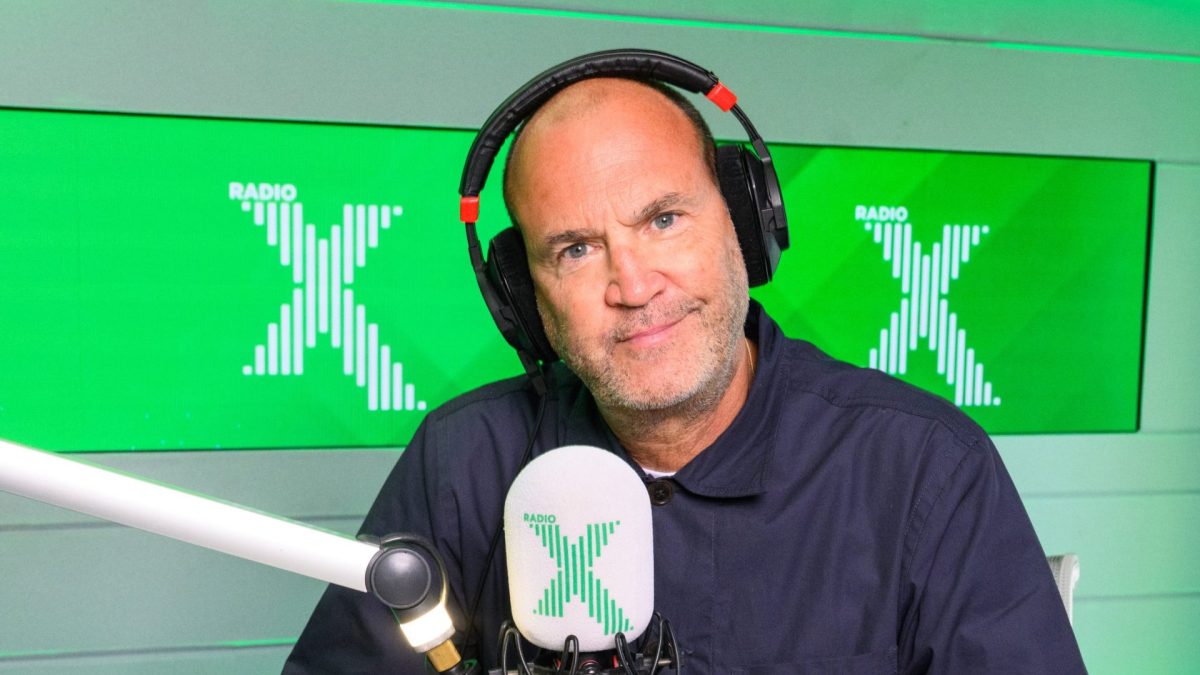
“I heard someone say that there are too many podcasts recently,” Johnny Vaughan tells me. “That’s like walking into a bookshop and going: ‘Who’s reading all these books?’ or going into a record shop and saying: ‘We don’t need any more music.’ My dad, God rest him, died last year and was known for saying the most extraordinary things – he could be quite pompous unless it was about sailing or engineering. I’d mention something about playing some new music and he’d say: ‘What do we need new music for? We’ve got enough music – we need someone to fix the bloody potholes.” Look up the word raconteur in the dictionary and you’re likely to find Johnny Vaughan’s name listed. He has built a name as one of the UK’s most irreverent and entertaining broadcasters and podcasters over the past four decades – but his path to success was far from straightforward. Born in London, the young Vaughan and his family moved to the Midlands, where he was duly enrolled in a local boarding school and suffered abuse at the hands of both staff and students. “It was miserable,” he recalls. “The men in charge were nasty bullies. It’s just not normal to beat eight-year-olds, or for a 13-year-old prefect to beat an eight-year-old, or to stop people writing home – or sacking cleaners for smuggling letters out. It was good practice for jail, actually.” Shorts What advice would he give the young boy he once was, struggling alone at school? “Speak up,” he says. “Tell your parents you’re miserable – don’t think you’ve got to soldier on and act grateful just because your dad’s paying a lot of money for it. But back then, this kind of behaviour was so normalised.” Despite his expensive education, he was already serving time at Her Majesty’s Pleasure by the time he was 21, for attempting to sell cocaine to undercover police – a one-off incident in which he claims to have been helping out a friend, rather than a low point in a more extended criminal career. Vaughan spent two years of a four-year sentence in prison, a period which prompted him to reflect hard on his future. Within years of his release, he had become one of the 90s’ most famous faces of popular culture as the co-host of Channel 4’s hit morning show The Big Breakfast and one of the highest-paid men in British television. Johnny now presents a podcast with Gavin Woods (Photo: David M. Benett/Dave Benett/Getty) His free-wheeling approach found the perfect home in the anarchy of The Big Breakfast, alongside Denise van Outen’s effervescence. And with this young, impish duo holding court, it is no surprise that playful shenanigans were an integral part of daily proceedings. “I have so many really good memories of it, but I don’t remember a lot of stuff that happened,” he says. “I think human beings only have the capacity to remember a certain amount of people, because our forebears wouldn’t have met that many – only a cave-full. I’m probably way over my quota.” One such moment he had (conveniently) forgotten was locking American balladeer Curtis Stigers in a cupboard for two hours. “I’d completely forgotten about the entire incident when we met again,” he reveals. “But you meet these people and these memories wake up – it’s sort of like a vast unopened Advent calendar.” Of the Stigers incident itself – one which the singer made clear he had not forgotten – Vaughan recalls, “He’d misbehaved: he’d shouted out an answer to the quiz – so I locked him in the cupboard under the stairs and just carried on with the show and forgot about him.” By the mid-Noughties, Vaughan had found a natural home on the radio – a format he had grown up with. “My mum was a BBC Radio Two fanatic who loved Terry Wogan. For me, he was a great communicator who really understood radio. His use of innuendo and irony… he was just wonderful at it.” Vaughan is still a radio devotee, with an old-fashioned radio in every room of his house. “Radio has really kept me company over the years – through boarding school and even jail,” he says. “I call it ‘eyes-free entertainment’ – you can get on with something else while you’re listening. If you’re trapped in traffic or ironing, it’s there. If you have it on at work, it’s like working with a funny colleague.”Following stints at the BBC, Capital FM, Absolute Radio and TalkSport, he took the prime drivetime slot at Radio X (formerly XFM), That 4 ‘Til 7 Thang, in 2015 and hasn’t looked back. Johnny at Global’s Make Some Noise Charity Gala last year (Photo: James Manning/PA Wire) A typical Radio X playlist focuses on alternative, indie and rock music. What kind of songs would Vaughan select if he were on Desert Island Discs? “I fantasise about being on that show,” he says, “but I’ve always thought that when you’re on it, you’ve reached the end. Similarly, I never do a bucket list because once you start ticking the things off, it’s a countdown – and I really avoid things like that. Instead, he opts for “nine huge pieces of music I’ve never heard”, selected by experts in their genre. “So, the purists might say: ‘This is the greatest opera or the greatest jazz or funk record – and so on. That way, I’d have some new things to look forward to on my desert island rather than putting on a long list of my favourite records that I’ve likely hammered already. You’d put one on and sit there and think: ‘F**k, I’m bored of this.’ Better to just go for the unknown, I think. Then, after years as a castaway, you think: ‘I get it! Now I understand why The Marriage of Figaro is the greatest piece of art man has ever come up with!’” Vaughan is also a podcast veteran and the co-host of The Kickabout, focusing on Saturday sports, plus Bloomin’ Legends, a series focusing on extraordinary figures throughout history. “It’s headline history,” he tells me. “If you listen to a really learned podcast that’s really well-researched, you probably remember a few headlines. We’re just those headlines. We go beyond what you’ve forgotten about the people you learned about at school. It’s like a history refresher and very anecdotal.” I ask him to share some of his favourites and he’s off. “Jack Churchill’s probably my favourite,” he says. “He was an army officer who always carried bagpipes, a bow and arrow and a sword into battle during World War Two because he felt an officer should carry a sword. He killed someone at D-Day with a bow and arrow. Imagine how that German felt – you’d never see that coming. “Boadicea’s near the top of the leaderboard – a fascinating woman,” he continues. “She killed 30,000 Roman soldiers by impaling them because they tried to stiff her on inheritance tax. My father passed away last year and I totally get it – that anger. We’ve all felt like doing it.” He’s in full flow now: “Christopher Lee was fantastic – a neighbour, actually, who I knew quite well. The most successful British actor: he worked on Star Wars, The Lord of the Rings and Harry Potter – the big three. Six foot six, in the Secret Service, could speak passable Hungarian, sang opera – he was just an amazing man. “And then there’s Major Digby Tatham-Warter, who fought in the Second World War and always carried an umbrella into battle. When a tank was coming towards him on the battlefield, he crouched down, shoved his umbrella through the viewing slit and killed the driver with an umbrella through the eye. What a man! Imagine how safe that guy felt in a tank. Little did he know there’s a posh Brit who decided to take a brolly into battle.” Johnny discusses extraordinary figures from history (Photo: Provided) “I hope people read this before they go on holiday, because as much as I love reading, it’s much easier listening to podcasts when you’re sunbathing.” He then launches into a colourful monologue regarding AI and the future of books that typifies his curious way of looking at the world. “I was wrestling with a paperback on holiday when I realised that books are flawed because their default is to be on a shelf,” he says. “Every page you’re reading, you’re defying what the book’s designed to do. They’re not designed to be read, they’re designed to be put on shelves and sold. That’s my Johnny Vaughan theory number 571. “And what with Kindles and things, it’s nice to see that actual physical books are surviving,” he continues. “I would personally pass two laws: one that says you’ve always got to buy a physical copy of a book then you automatically get the digital rights to it on your device. But there must be a physical copy, even if it’s a tiny little one, so no one can start f**king with the words. We need a hard copy to prove it.” He references the UK Society of Authors’ recent decision to launch a “Human Authored” logo identifying books that have been written by a real person rather than AI. “No! No! It’s the other way round,” he exclaims. “If you use AI to write a book, you must declare it. A writer shouldn’t have to validate anything. “It’s ridiculous,” he continues. “If anyone’s reading from the Society of Authors, please correct this because it’s a travesty. And what does that mean: in the future, people will look back at old books and just assume they’ve all been written by AI or are they going to have to put it on every single book now? No. F**king idiots.” As well as having two grown-up children, Vaughan is also father to five-year-old Milton. How does being a father in his late fifties compare to parenting in his early thirties? “I’m not a better father, but I’m a much more appreciative one,” he says. “When your kids are five, it’s the best time you ever have. I was so busy for my first two, but now I’ve got an afternoon show, so I can get up and do the breakfast thing and have lunch together. Plus, I get a life with my older children, Tabitha and Rafferty, who both really love Milton. I’m a lucky, lucky man.” Vaughan’s life to date has undoubtedly been colourful. What would he say to someone seeking a happier or more interesting existence? “If you’re unhappy, read any of Paul Theroux’s travel books and then try to emulate him,” he says. “Get out there and live life – see it as an adventure. He’s a real inspiration; I like him so much, I bought his house.” It might sound outlandish, but it’s true: Vaughan purchased a four-storey Victorian family home in Wandsworth, south-west London, from the Theroux family in 1999, though put it back on the market nearly a decade and a half later. On the subject of outstanding ambitions he’d still like to achieve, it’s an easy answer for Vaughan. “My only real ambition is to dance with my grandchildren at my children’s weddings while they watch,” he says. “Now that’s success.” Listen to Johnny Vaughan on Radio X weekdays from 4pm–7pm and Sundays from 11am–1pm, and to ‘Bloomin’ Legends’ now on all major podcast platforms
Johnny Vaughan: Boarding school was good practice for jail
Full Article
Original Source
Read the full article at Inews →KhanList aggregates and links to publicly available news content. We do not host full articles from third-party sources. Always verify important information with original sources.