
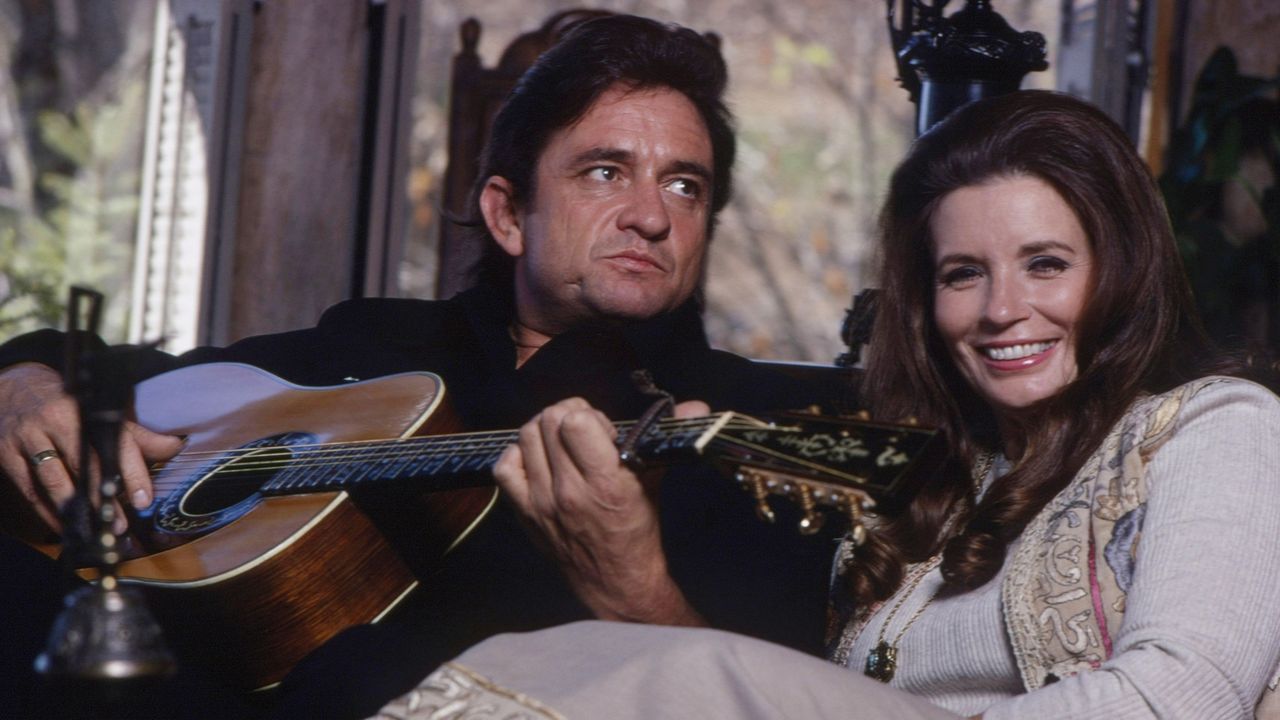
Born J.R. Cash to impoverished parents who couldn’t decide whether to name him John or Ray, Johnny Cash grew up in Dyess, Arkansas, a New Deal community where the government lent families land and resources to establish them as farmers. Cash’s early life during the Depression was marked by lean times as well as tragedy when, at 12, he suffered the loss of his brother to a workplace injury. But the young Cash found joy in music, and his mother took in laundry to pay for singing lessons.After a stint in the Air Force as a teen, he moved to Memphis and married Vivian Liberto, whom he’d met in a roller rink in San Antonio before shipping out. There, Cash started both a family and a legendary career, recording music at Sun Records alongside the likes of Elvis Presley and Jerry Lee Lewis. After a few years in Memphis, Cash and his family moved out west, first to Encino, then Casitas Springs, California. The musician would go on to find his forever home in Hendersonville, Tennessee, with his second wife and performance partner, June Carter Cash.The pair died four months apart in 2003. In his final interview, given shortly after Carter Cash’s death, Cash offered some sage marital (and floor plan) advice: “We were together for forty years; we worked on the road together since 1963, and we got married in ’68. And, uh, the secret for a happy marriage? Separate bathrooms.”Cash pictured with Liberto and their two young daughters, Rosanne and Kathy, in 1957. Photo: Michael Ochs Archives/Getty ImagesMemphis milestonesJohnny Cash and Vivian Liberto only lived in Memphis for three years, but their short residency was a monumental time for the young family; not only were their daughters Rosanne and Kathy born in the city, but it’s where Johnny began recording music at Sun Records. The songs he made there, including “Folsom Prison Blues,” would put him on the map. Before getting his musical career off the ground, he was a home appliance salesman. “My parents lived in a tiny, bare apartment within walking distance of Dad’s workplace,” Rosanne told The Oxford American in 2013, adding that her father was such a “lackluster” salesman that he managed to talk a customer out of a refrigerator—that conversation evolved, though, and ended up with Cash landing an opportunity for housing at the would-be buyer’s duplex on Tutwiler Street in Memphis.Cash and Liberto had four daughters together. Photo: Michael Ochs Archives/Getty ImagesMusical inspirationCash wrote his first hit, “I Walk the Line,” while on tour in 1956 as what he called “a pledge of devotion” to Liberto. The pair are pictured here in Memphis in 1957. That year they relocated to California, where they briefly lived in Studio City. They then bought Johnny Carson’s house in Encino when the talk show host moved to New York. That house was at 4259 Hayvenhurst Avenue, situated on the same street the Jackson Five and family made home. After three years there the Cash family moved to more rural Casita Springs, California. The couple had two more daughters, Cindy and Tara, before divorcing in 1967.Cash and Carter Cash stroll the grounds of their Tennessee home in 1969, the same year The Johnny Cash Show premiered on ABC. Photo: ABC Photo Archives/Disney General Entertainment Content via Getty ImagesTennessee waltzingCash met musician June Carter backstage at a 1956 performance at the Grand Old Opry, where both she and her husband at the time were singing. Carter divorced her husband soon after, but by 1960, she was married again and touring with Cash. Her second marriage ended six years later, Cash followed suit in 1967, and Carter and Cash tied the knot in 1968—a few weeks after he proposed onstage during a performance in London. The newlyweds moved into a 14,000-square-foot lakefront mansion in Hendersonville, Tennessee. They bought the stone-and-wood structure directly from the architect-builder Braxton Dixon, who was building the home for himself until Cash told him: “Name your price.” The musician had to borrow from Columbia Records to meet the $150,000 Dixon asked for, but it proved to be a good investment; he and Carter Cash would live there for 35 years.Cash pictured at home during a promo shoot for The Johnny Cash Show. Photo: ABC Photo Archives/Disney General Entertainment Content via Getty ImagesThe lure of the lakeThe contemporary Hendersonville home featured four round rooms with picturesque views of Old Hickory Lake. “Dad had a little speedboat, and he taught all of us to water ski. He was the most patient teacher in the world,” Rosanne recalled of summers spent at the lakefront estate. “Once I was sitting in the boat with him while he pulled one of my sisters up on the skis when the glove box popped open and money—bills of all denominations—flew out and away. My dad glanced at the currency as the wind carried it out of the boat, but never looked back, never said a word. That gave me an insight into my dad’s relationship with money: He let it fly and never looked back.”Cash and Carter Cash each had daughters from their previous marriages but shared only one child together: John Carter Cash. Photo: Everett CollectionJohn Carter CashIn March 1970, John Carter Cash was born—an only brother to six girls (Cash’s four daughters and Carter Cash’s two). Shown here with his parents in 1971, John now manages Cash Cabin Studio, a private recording space in a log cabin his father had built on the grounds of the Hendersonville property in the late ’70s. The cabin is made out of hand-hewn logs and features the signatures of visiting artists—among them, Elvis Costello, Taylor Swift, and Snoop Dogg—on the fireplace mantel.Cash and his mother-in-law Maybelle Carter at the Hendersonville home in 1970. Photo: Courtesy Everett CollectionFamily manIn this photo from the 1970s, Cash poses beneath his gold records with his autoharp-playing mother-in-law (and frequent performance costar) Maybelle Carter. Maybelle lived in her own home not far from the lake house, but would often visit and stay over—including when Johnny quit drugs cold turkey and suffered withdrawals. “Knowing June, her mother and daddy, and all my friends were downstairs in sleeping bags in this big house that I had bought on the lake—it kept me going,” the “Ring of Fire” singer told television reporter Glenn Jorgensen in 1983. Cash also enjoyed time out on the water with Maybelle. “She was my fishing buddy. That was my relationship with her,” he told interviewer Patrick Carr in 1978, shortly after Maybelle’s death. “I’ve just lost an old buddy…. She was the greatest.”Cash pictured with a kitten in 1983 as part of an appearance on “The Barbara Walters Special.” Photo: ABC Photo Archives/Disney General Entertainment Content via Getty ImagesWild at heartThis kitten, Cash’s costar in a 1983 Barbara Walters special, was just one part of the country star’s menagerie. He enclosed 40 acres with barbed wire to house his exotic pets, including buffalo, antelopes, deer, and ostriches. This was not always a peaceable kingdom; in 1981, Cash nearly met his end when a male ostrich named Waldo clawed him in the abdomen.Cash in his Tennessee home studio Photo: Beth Gwinn/Redferns/Getty ImagesWork from homeIn 1994, the year this photo was taken, Cash worked on American Recordings at Cash Cabin Studios. The Hendersonville property’s log cabin refuge features vaulted ceilings, a stained glass window depicting Maybelle playing the autoharp, and a game room with taxidermied animal heads and lots of pianos. The studio also holds lots of family memorabilia, including Cash’s hymn book and rocking chair.Cash and Carter Cash in their Jamaican estate. Photo: Rick Diamond/WireImage/Getty ImagesHaunted houseAs much as they loved Hendersonville, the Cashes didn’t spend all their time there. In the early 1970s Cash bought Cinnamon Hill, an 18th-century Georgian estate in Jamaica that was once the home of another famous poet: Elizabeth Barrett Browning. Carter and Carter Cash, shown here at Cinnamon Hill in 2002, spent time at their vacation home until their deaths in 2003. Today tourists in Montego Bay can visit the historic home, which is filled with Cash family photos and memorabilia, including a crocodile that the Man in Black helped catch. Sightings of the resident ghost, the so-called White Witch of Rose Hall, are not guaranteed, but Cash immortalized the legend in his song “The Ballad of Annie Palmer.”Cash and Carter Cash sing a casual duet at home in Tennessee. Photo: Courtesy Everett Collection“Hurt”Carter Cash died in May 2003 following complications of heart surgery; Cash passed away four months later. Their home in Hendersonville was purchased by Barry Gibb of the Bee Gees. Though it burned down in 2007, those looking for a glimpse of the house (and the abandoned House of Cash Museum, which closed in 1995) should watch the award-winning music video for Cash’s cover of the Nine Inch Nails song “Hurt” (which has been named both among the best and saddest music videos of all time). In it, Cash sings in the Hendersonville house while June looks on, interspersed with home movies of their past. “She was my great encourager,” Cash told MTV VJ Kurt Loder in the last interview he gave in 2003, after Carter Cash’s death. “She loved the ‘Hurt’ video. She loved it. And I’m so glad she lived long enough to see it do what it did and to get the attention it got.”
Johnny Cash at Home: Tour the Man in Black’s Tennessee Life in Photos
Full Article
Original Source
Read the full article at Architecturaldigest →KhanList aggregates and links to publicly available news content. We do not host full articles from third-party sources. Always verify important information with original sources.