
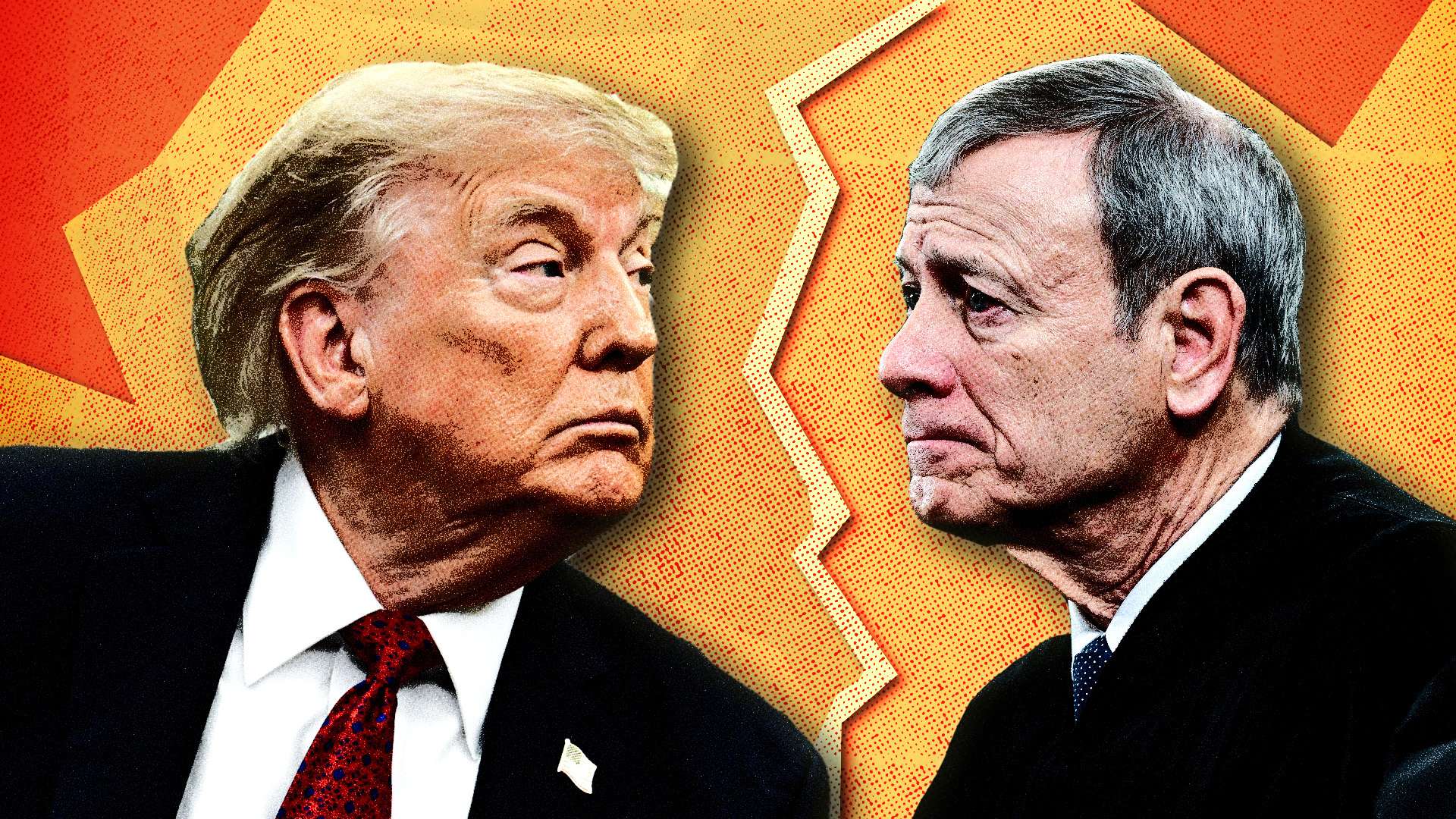
Supreme Court John Roberts Overruled Trump's Tariffs. But He Can't Seem To Stop Trump's Ballroom. The chief justice finds himself in dissent in his latest showdown with the president. | 9.3.2026 7:00 AM (Photo: Annabelle Gordon - Pool via CNP/picture alliance/Consolidated News Photos/Jessica Koscielniak - Pool via CNP/MEGA/RSSIL/Newscom.) One of John Roberts' responsibilities as chief justice of the United States is to write an annual "Year End Report on the Federal Judiciary." The 2025 edition of that report, which came out at the very end of last year, makes for interesting reading in light of what has happened at the U.S. Supreme Court so far this year. "The Declaration [of Independence] charged that George III 'has made Judges dependent on his Will alone, for the tenure of their offices, and the amount and payment of their salaries,'" Roberts observed in his 2025 report. "The Constitution corrected this flaw, granting life tenure and salary protection to safeguard the independence of federal judges and ensure their ability to serve as a counter-majoritarian check on the political branches. This arrangement, now in place for 236 years, has served the country well." You’re reading Injustice System from Damon Root and Reason. Get more of Damon’s commentary on constitutional law and American history. To "serve as a counter-majoritarian check on the political branches" is another way of saying that it is the role of the courts to stop the other branches of government from exceeding the scope of their proper authority. Or, as James Madison once put it, it is the job of the courts to stand as "an impenetrable bulwark against every assumption of power in the legislative or executive." Congress doesn't need much bulwarking against nowadays because the legislative branch is effectively AWOL. But the president has certainly given the courts plenty of work to do. And the chief justice has, at least sometimes, followed through on the lofty words of his 2025 report. Roberts has labored, though not always successfully, to provide the judicial check on a rogue executive that the founders both wanted and expected to see. Roberts' successes on this front in the past year include leading the Supreme Court in overruling President Donald Trump's illegal tariff scheme and rejecting Trump's unconstitutional executive order on birthright citizenship. A notable defeat for Roberts occurred earlier this week, however, in the case about Trump's White House ballroom. The Constitution assigns to Congress the sole authority "To exercise exclusive Legislation in all Cases whatsoever" over Washington, D.C. And Congress, acting on that constitutional authority, has outlawed the construction of any "building or structure…on any reservation, park, or public grounds of the Federal Government in the District of Columbia without express authority of Congress." Yet none of that has stopped Trump from demolishing a large part of the White House without any congressional approval in order to build his much-desired ballroom. Sounds like a clear-cut case of executive overreach, right? Roberts thought so. But this time the chief justice found himself in dissent. Five members of the Court cohered around an unsigned per curiam opinion this week that allowed the construction on the White House to proceed for now because, in their view, the legal challengers who had sued to stop the ballroom likely lacked the requisite standing needed to sue in the first place. Roberts, joined by Justices Sonia Sotomayor, Elena Kagan, and Ketanji Brown Jackson, thought the challengers did satisfy the necessary standing requirements and therefore faulted his colleagues for effectively giving the green light to Trump's "likely unlawful" ballroom building spree. Legal standing is one of those handy doctrines that judges can selectively employ when they want to avoid ruling on the merits of a particular case, or when they want to defer to the government without coming right out and deferring openly. It's hard to tell in this case which one of those two reasons might account for the majority's actions. Roberts' dissent is much easier to parse. He simply tried and failed to convince the Supreme Court to provide the judicial check on executive lawlessness that the Constitution demands. NEXT: Brickbat: School of Hard Knocks Supreme CourtDonald TrumpExecutive PowerSeparation of PowersConstitutionLaw & GovernmentWhite House
John Roberts Overruled Trump's Tariffs. But He Can't Seem To Stop Trump's Ballroom.
Full Article
Original Source
Read the full article at Reason →KhanList aggregates and links to publicly available news content. We do not host full articles from third-party sources. Always verify important information with original sources.