
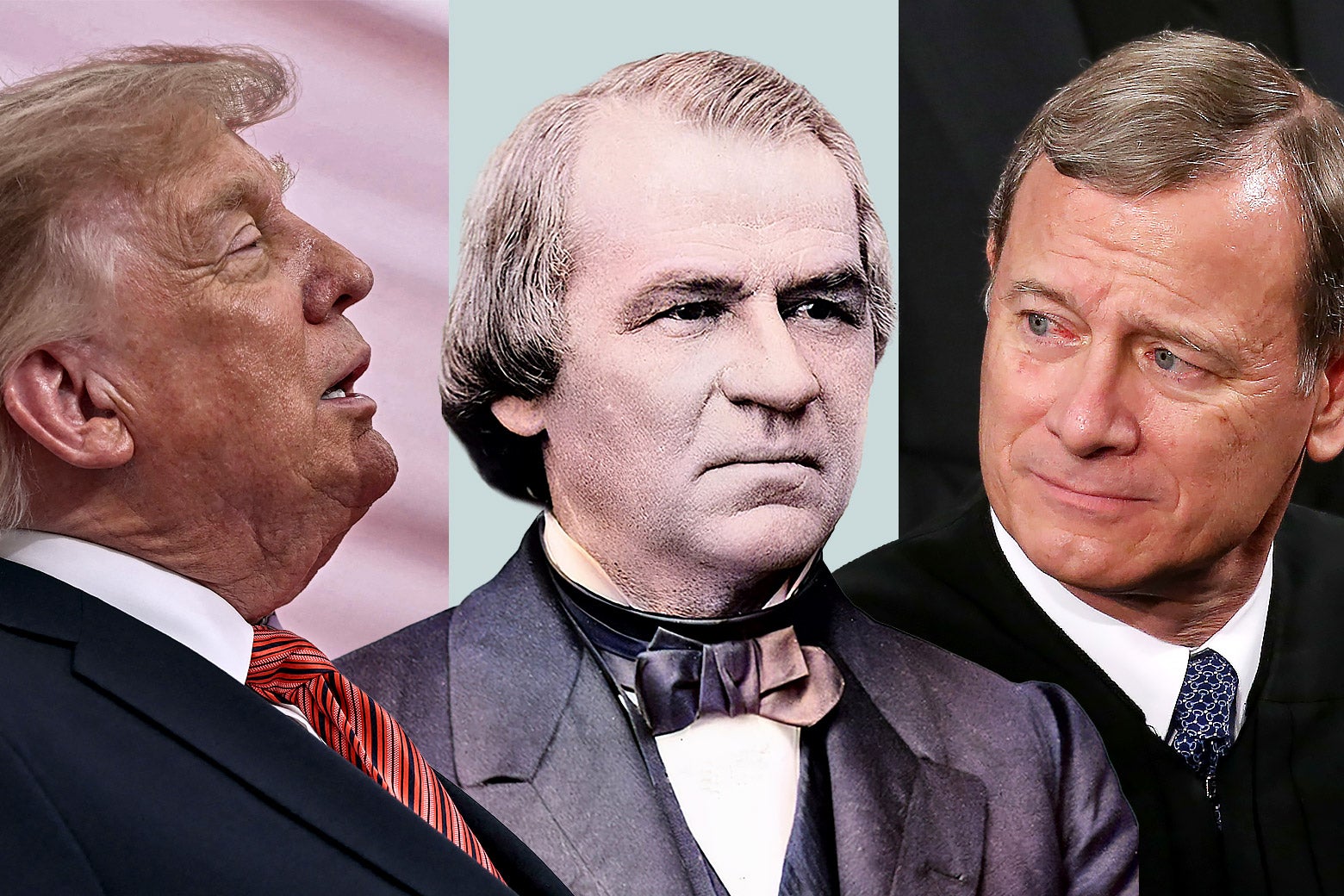
Jurisprudence Donald Trump, Andrew Johnson, John Roberts. Photo illustration by Slate. Photos by Brendan Smialowski/AFP via Getty Images, Gado/Getty Images, and Mario Tama/Getty Images. Sign up for Executive Dysfunction, a weekly newsletter that highlights one under-the-radar story about how Trump is changing the law—or how the law is pushing back—and keeps you posted on the latest from Slate’s Jurisprudence team. After the Supreme Court refused on Monday to let him disrupt mail-in voting, President Donald Trump denounced his own appointees and said the court’s recent rulings are so “shockingly bad” that “it won’t be easily possible for our Country to recover.” But if anything threatens the country’s recovery, it is the court’s other rulings, the ones that place the president above enacted law. The court has insulated the president from criminal laws designed to prevent corruption and election interference. It has let him disregard votes by Congress that prohibit him from starting illegal wars abroad. And it has said he can fire the watchdogs Congress installed to check him—replacing independent agency leaders with bootlickers. Yet because of decisions like the mail-ballot ruling, the court is often cast as the last line of defense between the presidency and autocracy. Such a view misunderstands what the court is up to in those rare instances when it has stood up to the president. In each of those cases, what we have witnessed is the court enforcing federal statutes. A judicial duty explicit in the Constitution, the enforcement of federal statutes is foundational to a nation where every individual, including the president, is subject to the rule of law. But alongside this important judicial role, the court has claimed a second, and more troubling function: a power to defy enacted federal law. Since the 1850s, the court has claimed that it may dissolve any statute Congress enacts whenever five justices dislike Congress’ constitutional judgment. The result has been an imperial presidency—along with a court that claims the exclusive power to police or condone the president’s excesses. To save our democracy from this unsustainable situation, the next Congress must replace judicial supremacy with a court accountable to federal law. A court required to enforce federal statutes would still strike down executive actions that violate the Constitution—indeed, a federal statute instructs judges to do precisely that. What the court would lose is a judicial power to immunize the president from the laws Congress has written to restrain him. We’ve seen it done before. After the Civil War, Congress began building a multiracial democracy in the United States. It passed civil rights acts that guaranteed birthright citizenship and enacted Reconstruction Acts that secured black suffrage in the South. Congress also faced a white-supremacist president, Andrew Johnson, determined to break its laws. Johnson commanded the military officials responsible for carrying out Reconstruction and he intended to sabotage it. So Congress bound him with legislation. The Command of the Army Act required presidential orders to flow through Gen. Ulysses S. Grant, whom Congress trusted, and it barred the president from removing Grant without the Senate’s approval. The Tenure of Office Act gave the same protection to the civilian officials in charge of Reconstruction. When Johnson appeared to violate that second law by firing Secretary of War Edwin Stanton, the House impeached him. During the impeachment trial in the Senate, Johnson’s lawyers made a novel and controversial claim. Even if Johnson had defied a federal statute, they argued, it was merely to allow the Supreme Court to decide its constitutionality. Members of Congress were horrified. They conceded that a president could object to the constitutionality of a bill by vetoing it during the lawmaking process—but they objected that the president could not wield a second veto by ignoring the law after it was enacted. A Constitution designed to free the people from monarchy would not have handed to the president this “more than kingly prerogative.” Johnson was spared by a single vote in the Senate. But he was also chastened. A president bent on defying federal law was restrained—not by nine justices, but by federal statutes and the representatives who enforced them. Reconstruction’s opponents drew a different lesson. They insisted that the president needed a court powerful enough to protect him from “the meshes” of Congress. As the nation abandoned Reconstruction, a generation of politicians and historians recast Johnson as a martyr to congressional tyranny. Their remedy was to articulate and entrench a new doctrine: that the Constitution makes the court supreme over Congress. They encouraged the court to void any statute that hems in presidential power. It took 50 years for that doctrine to triumph. It arrived carrying a grudge. In 1926, Chief Justice William Howard Taft wrote that studying “the injustice that the radical Republicans did to Andrew Johnson” left him “humiliated as a Republican.” He then used a case before him, Myers v. United States, to condemn the Tenure of Office Act and strike down a Reconstruction-era regulation of the presidency. Admirers cheered that the court had at last vindicated Andrew Johnson. Today’s court has resurrected that project. Just this term in Trump v. Slaughter, the court invoked Myers to shred century-old statutory protections that kept public servants from being replaced with loyalists. Afterward, on Substack, Chief Justice John Roberts wrote admiringly that Taft’s leadership not only protected the president from Congress, but also helped to fend off congressional efforts to rein in the court. Slaughter follows a dangerous pattern of opinions placing the president beyond the reach of enacted law. In Trump v. United States, the court exempted the president from most federal criminal law. The statutes that prohibit corruption, obstruction, and election interference now bind everyone in the country except its most powerful officer. With a subtle procedural order issued earlier this month, the court permitted the president to finish a $400 million ballroom on the rubble of the East Wing he demolished, a project two lower courts held he had no authority to build without Congress. Thanks to the court’s decisions kneecapping the Voting Rights Act and campaign-finance laws, the court has also unleashed dark money on our elections and prized partisan entrenchment over competitive elections and minority representation. Worse yet, the court has made clear it will not tolerate statutory responses to presidential overreach and corruption that any future majority might attempt. If we want a president who can be prosecuted for his crimes and who cannot purge the civil service or send masked agents into our neighborhoods, then Congress must be able to bind the presidency with laws that stick. Sticky laws require limiting the court’s power to dissolve them. Congress cannot use statutes to restrain a president whom the court exempts from duly enacted federal law. Some may object that the court has lately made itself the indispensable man. It struck down the president’s illegal tariffs. On Monday it refused to let the Postal Service impose new rules that would have kept millions of mail-in ballots from reaching voters. It appears poised to continue preserving birthright citizenship from the president’s attacks. Lower courts have blocked unlawful National Guard deployments and lawless Immigration and Customs Enforcement raids. Curb the judiciary now, the worry goes, and you disarm the last sentry on the wall. But look at which power the court is using in each case. Every one of these rulings restraining the president is enforcing a federal statute: the tariff decision enforced the law Congress wrote governing emergency powers; the mail-ballot order enforced the statute governing the Postal Service, which nowhere authorizes it to regulate elections; the birthright citizenship cases enforced a statutory guarantee Congress first enacted in 1866, even before the 14th Amendment; relief against ICE enforced the Administrative Procedure Act, a federal statute that instructs courts to vacate unconstitutional executive actions. By contrast, when the court has defied or rejected a federal statute because it doesn’t comport with how five justices see the Constitution, the court has loosened vital checks on presidential power—sometimes checks that many Congresses, and even many presidents, believed were both constitutional and crucial for a healthy democracy. These two types of judicial power are not two sides of one coin. They are in conflict. A court that defies federal law enables presidents to do the same. The choice we face today is not between a strong court and a weak one. It is between a court that puts the president above the law and a court that holds him to it. But to choose a president beholden to the rule of law, we need to hold the justices to enacted law as well. That choice is ours to make. Congress Donald Trump History Impeachment Jurisprudence Supreme Court John Roberts Judiciary
John Roberts’ New Role Model Demonstrates Everything Wrong With the Supreme Court
Full Article
Original Source
Read the full article at Slate →KhanList aggregates and links to publicly available news content. We do not host full articles from third-party sources. Always verify important information with original sources.