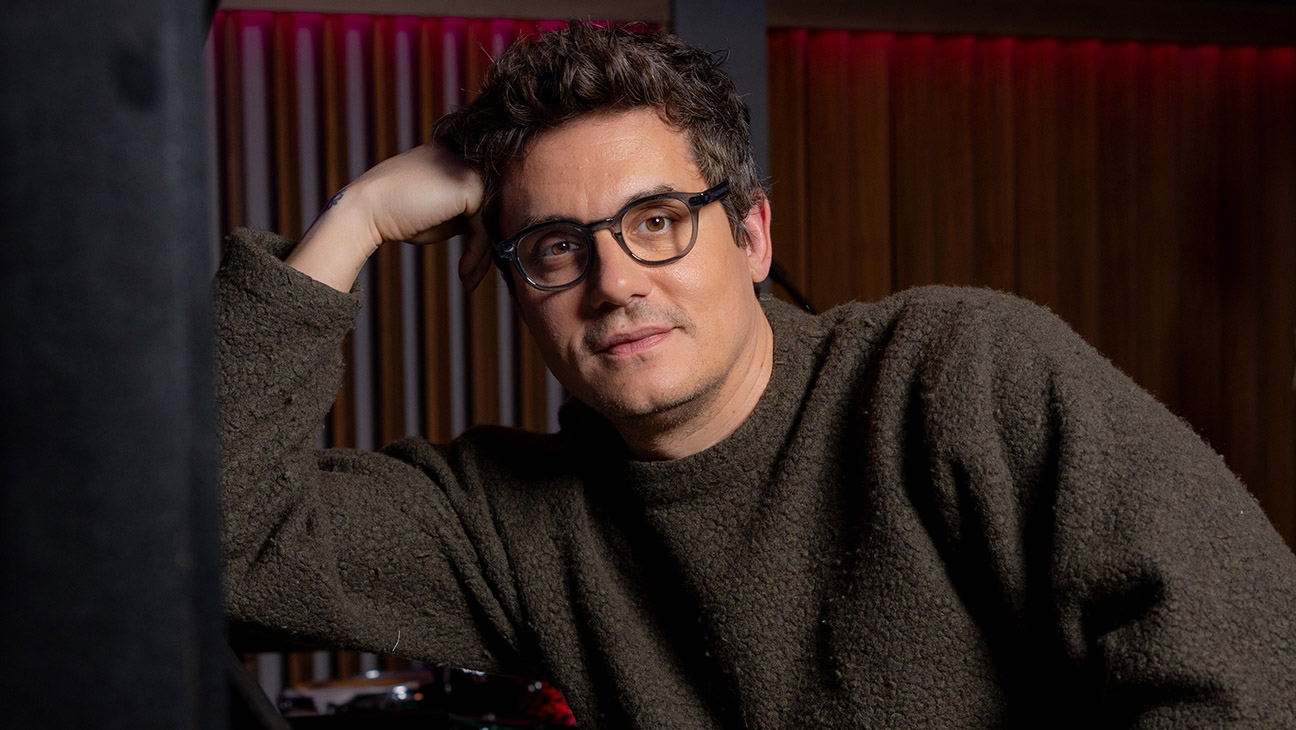
We’re less than 30 seconds into our conversation, and John Mayer already has me wondering whether I have his full attention. He has just climbed out of a Sprinter van and into an office beside the garden at his Chaplin Studios compound. After a quick handshake, he sits down and begins explaining what he calls the “villainous” nature of recording an album. “You start to lose your social grace,” Mayer says. “You dedicate everything to the mathematics of coming up with the thing, and so then as someone is talking to you, you’re going, ‘Uh-huh,’ but meanwhile [in your head], you’re going, ‘You’re coming back to me slow.’ ” He sings those last few words. “You’re working on the song and just going, ‘Yeah, yeah.’ “ “It takes up all the RAM,” says Gerard Choucroun, the executive director of Mayer’s nonprofit, Heart and Armor, from across the room. “It takes up all the RAM,” Mayer agrees. There is plenty competing for it. Mayer is working on his first album since 2021’s Sob Rock and his first since leaving Columbia Records, which released every previous album of his career. He also is helping run Chaplin Studios, the historic Hollywood lot he bought with director McG in 2024, when it was still known as the Henson Company Lot. Earlier this year, they restored the property’s old name, part of an effort to revive some of its old-Hollywood character. “I’m working on the studio, I’m working on that record, and, purposely, my tide has recessed a little bit from the world,” Mayer says. “I’m investing all my time and energy into making a record so that when I come back out, I’ll have something to really present the world.” Somehow amid all that, Mayer has kept a few megabytes free for Heart and Armor, the veterans nonprofit he formally launched in 2019 after years of funding research into post-traumatic stress disorder and other veterans health issues. He has put roughly $5 million of his own money into its scientific studies and veterans programs, work that has made him one of THR‘s Philanthropists of the Year alongside Stephen and Ayesha Curry and Michael J. Fox and his foundation co-founder and CEO Deborah W. Brooks. Heart and Armor’s origins go back to the late 2000s, when Mayer visited Camp Lejeune in Jacksonville, North Carolina. His self-defense trainer was heading there while Mayer was on tour and invited him along. Mayer visited the wounded-warrior barracks, which kick-started his path. “I found myself so moved by it right there on the spot when talking to someone who had a traumatic brain injury and understanding viscerally what that feels like to hear them speak,” Mayer says. “If you had asked me what PTSD was at the time, I would have given you a very narrow definition, but I never had the opportunity to even answer that question wrong. I just saw it, and I saw it in a very naked kind of way. I was moved by seeing people who speak beyond their injury.” Mayer began commissioning studies in 2012 and eventually connected with Choucroun, a social worker who had spent years researching PTSD and veterans health at organizations including the Northern California Institute for Research and Education and UC San Francisco. By the time Heart and Armor was publicly unveiled seven years later, the work already had produced nearly a dozen studies on subjects including exercise and PTSD symptoms, military service and women’s eating habits, as well as the psychological effects of military sexual trauma. What surprised Choucroun was not Mayer’s initial interest but his longevity — and how deeply he immersed himself in the science. “It’s very unusual for someone to come in without a camera and to stay for 15 years,” he says. “He was well read on things like the difference between a three-tesla and a seven-tesla magnet or the hippocampus. He’s fucking John Mayer, man. He knows all this stuff that you never think he’s going to know.” Mayer with Katie Miller, a Navy vet and Heart and Armor’s manager of community events. She says the rock star and philanthropist “doesn’t shy away from the weird stuff.” Emma McIntyre/Getty Images Katie Miller, a Navy veteran and Heart and Armor’s manager of community events, saw the same inquisitiveness at an event last year, when she, Mayer and a scientist found themselves discussing accelerated uterine aging for women veterans. “Normally that would be an uncomfortable conversation, but John was listening to the scientists explain more about it, genuinely interested in the science, why this is happening, what we can do to fix it,” Miller says. “He just doesn’t shy away from the weird stuff.” Right now, Choucroun says Heart and Armor’s most promising studies focus on sleep. One study seeks to address whether treating insomnia shortly after a traumatic event could prevent PTSD from developing in the first place. Working with emergency departments at UCSF and the University of North Carolina, researchers are recruiting patients who have recently survived car accidents, then studying whether improving their sleep lowers their risk of developing PTSD. Another project examines the relationship between PTSD and what’s called the glymphatic system, the brain’s waste-clearance process, which is most active during sleep. Mayer and Heart and Armor are proponents of these sorts of tangible studies, centering PTSD not just as a mental health struggle but as a physical injury. That sort of framing, Mayer says, changes the source of these struggles from something opaque into a problem that can be observed, properly explained and, perhaps, interrupted. “If you can take it outside of the mystery of the mind and externalize it, people get very energized by seeing it as an empirical, objective challenge,” he says. Beyond the more scientific angling, he also hopes the work can help destigmatize these sorts of struggles, particularly among a veteran population that faces more pressure to be forthright about those sorts of issues than the broader population. “When you hear about these stories of how someone with PTSD ends up self-medicating, you understand it,” Mayer says. “If the only way to sleep after coming home is half a bottle of wine, that’s not choosing drinking over not drinking, you choose sleep over not sleeping.” The same goes for triggers. “When I heard someone tell me that the smell of diesel gasoline takes them back, we all have things that stop us in our tracks,” he says. “We all have things that are hard to see now because of something we’ve seen. It’s just a lot more compounded in people who are veterans because the experience is compounded.” Although the research is focused on veterans, any breakthrough could extend far beyond them to survivors of assault, accidents, disasters and other forms of trauma. Mayer compares that possibility to medications that began with one purpose and found another. John Mayer Jason Armond/Los Angeles Times via Contour RA/Getty Images “Look at GLP-1s and diabetics or [minoxidil] and blood pressure,” he says. “These things start on one track and jump over another track into a more generalized use case. GLPs have been a touchstone of hope for people that you would have said a few years ago that science has basically maxed out anything we can do.” He is careful not to promise a cure. Research, Mayer says, is “not a pass-fail, it’s an ongoing bit of detective work that takes you to the next little ray of hope that takes you to the next ray of hope with research.” Still, Mayer is optimistic: “I have a very good feeling that can’t be substantiated by logic that the pivotal moment in helping treat PTSD is going to come from Gerard and Heart and Armor, at least in some way — that it’s going to be Gerard and Heart and Armor that rip the paper off the printer and hold it up in the air and go, ‘We figured it out.’ “ The work also has changed the way Mayer thinks about his own difficulties. “I see everything now as a question as to whether I can or whether I cannot cope,” he says. “Do I have what it takes to cope with this, or do I need assistance? Most of the time I have in me the tools to cope, and I have gratitude like I haven’t had before to have the tools to cope.” Mayer sees the work as part of a life that should keep expanding beyond the thing that first made him famous. He always has been drawn to people whose interests and abilities refused to fit neatly inside their public identities. “Dudley Moore was a great piano player, or Shaq was also a reserve sheriff,” he says. “John Travolta as a pilot. I was always very inspired by people who were able to live very rich lives. You weren’t hit over the head with it, and you were intrigued when you learned that someone had already been doing something. Kenny G invested in Starbucks. The lead singer of Iron Maiden flies the band. Any time I hear these things that don’t sound like boilerplate famous-person experiences, I get inspired to also be of use in some other kind of way.” For all of Mayer’s interest in unexpected second acts, he does not want Heart and Armor’s credibility to rest on his celebrity. “We didn’t get a Department of Defense grant because they said, ‘Oh, John Mayer’s a part of this,’ ” he says. “We got it because we passed all the levels of scientific skepticism and showed these departments that there were applicable results. “I approach things along the lines of, ‘If I wasn’t a celebrity, I would still be doing this,’ ” Mayer continues. “I want to see myself as a person doing this stuff, which to me is more expansive than being ‘John Mayer the singer,’ and it makes sure I’m accountable the whole time.” He puts it another way: “I like everything in my life to work without my name on it and stand on its own. Does this work both with and without the celebrity label on it? If it does, then I feel in everything I do that it’s worthwhile.” Read more about the Philanthropists of the Year:– Michael J. Fox: Getting Back to Acting “Really Prolonged My Life”– Catching Up With the Currys: The Busiest Couple in Basketball Is Ready to Conquer Hollywood This story appeared in the July 22 issue of The Hollywood Reporter magazine. Click here to subscribe.
John Mayer on Why He Keeps Quietly Funding Brain Research Studies
Full Article
Original Source
Read the full article at Hollywoodreporter →KhanList aggregates and links to publicly available news content. We do not host full articles from third-party sources. Always verify important information with original sources.