
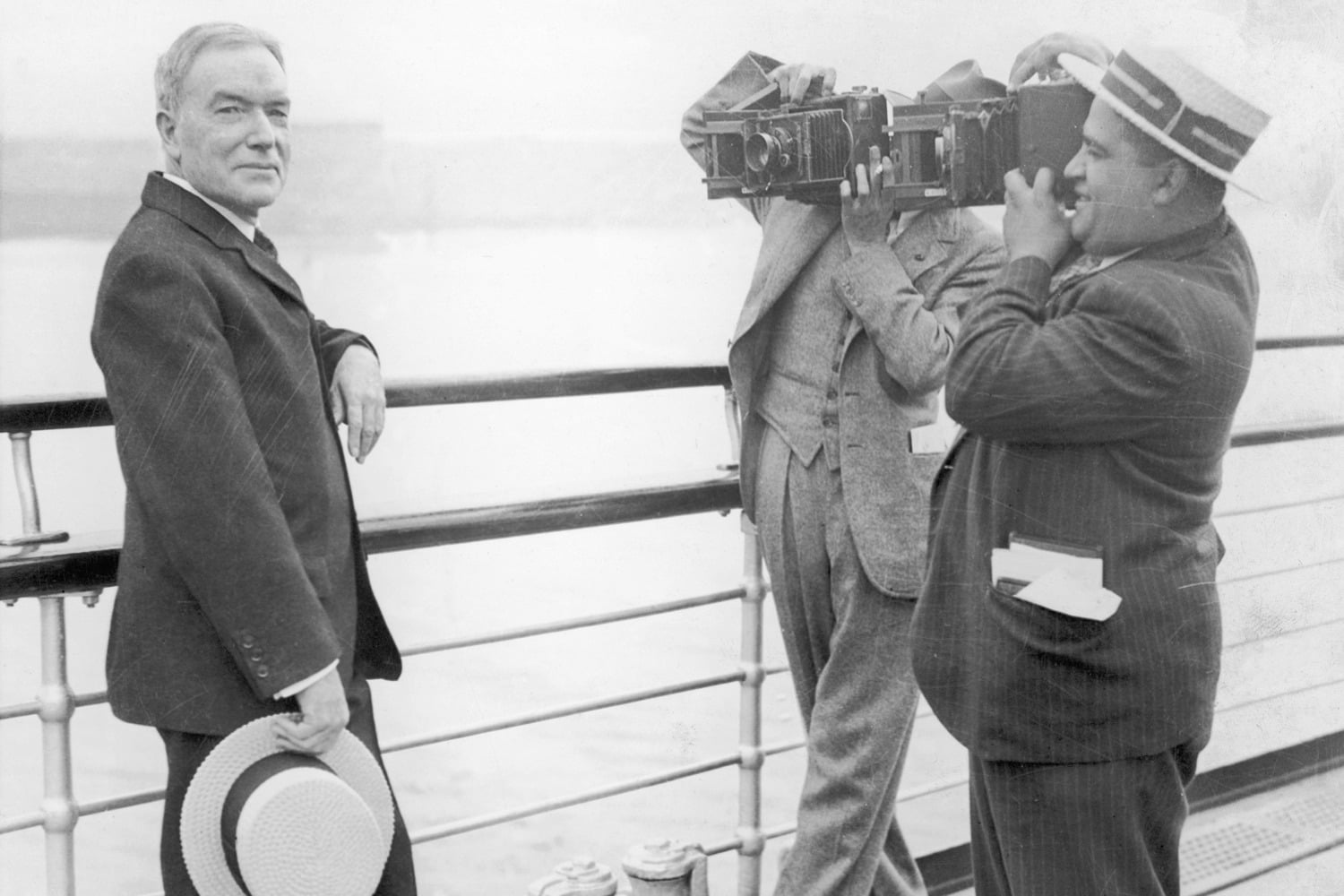
Today’s business titans have become some of the most controversial figures in U.S. politics. Elon Musk, Peter Thiel, Sam Altman, Mark Zuckerberg, and others are at the center of growing concerns about the impact of social media and artificial intelligence on the nation. These figures, who only a few years ago were celebrated as pioneers of technological innovation and credited with strengthening the economic position of the United States, are now viewed in a markedly different light. In August, a CNBC and Generation Lab poll found that more younger Americans don’t trust AI leaders than have confidence in them. These business leaders are promoting technologies that could create national security risks while worsening economic inequality and threatening the jobs of both white-collar and working-class Americans. They are members of an elite class that wields overwhelming political influence through its wealth, embodying the dangers that money poses to a democratic system. They oversee companies whose power is so immense that they render the principle of free enterprise and market competition increasingly fragile. Indeed, as was clear during his second inauguration, many of them have become closely intertwined with the Trump administration, participating in a close alliance between business and government that many Americans have criticized when observed in other countries. Today’s business titans have become some of the most controversial figures in U.S. politics. Elon Musk, Peter Thiel, Sam Altman, Mark Zuckerberg, and others are at the center of growing concerns about the impact of social media and artificial intelligence on the nation. These figures, who only a few years ago were celebrated as pioneers of technological innovation and credited with strengthening the economic position of the United States, are now viewed in a markedly different light. In August, a CNBC and Generation Lab poll found that more younger Americans don’t trust AI leaders than have confidence in them. These business leaders are promoting technologies that could create national security risks while worsening economic inequality and threatening the jobs of both white-collar and working-class Americans. They are members of an elite class that wields overwhelming political influence through its wealth, embodying the dangers that money poses to a democratic system. They oversee companies whose power is so immense that they render the principle of free enterprise and market competition increasingly fragile. Indeed, as was clear during his second inauguration, many of them have become closely intertwined with the Trump administration, participating in a close alliance between business and government that many Americans have criticized when observed in other countries. This is not the first time that Americans have confronted this problem. Throughout the nation’s history, numerous individuals once celebrated as symbols of economic success have come under intense grassroots and media scrutiny for the dangers they were perceived to pose to the rest of the country. Little more than a century ago, the oil tycoon John D. Rockefeller Sr. followed a strikingly similar trajectory. Rockefeller was born on July 8, 1839, in upstate New York. His father was a bigamist and traveling salesman who peddled dubious medical remedies, and his mother, a religiously devout woman who instilled in him the values of hard work and charity, was his greatest source of stability growing up. From an early age, Rockefeller took small jobs in his neighborhood to make money before attending Owego Academy. His family moved to Cleveland, Ohio, where Rockefeller proved adept at mathematics in high school from 1853 to 1855. He then enrolled in Folsom’s Commercial College, where he spent 10 weeks learning about different business practices, such as bookkeeping. In September 1855, he secured a job as an assistant bookkeeper in the shipping firm Hewitt & Tuttle. He steadily advanced within the company, earning greater responsibilities and eventually engaging in trade deals on his own. After several years with Hewitt & Tuttle, Rockefeller decided to go into his own business. On March 1, 1859, he and Maurice Clark formed Clark & Rockefeller, a commission merchant firm that dealt in agricultural commodities like grain and meat. The partnership thrived and the business quickly expanded. Rockefeller entered into the oil refining industry in 1863 with the firm Andrews, Clark & Company. Within two years, he had bought out the Clark contingent and secured greater control of the business. Together with his brother William, he established a new partnership and opened a refinery in Cleveland known as Standard Works. In 1867, they invited Henry Flagler into the firm as a partner. One year later, Rockefeller, Andrews, and Flagler was the biggest refiner in the world. The company negotiated highly favorable rates with the New York Central and Erie railroads, giving them a powerful advantage over rivals. On Jan. 10, 1870, Rockefeller and his partners founded the Standard Oil Company. The business continued to expand into a massive corporate juggernaut as it consolidated multiple firms under its control. In 1872, Standard Oil purchased 22 out of 26 competitors in his home city, which came to be known as the Cleveland Massacre. Rockefeller undertook a “grand-scale collusion such as American industry had never witnessed,” wrote Ron Chernow in his epic biography of the oil titan. Believing that the decentralized economy was inefficient, Rockefeller integrated nearly every aspect of Standard Oil’s operations: building refineries, negotiating favorable rebates from the railroads, and even producing its own barrels. The company acquired many of its competitors, accelerating control by capitalizing on the economic turmoil from the Panic of 1873, and by 1880 controlled almost 90 percent of the nation’s oil-refining market. The Standard Oil Trust eventually oversaw dozens of affiliated companies. For a time, Rockefeller stood as a shining example of the extraordinary wealth and economic power that capitalism could produce. He was the American dream. But the picture changed. Independent oil producers attacked Standard Oil for its monopolistic practices, charging that Rockefeller’s company was colluding with railroads to suppress competition. Critics accused Rockefeller of using his resources and political influence to secure favorable treatment from state legislatures. An investigation by the New York state l uncovered multiple ways in which Standard benefited from railroad deals that were unavailable to smaller rivals. Muckraking journalists such as Henry Demarest Lloyd published exposés about the company, gradually transforming Rockefeller and Standard Oil from celebrated symbols of U.S. capitalism to monopolistic threats to democracy. Under mounting public pressure, Congress enacted the Interstate Commerce Act of 1887, which regulated railroads, and the Sherman Anti-Trust Act of 1890, which prohibited monopolies from restraining interstate trade. In 1892, the Ohio Supreme Court ruled that the Standard Oil Trust had to be dissolved. Rockefeller once again showed his acumen by quickly reorganizing the company as a holding corporation in New Jersey, where state laws were not as stringent as those in Ohio. Rockefeller might have cleverly outmaneuvered the law, but the press continued to scrutinize him and the company. The muckraking journalist Ida Tarbell published a series of articles compiled into a book, The History of the Standard Oil Company, that portrayed Rockefeller and his company in a deeply unfavorable light. Standard Oil, she wrote, “never played fair, and that ruined their greatness for me.” In 1904, Puck magazine published a cartoon that depicted a Standard Oil tank as an octopus, wrapping its tentacles around Congress and state houses, and reaching for the White House. President Theodore Roosevelt, who became president in 1901 after the assassination of William McKinley, targeted Standard Oil, painting it as a prime example of corporate excess, even as he accepted the permanence of large corporations in the modern industrial economy. In Roosevelt’s opinion, Rockefeller was one of the “malefactors of great wealth” whom he decided to rein in. Standard Oil’s market dominance was not the only concern. Critics also attacked Rockefeller’s immense wealth and political influence. In 1906, the Justice Department filed a suit against Standard Oil. Five years later, the Supreme Court ordered Standard Oil to be broken up into dozens of separate companies. But in a sign of the times, Rockefeller’s wealth only grew. In 1914, Congress passed the Clayton Antitrust Act that strengthened anti-monopolistic policies. For many Americans, Rockefeller had become the face of what had become known as the trust problem. Rockefeller was just one of the infamous robber barons of the Gilded Age, the term coined by Mark Twain and Charles Dudley Warner to describe the decades between the 1870s and the turn of the century, when immense fortunes gained through industrialization posed a stark contrast to massive poverty, political corruption, and labor conflict. J.P. Morgan, Cornelius Vanderbilt, and Andrew Carnegie were also considered robber barons. Although Rockefeller withdrew from the business after experiencing psychological and other health challenges, the Rockefeller name did not improve very much. In 1913 and 1914, his son, John D. Rockefeller Jr., became a focal point of working-class anger during a bitter strike in the Colorado coalfields. The conflict culminated in the Ludlow Massacre, when members of the National Guard and company guards attacked the strikers’ camp. The violence occurred after Rockefeller Jr.—who was one of the main owners of the Colorado Fuel and Iron Company—had expressed strong opposition to the United Mine Workers. The Ludlow Massacre resulted in the deaths of almost two dozen people, including children, and went down in history as a prime example of how wealthy business leaders abused their workforces. Rockefeller spent the remainder of his life giving away much of his fortune to philanthropic causes, yet his reputation never fully recovered. Once celebrated as the embodiment of entrepreneurship, he came to symbolize the Gilded Age excesses of monopolistic centralization, grotesque wealth, hostility to working Americans, and political corruption. Today’s high-tech leaders are beginning to find themselves in a similar position, often as a result of behaviors that echo those associated with Rockefeller. From their political influence and efforts to stifle competition to the threats their technology poses, these figures have become the focus of growing public concern. Even elected officials who have been sympathetic to the technology sector are facing increasing pressure to support measures that would limit the autonomy of major firms within the economy. These business titans should not underestimate how intense opposition can become when they are perceived as serving the interests of elites rather than acting as engines of broad-based economic prosperity. They should take a look at how the history books deal with John Rockefeller Sr.’s legacy. Whether the U.S. political system is still capable of producing the kinds of reforms that emerged in the Progressive Era remains an open question. It may be that the perpetual gridlock on Capitol Hill, the pervasive influence of wealth, and a news media that struggles to remain focused on a single issue for extended periods will allow these leaders to continue prospering and consolidating power, creating conditions that leave millions of Americans disadvantaged and disempowered. Many will continue to struggle to afford basic necessities, provide for their children, and achieve economic security, while the lords of high tech remain insulated within bubbles that shield them from the realities confronting Main Street.
John D. Rockefeller Is a Cautionary Tale for Today’s Business Titans
Full Article
Original Source
Read the full article at Foreignpolicy →KhanList aggregates and links to publicly available news content. We do not host full articles from third-party sources. Always verify important information with original sources.