
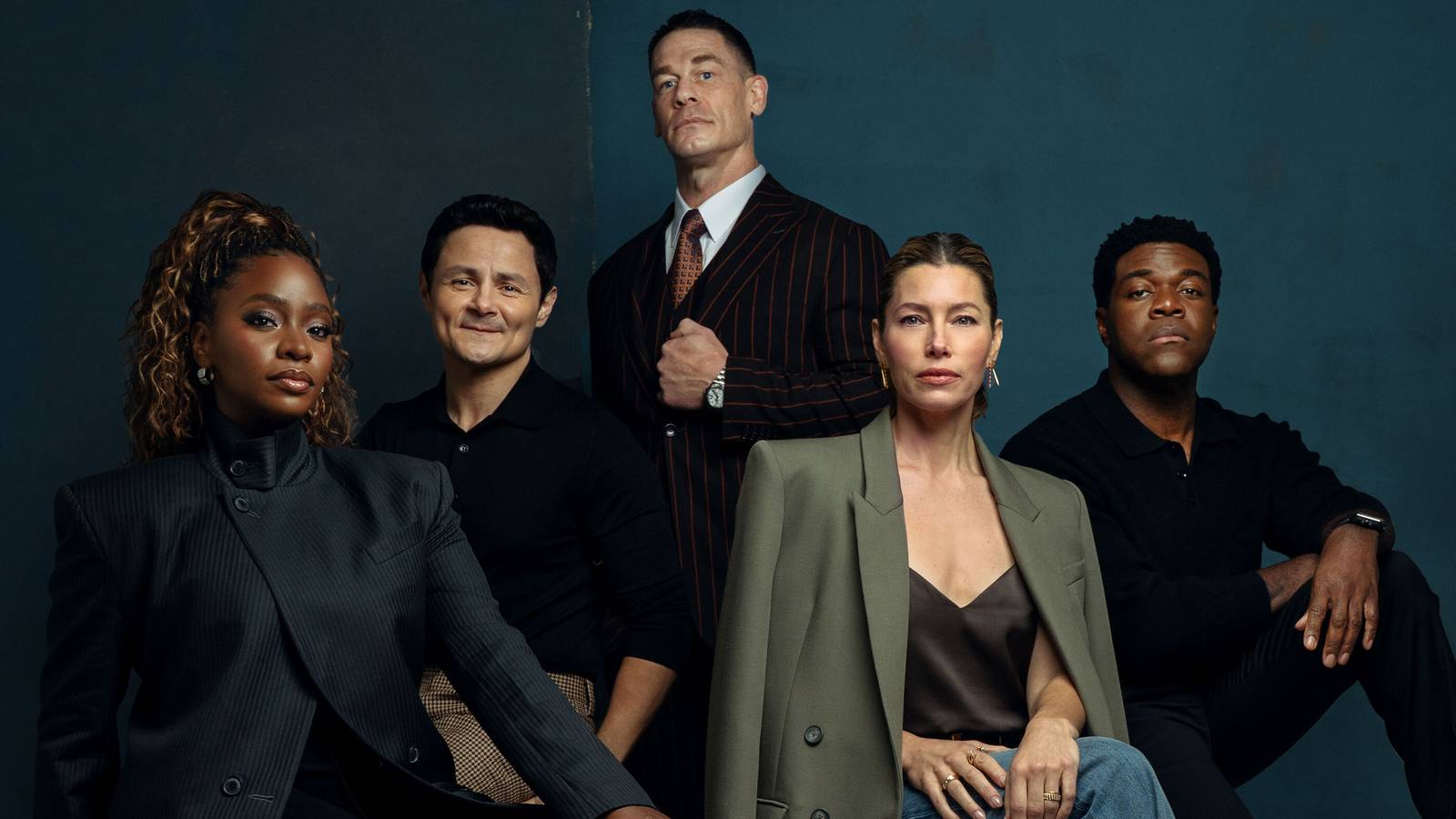
Photography by Andrew Lipovsky for Collider John Cena, Jessica Biel, Sam Richardson, Arturo Castro, and Teyonah Parris talk wild stunts and ’80s nostalgia in Apple TV’s ‘Matchbox.’ Published Oct 9, 2026, 12:00 PM EDT Gabrielle Moss has been writing about pop culture for over a decade, for publications including The New Yorker, GQ.com, Slate, Bustle, New York Magazine, and many more. Her book, "Paperback Crush: The Totally Radical History of '80s and '90s Teen Fiction," was released in 2018, and she was featured in the 2023 documentary "Judy Blume Forever." John Cena would like you to know that he did not wheelie a VW bus filled with his co-stars on purpose. Cena is one of the stars of Apple TV’s new Matchbox: The Movie, which uses Mattel’s classic toy cars as the inspiration for an action-comedy tale of five childhood friends who must fight an international crime conspiracy, often by driving very cool cars very fast. “I was swindled,” says Cena. “I thought by being in Matchbox, I would do a ton of driving.” He didn’t. His character, a CIA super-spy, is usually too busy fighting off legions of baddies, leaving the driving to his co-stars — primarily 2000s-action-hero-turned-Emmy-nominated-thriller-star Jessica Biel, but also TV comedy mainstay Sam Richardson, Broad City and Narcos’ Arturo Castro, and Teyonah Parris, best known as the MCU’s Monica Rambeau. But the star did find himself behind the wheel a few times on set — during a sequence shot in the Sahara, where “they let me beat the shit out of those Land Rovers in the desert,” and during the film’s climax, when Cena and company are speeding through the streets of Budapest. In that scene, the actor’s job was to drive the bus a few yards and stop on a mark, as his co-stars rode along. Months later, in a conference room at New York’s Waldorf-Astoria Hotel, Parris remembers that her co-stars were more than fine with sitting through the abrupt stops in the vintage van. “They're all chill, cool,” she laughs, “and I'm like ‘Ahhhhh!’ in the back.” “She didn’t say ‘ahhh!,’” Richardson happily interrupts. “She said—” “‘Woo woo woo woo woo!’” Cena, Biel, Castro and Richardson explode in giggly unison, with the exact same energy you’d use to roast an old college friend — an energy that permeates Matchbox: The Movie. “In my mind, ‘woo woo woo woo woo’ was... I was still on camera, and I was calm; I looked calm,” Parris recalls. “You can’t see that I'm freaking out, but it's still expelling [the fear] from my body. But I will say, John hit the mark every time. We were safe. No one else was scared. Just me.” “I think at one point, I wheelie’d the bus,” Cena adds. “The back came up,” Parris laughs. “The back came up, but the front was on the dime,” Richardson adds. The wheelie wasn’t in the script; it was simply an accident of physics. “I actually wheelied the front, because the engine's in the back,” Cena explains. “And I would speed up to the mark, but then I would have to reverse to go to the mark. I hit reverse, and we're trying to go to the mark, and [director Sam Hargrave] comes running around with a note, so I stop.” And the VW bus ever-so-slightly caught air. Hargrave, a stunt-coordinator-turned-director known for the practical-stunt-filled Extraction films, was running over to the bus to say what could have been the motto for both the film and its shoot: “Man, that was cool. Is everybody okay?” 'Matchbox' Brings Back Classic '80s and '90s Action to 2026 Image via Apple TV Matchbox is a movie about people getting pushed out of their comfort zone. So it’s only fitting that the experience of shooting Matchbox pushed the cast out of their comfort zones, too. Biel, an action vet, had never done any tricky on-camera driving before. Castro, whose previous stunt experience largely involved “shooting people or getting shot at” (“I’ve died a lot on film,” he jokes), got pulled down a deserted highway on a motorcycle, as real big-rig trucks boxed him in. Richardson, who’s best known as the comedic secret weapon behind shows like The Afterparty, Detroiters and Veep, gets his own action hero moment, jumping out of a moving truck on the open road. As the star of MCU’s The Marvels, Parris is no stranger to the genre. “The action I've done has mostly been on blue screen, green screen warehouses. So I've done a lot of wire work and a lot of flying sorts of action.” However, Matchbox “was very different, in that I was mostly watching these guys do very practical, real-life stunts.” When a character gets set on fire — a fate that befalls both Castro and Richardson, making this likely the first movie in film history to have the stars of two separate Comedy Central sitcoms burst into flames — it’s not just a CGI blur; the effects are practical, and their faces are visible, Parris points out. Most of the car stunts were achieved practically — many with the film’s actual stars driving or riding along — and this required that Parris find the “balance of me, Teyonah, who was very scared, with trying to allow Charmaine to enjoy bits of this.” Even an action vet like Cena was challenged, with one terrifying stunt he never wants to do again (more on that later). But there’s more to Matchbox, and Matchbox’s cast, than cool stunts (though, for the record, they’re very cool stunts). In addition to the built-in nostalgia of being inspired by a toy that almost everyone played with as a kid, the film is a throwback to an earlier style of action filmmaking. Full of color and lighthearted, it couldn’t be farther from the grim, ultra-serious style that’s become the action standard over the past decade. Matchbox throws back to classic ‘80s and ‘90s “average-person-in-extraordinary-circumstances” flicks — the type where you might think the worst part of your day is running late to work, only to find yourself suddenly having to drive a bomb-filled bus through the streets of L.A., or go up against the Terminator. It also looks back to action ensemble classics like Armageddon about unlikely teams coming together to achieve a goal and learn from each other. “There's a lot of action going on, but there is also a lot of heart,” says Parris. “There's a lot about relationships and friendships, and that is the driving force for all of the action. I felt that our director Sam Hargrave and the writers did a really great job keeping that strong.” “Sometimes you hear that something’s an ensemble comedy and it's really not,” says Castro. “But this was such a true ensemble, in that everybody had their moment — their heroic moment, and their moment in the sun. And the gang had a lot of moments as the gang, shining together. And so it's the first movie of its kind that I've been a part of, at least, where it just did feel like everybody's story mattered to the movie itself as much as anything else.” He laughs. “It's the first of its kind. You can quote me on that." “Uh, Ninja Turtles is the first movie like that,” Richardson shoots back. “Michelangelo has his moment. Donatello does.” “First of its kind, non-mutant,” Cena adds. Matchbox’s teamwork vibe extends to how the group feels about each other off-screen, too. An intense shooting schedule didn’t allow much time for off-set shenanigans, so don’t wait for any stories about wild nights out in Budapest. But on set, the group quickly developed into a team based on their shared acting philosophies and charmingly unjaded outlooks. Or, to quote Biel: “Did we all become best friends and do karate in the garage day one? Honestly, yes.” Richardson remembers a rehearsal early on where “the immediacy of how we just took to each other, how we had a respect and a love [for each other], and we were on the same page — it was faster than I've ever had.” Cena points out that it was very quickly clear that the entire cast was united in trying to make a good ensemble film, rather than just trying to grab their moment in the spotlight. “Everybody's reason could be different,” he says, but it became obvious very early in rehearsals, “as we're talking through scenes, that everybody's out to make a good movie, not steal seconds on the screen. Everybody's creative pathway is different, but when you know that it's your time, nobody's going to be elbowing to get in front of you or taking away your time. All your scenes are to either shine or tee up somebody else's shine, and everyone's in on the gag. I think that's a really good environment to be with somebody for 95 days around the world. In rehearsals, I was like, ‘Man, this is gonna be all right.’” "Did we all become best friends and do karate in the garage day one? Honestly, yes." “Each one of us showed up very open and very generous, and had trust, like Sam was saying, and respect for each other's craft," Parris says "We all had different things to do and bring. No one on the set of Matchbox was thinking, ‘Oh, it's my moment, oh, I’ve got to do this.’ We really were like, ‘What do you need here? I'm gonna toss it to you. How can I support you? How can I be there for you?’ And we watched each other shine," Parris remembers, "and that was a great part of the shoot.” “Correct me if I'm wrong, but this cast isn't cynical," Castro adds. "I think we know what the job is. We know how lucky we are to do the job.” Castro learned he was among fellow idealists when, while rehearsing a scene in which the group gets kidnapped by rogue agents, “we're all pretending to be tied up to the plane, and we're on the floor of this carpeted office in Budapest. We're doing it, and you start to see everybody's rhythm, and I'm getting excited about how the cadence of this film is gonna go. And [Biel] turns to us and goes, ‘Can you believe this is our job?’ If somebody who's been doing this as long as she has can still feel that way, I'm like, ‘Oh, I'm with the right people,’ I'm with the people that are still excited about their job, and I think that's a really core thing that we have in common.” The support and compliments flow freely even today, as Cena admiringly recalls how Biel made it through a particularly cold outdoor shoot with much of her upper body exposed. “Stunts are great,” says Biel. “Hardest part? Cold dress, high heels. Very, very small dress.” Cena sets the scene: “There’s a scene where she comes out in this beautiful dress. And it is zero degrees out.” And Biel “just comes out like it’s 90 degrees. We're all in warmers and layers and long johns, and she comes out and just sells it.” “Just squeezing every muscle,” Biel remembers, laughing. “Every muscle.” John Cena Promised Himself He'd Never Jump Off of a Perfectly Good Building All that mutual support and admiration flowed into the group’s approach to stunt work, too. “Watching you guys and watching you conquer your fears, watching how stoked [Biel was]... it was inspiring in a way,” says Castro. “Definitely after [Matchbox:The Movie], I'm like, I don't know... I'd like to try jumping off a building one time.” And so, we have arrived at The Day John Cena Jumped Off a Building. Matchbox is filled with wild practical stunts, most of which are performed by Cena — so much so that every cast member remembers a day on set when they looked up and just happened to see the actor dangling from a helicopter. He’s the most experienced action performer in the crew by far. But there are stunts that are rough, even for him. “You had to jump off the building. Do you remember that day?” Biel asks. Oh, Cena remembers: “I did that shit once,” he says, very emphatically. “That,” says Biel, “was a really intense afternoon.” Cena has had a long and distinguished physical career — not just in his time as DCU’s Peacemaker or as Jakob Toretto in the Fast and Furious franchise, but in his legendary, multi-decade run as a WWE superstar. Somehow, through all that, he has never before been called upon to hurl himself off any structure’s roof. “I promised myself I'd never jump off of a perfectly good building,” Cena says. “Sam Hargrave changed my mind.” But that doesn’t mean he was necessarily enthused about the prospect: “I was like, ‘Yo, you get one,’ because that's my nightmare for some reason. I don't know why, I have a recurring nightmare that I am falling off a building.” If jumping off a building was bad, planning out jumping off a building was horrible. “The prep was worse because you just think about it,” says Cena. “Like, ‘Oh, it's days on the calendar. It's coming up.’ No avoiding it. You just do it. And it was more of, you don't want to think about it, you just do it. Guys are hooking me up, trying to explain the rig, and I'm kind of half-heartedly listening. I just wanted to get it over with.” “They had to cover up him saying, ‘I’m John Cena, I’m falling, I hate this! This is my nightmare! I’m not acting!’" And while many of the on-set stunts left the actors eager to push their limits further, this was not one of them. “It was not one of those things where it's like, ‘Oh, I did it, I can do it again,” laughs Cena. “I was like, ‘Nope, that's all you get.’ That’s what you’ll be using in the movie because that's the one you get; can't do that again.” “They had to cover up him saying, ‘I’m John Cena, I’m falling, I hate this! This is my nightmare! I’m not acting!’" jokes Richardson. “But they were able to do ADR.” Richardson, for his part, was absolutely thrilled to be pushing his own limits in the scene where he was set on fire. “I wanted the fire to go on as long as possible, just for comedic effect. I think it's funny to have a person on fire and not react to being on fire for as long as possible, like a Bugs Bunny cartoon. So I was really trying to push it, and they're like, ‘Not so long, Sam.’” The scene called for Richardson’s leg to catch on fire in a moving truck; he then bounces out the back door and hangs on for dear life, burning all the way. “My leg really is on fire, and I'm really being driven around and waving it around,” he recalls. Richardson’s leg was wrapped in a special sleeve and filled with gel used to create the fire effect. Richardson remembers that because of this, when his leg was on fire, “you don't feel it, you don't feel it, you don't feel it, and then you feel it.” Effects supervisors told him beforehand to let them know when the heat got to be too much, “and I'm like, ‘Ah, it won't be. No, it's nothing.’” But after a few moments, Richardson realized, “‘Oh no, it's legitimately on fire.'” “You don't get enough credit for how long you were on fire,” says Castro. “You were just so chill. You did not see me when I was on fire. They had to come in with the [fire extinguisher] because it started catching fire a little faster. And so I kept warning him, ‘You know it's a little scarier than you think,’ but he was chilling.” Richardson laughs, “I loved it.” Jessica Biel Is (Literally) Back in Action in 'Matchbox' But no one was quite as stoked for their action scenes as Biel, who was beyond calm about a stunt that involved dropping from a six-story building. “I mean, of course, I don't want to fall off the building and die,” says Biel. “But I don't have that fear like [Cena does]. I really enjoy that weird shit. Just knowing that Sam and the team were behind it. You know, we're not falling, that's not going to happen.” “If you think both of us [Cena and Biel] are going to do something death-defying,” says Cena, “normally people are like, ‘John, just fucking jump the thing,’ and they come [to Biel saying] ‘Are you okay? Is everything all right?’ [This time], everybody's coming to me, saying ‘You okay?’ And Jess' like, ‘I'm just going now.’” Biel’s fearlessness is so notable, it’s an in-group joke; her co-stars claim that she’d jump off a building even when the cameras weren’t rolling, just to entertain herself. Matchbox: The Movie represents not just Biel’s return to feature films after a nine-year break, but also her return to the action genre. Though fans might immediately think of her more recent work in twisty TV dramas — like her Emmy and Golden Globe-nominated turn on The Sinner, or her recent run alongside Elizabeth Banks in Prime Video’s The Better Sister — throughout the 2000s, Biel was a regular presence in action films, wielding a bow and arrow in 2004’s Blade Trinity, or holding her own in gun battles in Liam Neeson's 2010 The A-Team reboot. “I think that one of the reasons I was really excited about this opportunity,” Biel remembers, “was because I hadn't done anything in the action space in such a long time, and it really was so much a part of my 20s, doing so many fun, wild action movies.” An avid snowboarder who once famously skipped the People’s Choice Awards to hit the slopes, Biel admits, “I just like being physical in that way. It feels fun to be at work, and you know you're not just doing the dialog scene. You're physically checking your capabilities and challenging yourself all the time. It keeps it fresh. It keeps it active in my mind, and I'm just a physical person in that way. So I just loved it.” But while this film allowed Biel to rediscover that part of herself, it also didn’t call heavily on her previous action skillset — “I wasn't shooting a compound bow. I wasn't doing any martial arts, I wasn't doing the stuff that John was doing, which is the stuff I would have really loved to do, like hanging off the helicopter and running up the bridge.” Instead, Biel is the one steering everything from an ambulance to a classic Mustang, with, she recalls, “camera cars with cameras hanging off, with guys on motorbikes and things flipping, huge big rigs coming up on both sides, and it was so exciting.” “I'd never really performance-driven before, in that sense,” Biel recalls, “so it felt all brand new again.” Though many car-focused action films rely more heavily on stunt drivers, Cena says that Hargrave encouraged the actors to spread their wings when it came to driving: “If it's safe, [Hargrave] wants to try to encourage you to do it. He knows when to let professionals step in, and he'll push up until that point.” (And for anyone curious, Parris is the most patient driver of the group in real life; Cena, perhaps unsurprisingly, voted himself the least-patient driver.) 'Matchbox' Is More Than Just Nostalgia Bait Photography by Andrew Lipovsky for Collider The Matchbox gang were happy to set themselves aflame and drive a car down a sand dune for the sake of entertainment. But they were also undertaking one of the most dangerous activities in the film industry: making an IP film. While films based on pre-existing properties may come with built-in fans who are eager for a ticket before a single scene is shot, which is any performer’s dream, those same people are also incredibly eager to rip you a new one if the thing they see on screen doesn’t line up with what they’d hoped for, which is, well, less of a performer’s dream. Cena points out that working with a nostalgic property “is cool and burdensome at the same time, because you wanna do right by their nostalgia. Yet, you can't. You can't take everyone's individual story and bring that on screen. You just write a good film and put it on screen the best you can. It's great because you come out of the starting gig with relevancy. ‘Matchbox, oh, I know that. I might check that out.’ It's also a burden because everybody knows in their mind and heart what Matchbox means to them.” Cena himself was also initially skeptical of the script, because “I have those toys in my heart and mind, and I was like, ‘Well, how can you get in there and show me that on screen?’ And when the movie evolves, and the Matchbox cars themselves are a conduit for nostalgia, that's perfect because I don't have to live in a particular vision or a particular lane. I'm just letting you know that if you remember these, you remember why they were important, and they were a conduit to a simpler time, and that's nostalgia.” Though our current nostalgic film craze has numerous causes, from corporate copyright wrangling to studio fears about disappearing cinema audiences, Cena thinks it’s the unpredictability of the current moment that’s causing audiences to embrace their old favorites: “It's not necessarily that we're in a bad time in the world. It's just a very uncertain time in the world. So we want certainty. We want solid answers. We want a simpler time.” "You can't take everyone's individual story and bring that on screen. You just write a good film and put it on screen the best you can." He thinks Matchbox fit the bill of evoking that simpler time: “I'd say [nostalgia is] a bit of a gift and a curse, but I hope we cracked the code.” “And maybe just because it's such a thing that has been in so many people's lives and part of so many people's childhoods — even still now, part of our own kids' childhoods — that people will get their butts in the seats,” says Biel. “I mean, that's the thing that you worry about, right? You work so hard on these pieces of material and creating this content. And sometimes, it just never gets seen, you know? It just disappears. That cool movie that you did, you're like, ‘Well, nobody saw that.’ Well, there's that TV show I did. ‘Yep, nobody saw that.’ And you just kind of feel like, ‘Oh, man’. “But this, you feel like, hopefully, no matter what age you are, it just can cross over so many different demographics, and hopefully people will get in the seats and have a good time and enjoy it. And we worked really hard on it. We really care about it. That's what I hope for.” The cast of Matchbox: The Movie might not seem like they have a lot in common on paper, but that thread is what connects them: a sense of optimism, and a belief that working hard, and working together, always creates something meaningful — even if that meaningful thing also involves being made to jump off a building. Or, as Cena jokes, "Watch the movie. Don't make us cynical.” Photographer: Andrew Lipovsky | Producer: Carol Lee | Photographer Assistant: Miles Henderson | Location: Waldorf Astoria, NYC
John Cena’s ‘Matchbox’ Cast Went Through Hell To Give Apple TV the ‘80s We Need Right Now
Full Article
Original Source
Read the full article at Collider →KhanList aggregates and links to publicly available news content. We do not host full articles from third-party sources. Always verify important information with original sources.