
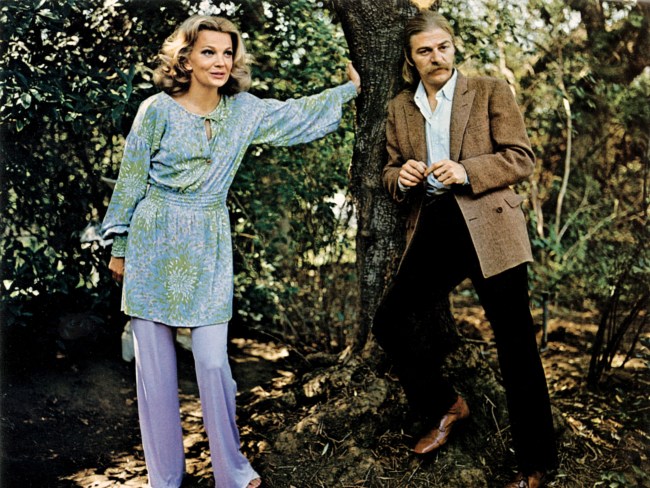
Writer/director John Cassavetes is widely considered, with ample justification, to be the godfather of independent filmmaking in America, a maverick whose intensely personal and unconventional work paved the way for later iconoclasts as varied as Abel Ferrara, Hal Hartley, and both Safdie brothers. There’s no question that Cassavetes’ voice was singular — but his relationship to the mainstream was always a little more complicated than historical record acknowledges. Setting aside his work as an actor in blockbuster studio pictures like “Rosemary’s Baby,” “The Dirty Dozen,” and other lucrative jobs that Cassavetes often took so that he could funnel the fees into his own productions, Cassavetes was hardly an outsider, particularly in the first decade and a half or so of his directing career. While his debut feature, “Shadows” (1960), was truly independent, Cassavetes followed it with two studio gigs, on “Too Late Blues” (Paramount, 1961) and “A Child is Waiting” (United Artists, 1963). Cassavetes would go on to alternate studio and independent work for the rest of his career. Ultimately, major studios financed and distributed half of the 12 features he directed. (He also, oddly, made possibly his greatest movie, “Love Streams,” for exploitation outfit Cannon Films in 1985.) Cassavetes’ initial forays into corporate filmmaking were fraught, with the director chafing under Paramount’s assembly-line production on “Too Late Blues” and clashing with producer Stanley Kramer on “Child.” Cassavetes more or less disowned both films, even though they show plenty of his strengths in fluid, energetic camerawork and sensitivity to performance, and “Too Late Blues” is thematically a piece with later Cassavetes classics like “Killing of a Chinese Bookie” and “Opening Night.” For Cassavetes, any form of compromise was total failure, so he returned to independent production for his fourth feature and first masterwork, the 1968 marital discord drama “Faces” — and, ironically, received the warmest embrace of his career from the establishment. That came in the form of three Academy Award nominations: for Cassavetes’ screenplay and two performances (Seymour Cassel and Lynn Carlin). Critics were divided on the movie (Roger Ebert loved it, and Pauline Kael hated it, for example), but middlebrow Hollywood loved it in spite of its abrasive, harrowing depiction of men and women at emotional war, and Cassavetes was able to parlay its success into studio financing for his next feature, “Husbands” (1970). “Husbands” was made for Columbia, and Cassavetes would complain once again about the compromises that came with institutional filmmaking. To the outside viewer, however, it’s difficult to imagine a less compromised piece of work: a structurally unconventional portrait of three men (Cassavetes, Peter Falk, and Ben Gazzara) who begin the movie lost and achieve only minimal enlightenment by the story’s end. It’s a film of rambling digressions and unpalatable behavior, with scenes that often end abruptly in the middle or run far past the point of resolution. Cassavetes’ next film was another studio movie, and based on its premise alone one might think it was a better commercial fit for Hollywood than his earlier work. “Minnie and Moskowitz” (1971) tells the story of a strait-laced single woman (Gena Rowlands) who falls in love — in fits and starts — with a colorful hippie (Seymour Cassel) who pursues her with abandon, initially repelling her but eventually winning her over with his offbeat attitude and fearless passion. In other words, it’s a rom-com, a gender-reversal of the genre’s classics like “Bringing Up Baby” and “The Lady Eve,” in which a kooky free spirit chases, ultimately catches, and transforms a humorless stuffed shirt. The catch is that by simply switching the genders of the two characters, Cassavetes turns the formula into something more intense and, at times, sinister — the obsessive behavior of a Katharine Hepburn in “Baby” or Barbara Stanwyck in “Eve” plays as more real and threatening when projected onto a man, and the amusing befuddlement of Cary Grant or Henry Fonda turns to genuinely unsettling concern and fear when Gena Rowlands is the object of relentless desire. Yet Cassavetes plays the whole thing at a kind of light, breezy pitch, directing “Minnie and Moskowitz” as though it’s just another escapist crowdpleaser. ‘Minnie and Moskowitz’Courtesy Everett Collection That collision between the genre and the more authentic, idiosyncratic, and complex behavior that Cassavetes projects onto it is what makes “Minnie and Moskowitz” endlessly fascinating, and one of Cassavetes’ best films. In terms of the sheer number of laughs, “Minnie” is technically just as funny as a more typical rom-com — Cassel in particular is quite hilarious in his Lebowski-esque demeanor. There’s also a parade of comic supporting turns that recalls those classic Hawks and Sturges comedies in the breadth and depth of the character actors Cassavetes employs. Yet the comedy turns to violence and back again so quickly at times that it’s impossible to ever fully relax in “Minnie and Moskowitz” — this is probably the most intense “comedy” to come out of America until Martin Scorsese’s “After Hours” 14 years later. Cassavetes sets the tone right from the beginning, in a scene between Moskowitz and a fellow diner in a restaurant. The diner is played by Timothy Carey, one of the scariest actors of his era (he was often let go from productions for being too intense), and the amiable banter between the two men moves from silly to threatening at the drop of a dime; Cassavetes is probably the only director who can make a casual encounter over eggs and coffee as suspenseful as a bank heist. The comic tension embodies Cassavetes’ approach to the entire film, which involved some not-so-subtle manipulation of his actors behind the scenes. The director exploited the real-life dynamic between Rowlands (to whom Cassavetes was married for most of his adult life) and Cassel. Rowlands didn’t really like Cassel, whom she thought was a bad influence on her husband, but Cassel had a bit of a crush on his pal’s beautiful wife. Cassavetes played up the conflicting feelings on set and exacerbated them by giving Rowlands and Cassel contradictory directions that constantly set the actors against each other. Cassavetes went even further in the scenes between Minnie and the married, abusive lover she’s seeing as the story begins by not telling Rowlands that he planned to play the character himself — she didn’t find out Cassavetes had cast himself in the role until it was time to shoot his scenes, and her agitation and anxiety are palpable. They also seep into the DNA of the celluloid itself. Rowlands’ unease becomes the audience’s unease, yet the split identification Cassavetes encourages also causes us to share Cassel’s exuberant iconoclasm (which, it’s safe to say, he shares with his director). According to Cassavetes’ producing partner Al Ruban, “Minnie and Moskowitz” represented Cassavetes’ attempt to prove that he could make a movie in the studio system without altering his own approach or sensibility, and he pretty clearly achieved his goal. Yet the movie was another unhappy experience for Cassavetes, who felt Universal dumped it with poor advertising and didn’t back it because it didn’t have movie stars (they wanted Jack Nicholson in the Seymour Cassel part). “Minnie and Moskowitz” only got made in the first place because Universal had created a low-budget unit to find the next “Easy Rider.” Executive Ned Tanen gave green lights to hip young auteurs like Cassavetes, Monte Hellman (“Two-Lane Blacktop”), Miloš Forman (“Taking Off”), and Dennis Hopper (“The Last Movie”). Most of these experiments flopped, but it didn’t matter — the one hit to come out of the unit, George Lucas’ “American Graffiti,” more than paid for the rest. (Though, ironically, Tanen reportedly hated it and wanted to dump it to television.) For Cassavetes, history repeated itself. He followed his two unhappy (by his account, not his fans’ or history) studio experiences with another self-financed indie, “A Woman Under the Influence” (1974), that scored Oscar nominations — this time for Rowlands as Best Actress and Cassavetes as Best Director. Again, even at his most independent, Cassavetes always had one foot in the system, and he would continue to succumb to the studios’ temptations off and on — usually, as in the case of 1980’s “Gloria,” making fantastic movies in the process. (I happen to be a big fan of Cassavetes’ maligned final feature, “Big Trouble” from 1986, as well, but that’s a topic for another article.) “Minnie and Moskowitz” hasn’t quite been canonized the way “Faces,” “A Woman Under the Influence,” or “Killing of a Chinese Bookie” (maybe simply because it’s one of Cassavetes’ only masterpieces not available via the Criterion Collection?), but it’s every bit their equal and is essential viewing for any serious cinephile. (It also was, like most of Cassavetes’ movies, more appreciated in its moment than people think — while it didn’t make money, it got a lot of strong reviews and scored Cassavetes a WGA award nomination for his screenplay.) The movie’s streaming availability has been erratic, and there hasn’t been an American physical media release since Anchor Bay’s long-out-of-print DVD, but next week Angelenos will have a chance to see it on the big screen at Quentin Tarantino’s New Beverly Cinema. The New Bev is showing a 35mm print of “Minnie and Moskowitz” on a double bill with another superb dramedy starring Rowlands, Lasse Hallström’s “Once Around.” Given the rarity of both films on the repertory circuit, it’s a double feature not to be missed if you’re in L.A. “Minnie and Moskowitz” screens at the New Beverly Cinema on September 29 and 30. For more information, visit the New Bev’s website.
John Cassavetes Practically Invented the American Independent Film, but Some of His Best Movies Were Made for Studios
Full Article
Original Source
Read the full article at Indiewire →KhanList aggregates and links to publicly available news content. We do not host full articles from third-party sources. Always verify important information with original sources.