
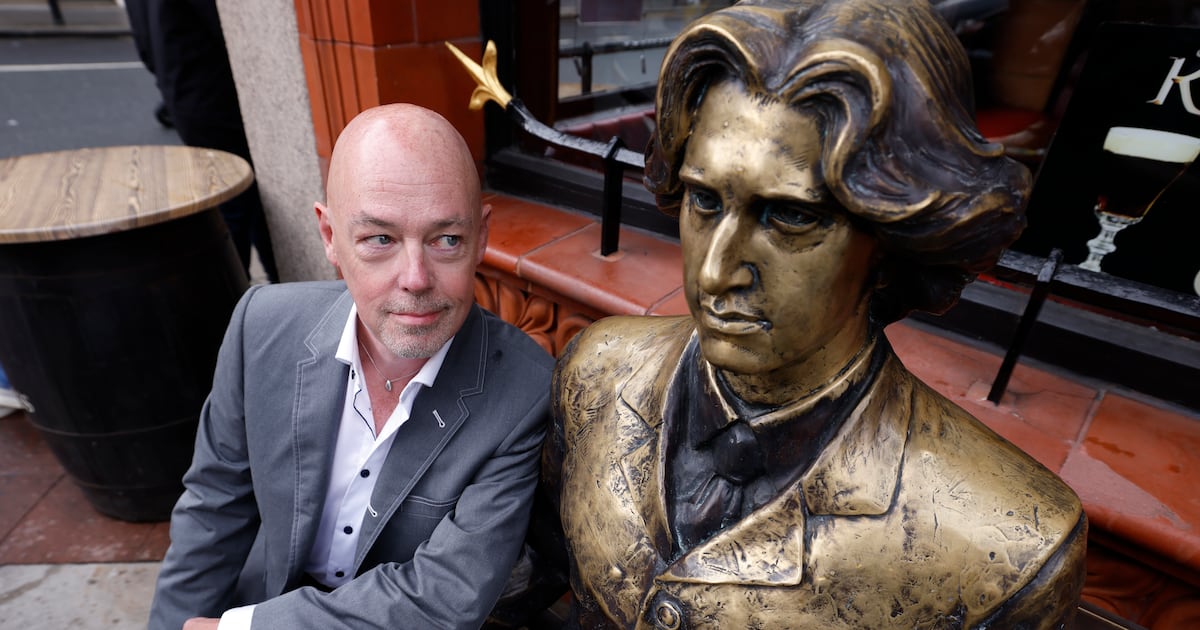
What if Oscar Wilde hadn’t sued the marquis of Queensberry for branding him, typo aside, a “posing somdomite” on the infamous calling card he left at the Albemarle Club in London in 1895? What if Wilde hadn’t set in motion the events that led to his imprisonment and the decline in health that hastened his death at the age of 46?In his new novel, The Weight of Angels, John Boyne has imagined exactly this. Boyne’s Oscar writes plays the real Wilde never got to write. He meets people – writers, politicians, Hollywood royals, actual royals – he never got to meet. And he eventually strives to push for gay rights, living long enough to see legislative change.“This one has been on my list for many years, waiting for its moment for me to think, yeah, this is the time,” Boyne says. “I’ve always liked the idea of one moment deciding how your life goes, and I feel he had that moment that night in the Albemarle Club. “That decision to sue, instead of just saying ‘Sod it’ and waking up the next morning and getting on with his life, was the beginning of the end for him.”READ MOREDoes Boyne feel an affinity with Wilde?“I do, for a couple of reasons. When I was in my late teens and early 20s, and starting to write seriously and think about Irish writing, I didn’t feel it with Joyce, who I could never really make head nor tail of, to be honest, and I didn’t feel it with Seán O’Casey. Those war plays just didn’t really do it for me. I felt it with Oscar Wilde.”He lists what they have in common. “Wilde was gay, he went to Trinity, he went to England to study there. That’s me, me, me, as well. He achieved success early in life; I did as well. I was in my 20s when I was published for the first time,” Boyne says.“We both went through the wringer a little bit as well. I can’t compare myself to somebody of that level of genius, but I would certainly feel more connection to him than I do with other great writers in the canon.”So, across a zippy 610 pages, Boyne tries to give Wilde “the second life that he didn’t get”. Indeed, his Oscar reaches the grand old age of 98, well past the average life expectancy of the era – “That’s one of those things where I’ve used a little bit of poetic licence” – before dying shortly after the coronation of Queen Elizabeth II, in 1953.‘I think I’m just a writer who happens to be from Ireland. I think Oscar was as well’— John BoyneWilde would not have thrived in the real 1960s, he says. “I don’t think it would have been his era at all. I can’t see Oscar with The Beatles or the Stones, or [the Look Back in Anger playwright] John Osborne or someone like that. No, I think I get him out at around the right time.”As for the social-media age – Boyne is no stranger to the vagaries of X – he thinks Wilde could have been a witty early adopter, “like Stephen Fry”, who played him in the 1997 biopic. “Then he would have eventually said something that brought it all down about his ears,” he says, laughing. “If not Reading Gaol, literary jail, shall we say?”His Oscar is a man of flaws. “It’s not about making him perfect, not about making him a saint, because none of us are, and he certainly wasn’t. And if I was to write a novel where I just polished his halo all the way through, I don’t think it would be very good.”So Oscar hurts Gus, the fictional partner Boyne invented for the book, who is “just this normal, decent person who has the measure of Oscar and is pretty much the best thing that’s ever happened to him”. Oscar has stabs of conscience about his treatment of the young boys he hired for sex but leaves it to Gus to vocalise disgust at the actions of his friend André Gide, the writer, a self-declared pederast. He tells Emmeline Pankhurst he will help with the suffragette cause, and he does to an extent, but “he’s not really willing to dig in there” – a sense of self-preservation kicks in.Boyne’s Oscar also causes havoc for EM Forster by accelerating the publication of his gay novel Maurice so that it emerges in the 1920s, not posthumously in 1971. “He recognises the brilliance of Maurice and how important it is that a book like that should be published. But he is not willing to publish one himself. He wants someone else to do it.”Literary inspiration: John Boyne with the sculpture of Oscar Wilde on Merrion Square in Dublin. Photograph: Nick Bradshaw The real Wilde “probably did” advance the cause of gay rights, Boyne believes. “Within about 15 years it was looked back on as outrageous and a tragedy and the loss of somebody of real genius,” he says. But he wanted his Oscar to be instrumental in bringing forward the decriminalisation of homosexuality in England.In reality, this did not begin until 1967, but the book notes an “Oscar’s Law” passed in 1953 with the aid of Winston Churchill. “By the time Oscar gets to Churchill, it’s years after he’s not done for Emmeline Pankhurst what he wants Churchill to do for him, which is to use his voice and help. I could be wrong, but I felt Churchill would.”Royal events are used as a marker of 20th-century history throughout. “I felt Oscar would be sort of mocking of those coronations but would give his left arm for a ticket as well,” Boyne says. He is “one of those people” who reads a lot about the royals. “You can get some good comedy out of it, some good drama.”Does he follow the current lot as well? “Oh God, yeah. I’m fascinated by the current lot.”The Weight of Angels at times leans into the playful improbability of the alternative-history genre, notably when Boyne’s what-if version of Wilde’s lover Bosie (aka Lord Alfred Douglas, the marquis’s son) is jailed and goes on to write The Ballad of Reading Gaol – the exact same one the real Wilde wrote. But as for the life and career trajectory of his Oscar – he wins the Nobel Prize in Literature and an Academy Award and affects not to be overly fussed about either – it feels to Boyne “like a reasonable concept of how he might have turned out”.One of the most obviously fun scenes in the book is a conversation Oscar has in 1909 with WB Yeats and Lady Gregory in the Long Hall pub in Dublin about what it means to be an Irish writer.“I wanted Oscar to question whether he was an Irish writer or just a writer who’s from Ireland. In the same way, are you a gay writer or are you just a writer who happens to be gay? “And I think I’m just a writer who happens to be from Ireland. I think Oscar was as well. But then he also feels, when he’s talking to them, a sense that he’s not included. “Sometimes it’s nice to be on the outside while not feeling that you’re excluded from the inside. Maybe that’s how he feels. Sometimes, in chapters like that, I’m asking those questions for myself.”Boyne researches as he writes because he tends to “get a bit panicky” if he isn’t getting a first draft down. For The Weight of Angels, the research included a trip with his partner, Jake Moriarty, to the Paris hotel where Wilde (or Bosie in the book) died. “Not a chore,” he says. “The room itself where he died is now the bar downstairs, but we stayed in the Oscar Wilde suite, which has a lot of memorabilia on the walls.”John Boyne: 'Everybody works differently, and good luck to them.' Photograph Nick Bradshaw / The Irish Times He also spent about a year reading “every word” Wilde wrote, “not just the obvious things”, to help him capture his voice. The book is peppered with invented epigrams. “I spent a long time just making up as many Oscar-type lines as I could and then finding ways to get them in – the best of them anyway.”One character interrupts Oscar mid-flow and tells him the lines are “boring”, not “terribly witty” like he thinks. “Yeah, you do want to throttle him sometimes,” Boyne says. “I also didn’t want to have every line be a joke, because nobody can get through life like that. So there are moments of introspection, humour, selfishness, narcissism. I think anybody in that sort of position probably has all those traits. I probably have them myself.”As a “novelist at heart”, Boyne identifies Wilde’s only novel, The Picture of Dorian Gray, as the work of his that means the most to him. Throughout the 18-month writing process, he was continually struck by how young Wilde was when he died, and the works that were never written as a result. “I still feel young, and I’m 55. I still feel like I’m only starting out.”What was he referring to when he said he also “went through the wringer a little bit”? “I was 23 or 24 when I told my parents I was gay, and obviously he didn’t have that experience. He wasn’t really able to say what he felt and who he was until he was in the dock.”He had it easier than Wilde, a century later, but it was still “a little more difficult” than it is today. “It wasn’t decriminalised in Ireland until I was in third year in Trinity, so my early sexual experiences, theoretically, were illegal. “When that happens, when you’re 18, 19, 20, whatever, if you know what you’re doing is theoretically illegal, it does mess with your head a little bit. It makes you feel that everything should be conducted in subterfuge and under cover of dark, and it’s obviously not the healthiest way to begin one’s romantic life.”The lighter side of The Weight of Angels appealed to him because he was “exhausted as a writer” after the two years he spent working on the four abuse-themed novellas – Water, Earth, Fire and Air – that make up The Elements, winner of two top literary prizes in France last year.“They were all so dark, you know. Barely a joke between the four of them. By the time I finished the last one, Air, I was so drained by the sadness of those four books that I needed to start something big and broad, with jokes,” he says.He doesn’t need to be so prolific. “I have 28 books, and they’ve sold all over the world and the royalties come all the time. So, no, I don’t have to, not financially, but it’s how I want to live my life. When I die there’ll be a Mystery of Edwin Drood – you know, the unfinished Dickens novel – on my computer.”As a writing-every-day kind of novelist who has “pretty much become a one-a-year guy”, Boyne is astonished by successful authors who leave long gaps between books. “I don’t know how they fill their days. I genuinely don’t,” he says. He gets “antsy” just waiting three or four weeks for the editorial notes to come back after he’s handed something in. “Everybody works differently, and good luck to them. If they bring out a great book every eight years, that’s great. But, for me, I need to be every year. Dickens was every year. Philip Roth was every year.”Boyne plans to spend time over the Christmas holidays and in the spring writing at his new place in Spain, just outside Malaga. He likes the sun and is “doing well” so far in his bid to learn Spanish via Duolingo. He has already delivered his next novel to his publishers. “It’s an out-and-out comedy. A pure comedy,” he says. “It was time to lighten things up a little bit.”The Weight of Angels is published by Doubleday on Thursday, October 1st
John Boyne: ‘Wilde was gay, he went to Trinity, he went to England. That’s me, me, me’
Full Article
Original Source
Read the full article at Irishtimes →KhanList aggregates and links to publicly available news content. We do not host full articles from third-party sources. Always verify important information with original sources.