
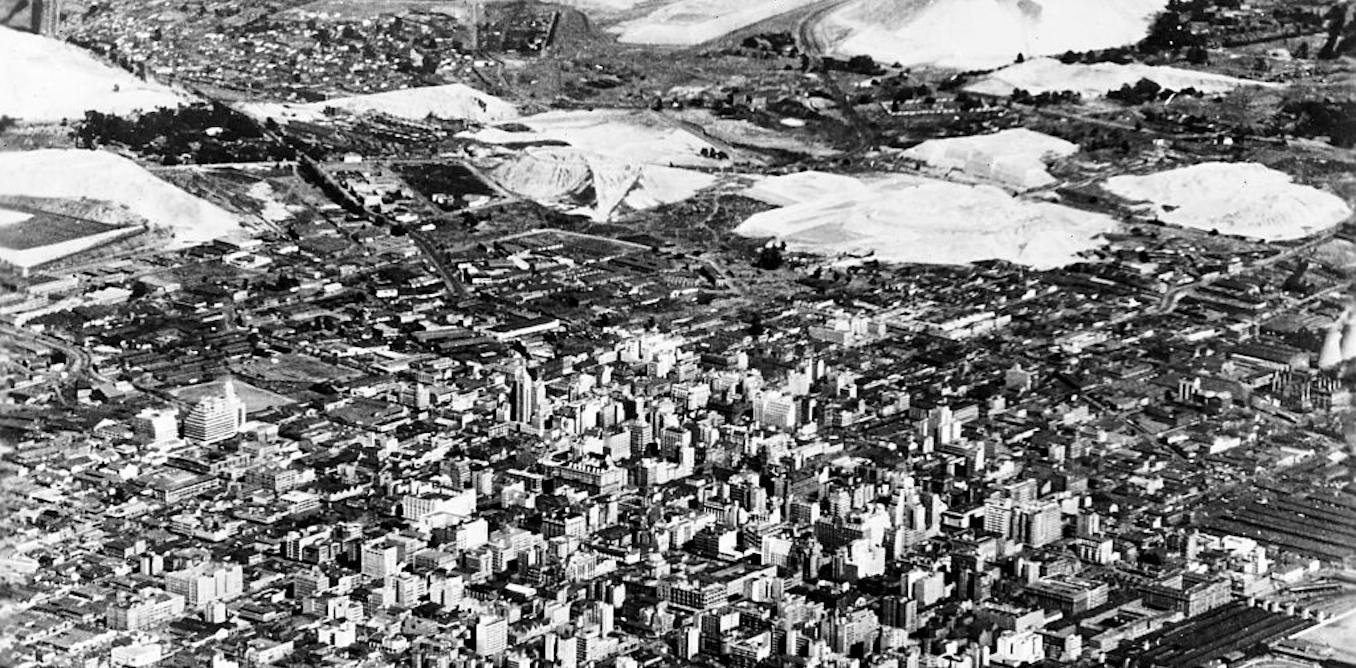
South Africa’s local government elections in November 2026 drew attention to the role of mayors in municipal government, particularly in Johannesburg. However, Johannesburg’s mayoralty has a long history, with more than 100 mayors having occupied the chair. Christopher McMichael and Philip Harrison have just published a book, Johannesburg’s Mayors: 140 Years of Making and Breaking the City. Harrison answers questions about it. You wrote the book amid a deepening governance crisis. How does the book speak to this? The book doesn’t try to solve – or even dissect – the current crisis. Instead, it steps back to view Johannesburg and its governance through the long lens of history. Cities swing between growth, crisis and stagnation; a single snapshot never tells the whole story. We think history offers hope: circumstances shift. Taking the long view matters for another reason too. Cities are the product of a complex layering of multiple processes with different time horizons. Johannesburg’s crumbling infrastructure is a prime example. While the past decade’s unstable coalitions have accelerated the decay, essential assets like water, power and road infrastructure are built to last 30 years or more – meaning their current state reflects decades of neglect. Understanding history transforms how we experience the present. What were the good years, and what were the bad? One group’s golden age may be another’s darkest hour. This was, for example, the case in the 1950s and 1960s when the white middle class was realising the benefits of an American-type suburban lifestyle while the Black residents of townships were experiencing heightened state repression. Nevertheless, some periods are associated with narratives of progress, and others with crisis or stagnation. The optimism in the late 1930s is a case in point. The Great Depression was followed by a mining boom, with the central business district going high-rise, and new infrastructure laid out across the city. Johannesburg celebrated its golden jubilee in 1936 with the Empire Exhibition, cementing its status as a new and prosperous City of Empire. Another period of optimism, for white Johannesburg at least, was the early 1970s. The United Party-controlled city council declared an era of civic progress with the construction of a vast network of motorways, the opening of the Carlton Centre as Africa’s tallest building, and a grand new civic centre. The celebratory mood, of course, ended when the youth in Soweto rose in revolt in June 1976. Other moments of hope came in the early 1990s, as the political impasse of the previous decade ended, although the transition was turbulent. The 2000s saw at least a decade of rapid economic growth, though governance controversies persisted. But there were certainly bad times: the South African War (1899-1902); a bitter struggle between white capital and white labour which culminated in the Rand Rebellion; two world wars, the influenza pandemic, the Great Depression, and the shock of the Afrikaner nationalist victory of 1948. The 1980s may have been the city’s low point. A conservative coalition of the National Party and the Independent Ratepayers Association resisted desegregation. It planned to celebrate Johannesburg’s centenary in 1986, but the then president, P.W. Botha, declared a nationwide state of emergency. The transition in the 1990s was a roller coaster, ending with a financial crisis that nearly bankrupted the city. Over the past ten years or so, the city has seen unstable coalition governments, deteriorated service delivery, and increasing corruption, along with the COVID-19 pandemic and a stagnant economy. It is a complex story of hope and despair, driven by an entanglement of local and national factors, but it does suggest a city of some resilience. Why does the mayor matter in all of this? In the colonial and apartheid years, mayors were ceremonial, elected for single-year terms, with governing left mainly to council committees. Mayors generally acted as a stabilising force, mediating in back rooms between competing interests. From 2000, with the introduction of the executive mayoralty, mayors mattered far more directly. They led the executive branch and could drive a vision for the city. From 2019, mayors had to cede power to coalition partners to remain in office. The city administration became a patchwork of fiefdoms. Mayors, whether ceremonial or executive, make the complexity of city governance visible to the public. However, the mayor is only one of many actors in city administration. Bureaucrats, councillors, union heads and many others play crucial roles. While we have used the mayor as a lens into city administration, we recognise its limitations. The book tries to contextualise the work of mayors within a much wider landscape of change. Were there good mayors, and what measures define success? Good and “bad” are subjective concepts. But we do have a definition of “good” for the colonial and apartheid eras, and for the post-apartheid period. Before 1994, a “good mayor” was one who pushed the bounds of convention towards a fairer society. White Joburg society was quite conservative overall, and a radically progressive politician was unlikely to become mayor. Nevertheless, there were individuals who tried in their limited ways: Edwin Orlando Leake, who was concerned with housing opportunities for African people; Maurice Freeman, who defended Indian people from discriminatory legislation; Max Goodman, who defied police orders in engaging with protestors; Alec Jaffe, who tried to protect vulnerable tenants from unscrupulous landlords; Monty Sklaar, who promoted multi-racialism in council events. The most consequential “good mayor” may have been Johannesburg’s first woman mayor, Jessie McPherson, elected in 1945 and representing the Labour Party. She clashed with segregationists and was subjected to a travel ban by the national government for 15 years. The good mayors were outnumbered by the bad ones, who entrenched civic exclusion and local prejudice. This leaves us to ask what a good mayor may be in the post-apartheid period; perhaps one who put the promise of making citizens’ lives better into effect. The first black mayor, Isaac Mogase, served during the transitional period of the 1990s, and with his integrity and steady demeanour, provided confidence in local government. Amos Masondo, the first executive mayor of metropolitan Johannesburg, benefited from ten years of office, but his discipline, sense of duty and consistent administrative action, even if humdrum at times, was revealed in visible implementation. The transformation of Soweto during his mayoralty was a case in point. Parks Tau introduced progressive city policies, but implementation was limited as he lost the election to Herman Mashaba after five years. Mashaba, in turn, promised to turn the city into a construction site within 12 to 18 months, but he underestimated the political and technical requirements for achieving this. After Mashaba, a quick succession of eight mayoralties followed (excluding one declared illegal by the high courts). Based on your sweep of the city’s history, what takeaways do you offer? We don’t offer explicit takeaways. But we can draw a few suggestions from our work. One concerns the mayoral system itself. The indirectly elected executive mayor was quite successful in the first 15 or so years of post-apartheid rule. But not anymore. Because of the instability created by coalition governance, the mayoralty needs a rethink. There are at least two options here. The first would be to adopt a system of directly elected executive mayors, separating the mayor from the chaos of coalition politics. Alternatively, some form of non-executive mayoralty could be considered. The mayor would be enjoined to remain above party politics and be a unifying figure. Johannesburg’s Mayors: 140 Years of Making and Breaking the City was published by Jacana Press.
Johannesburg has had 101 mayors over the last 140 years: new book reviews the good times and the bad
Full Article
Original Source
Read the full article at Theconversation →KhanList aggregates and links to publicly available news content. We do not host full articles from third-party sources. Always verify important information with original sources.